
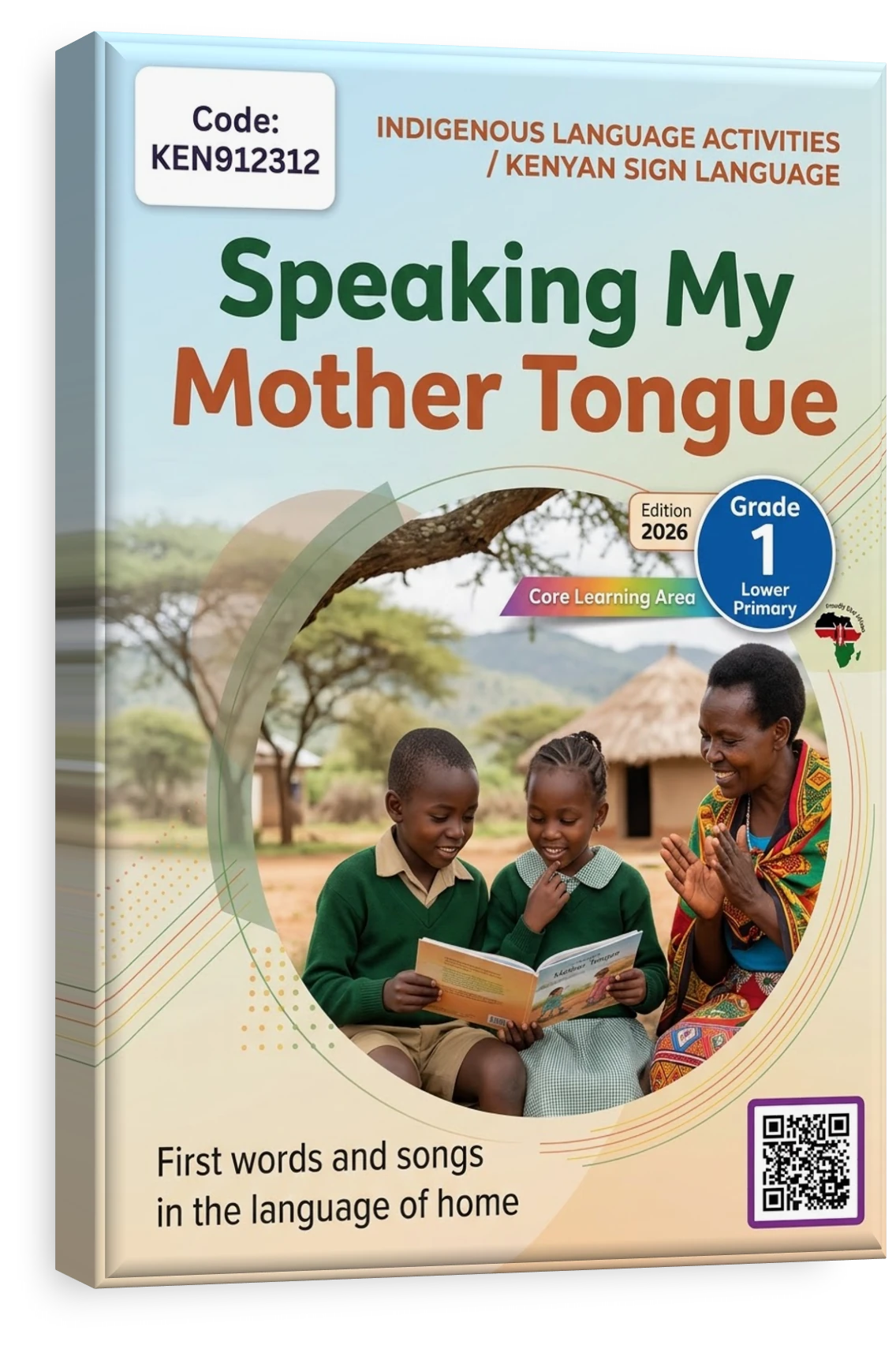
Speaking My Mother Tongue
Level: Grade 1 (Lower Primary) — Core Learning Area
Official Curriculum – Competency-Based Curriculum (CBC) – Kenya Institute of Curriculum Development (KICD).
PRELIMINARIES
1. Welcome to the Language of Home
Grade 1 learners arrive at school already fluent in the words of home, whether that home echoes with Dholuo near Lake Victoria, Kalenjin across the Rift Valley, Gikuyu, Kamba, or the signed language of a deaf family in Nairobi. This book treats that first language as a foundation, celebrating greetings exchanged at the gate, songs sung while grinding maize, and stories shared after a meal of ugali and sukuma wiki. Lesson objective: help teachers recognise and build on the linguistic knowledge each child already carries. Operational benefit: learners gain confidence faster when school language extends rather than replaces home language.
2. How This Mother Tongue Book Works
Each chapter in this guide follows the Grade 1 Indigenous Language Activities design: listening and speaking first, then early reading of sounds and letters, then careful writing practice, always returning to real life at home and in the village. Activities move from spoken words to printed symbols only once a sound is secure, following how young children naturally acquire language before they read it. Lesson objective: show teachers the logical order linking listening, speaking, reading and writing across five chapters. Operational benefit: learners build literacy on a spoken foundation, avoiding confusion that rushed reading instruction often causes.
3. A Guide for Parents and Teachers
Parents who speak the mother tongue at home are this book’s strongest allies, since a child who hears correct pronunciation, proverbs and songs daily arrives at school already rehearsing sounds a teacher will later name formally. Grandparents, aunts, and neighbours telling stories around an evening fire or during a walk to a local market all contribute lessons no classroom alone could replace. Lesson objective: invite every household member into daily language practice alongside classroom instruction. Operational benefit: consistent exposure at home and school accelerates vocabulary growth and listening comprehension noticeably within one school term.
Chapter I. Greetings, Family and Everyday Words
I.1 Greeting Elders and Friends Respectfully
Greeting customs differ across Kenyan communities, yet every mother tongue carries specific words and gestures showing respect toward elders, such as bowing slightly, kneeling briefly, or using a special greeting reserved only for grandparents and village leaders. Learners practise these greetings each morning at the classroom door, repeating the correct words and body language modelled patiently by the teacher before entering. Lesson objective: build correct pronunciation and cultural respect simultaneously through daily greeting routines. Operational benefit: children carry polite, confident greetings into markets, churches, mosques and family gatherings beyond the classroom.
I.2 Naming Family Members in Our Mother Tongue
Family vocabulary anchors early language learning firmly in a child’s own experience, since every learner already knows who a mother, father, grandmother, uncle and younger sibling are long before arriving at school. Lessons introduce the correct mother tongue term for each relative, practised through drawing a family tree, naming photographs, or acting out a home scene where every character greets another by name. Lesson objective: secure accurate family vocabulary through personally meaningful, repeated oral practice. Operational benefit: learners communicate confidently about their own household, strengthening identity alongside language skill.
I.3 Words for Home, Animals and Food
Words naming the hut or house, cooking pots, goats, chickens, and foods like ugali, milk and sukuma wiki give learners vocabulary rooted firmly in daily chores and meals shared at home. Lessons build this vocabulary through picture cards, real objects brought from home, and short dialogues describing what each family ate for breakfast or which animals a learner helped feed that morning. Lesson objective: expand everyday vocabulary using objects and foods immediately familiar from rural or urban Kenyan homes. Operational benefit: learners describe their own daily life accurately, linking classroom language directly to lived experience.
I.4 Listening Games and Call-and-Response Songs
Call-and-response songs passed down through generations train careful listening long before any child can read, since a leader sings one line and the group must answer correctly, in rhythm, without hesitation or mistake. Clapping games, riddles exchanged during a walk near a matatu stage, and simple instructions given in mother tongue all sharpen attentive listening skills essential for later comprehension. Lesson objective: strengthen listening accuracy and quick recall through enjoyable, rhythmic group participation. Operational benefit: learners who listen attentively in song transfer that same careful attention to classroom instructions and stories.
Chapter II. Sounds, Letters and Early Reading
II.1 Hearing and Repeating Sounds of Our Language
Before any letter appears on a page, learners must hear and repeat the distinct sounds that make up their mother tongue, noticing how certain sounds differ subtly between words that otherwise look similar when written. Teachers model single sounds slowly, asking learners to clap once for every sound heard in a short familiar word such as a family member’s name or a common food. Lesson objective: build phonemic awareness as the essential first step toward reading in mother tongue. Operational benefit: learners who hear sounds clearly decode written words with far fewer errors later.
II.2 Recognising Letters and Their Shapes
Once sounds are secure, learners begin matching each sound to its written letter shape, tracing curves and lines in sand, on a slate, or with a finger in the air before ever touching a pencil properly. Letters appearing often in local names, village signposts, or market stall labels become familiar anchors learners recognise joyfully outside the classroom walls. Lesson objective: connect spoken sounds to visual letter shapes through varied, low-cost tracing and recognition activities. Operational benefit: learners gain confidence recognising letters in their everyday environment, reinforcing classroom learning continuously.
II.3 Matching Sounds to Written Symbols
Matching a spoken sound correctly to its written symbol demands patient, repeated practice, since some mother tongue sounds have no equivalent in English and need careful, deliberate teaching rather than assumption that learners already know them. Flashcards, sound boxes filled with small objects, and group chanting of sound-symbol pairs help learners internalise this crucial reading skill steadily across several weeks. Lesson objective: secure accurate sound-symbol correspondence specific to the learner’s own mother tongue. Operational benefit: strong sound-symbol links prevent common reading confusion that slows progress in later grades.
II.4 Blending Simple Syllables into Words
Blending two or three known syllables into a whole recognisable word marks a joyful milestone, as a learner suddenly reads a familiar name or simple word independently rather than sounding out each piece separately and slowly. Teachers choose words meaningful to daily life, such as a sibling’s name or a common animal, to make this first blending success memorable and motivating. Lesson objective: guide learners toward independent syllable blending using personally meaningful, carefully sequenced words. Operational benefit: early blending success builds reading confidence that carries learners steadily into longer, more complex words.
Chapter III. Speaking Clearly and Telling Stories
III.1 Describing People, Places and Objects
Describing a grandmother’s kitchen, a favourite goat, or the muddy path leading to school teaches learners to select precise mother tongue words for colour, size, number and feeling rather than relying on vague gestures alone. Guided questioning from the teacher encourages longer, more detailed spoken descriptions built gradually across several practice sessions during the term. Lesson objective: expand descriptive vocabulary and sentence length through structured oral practice rooted in familiar surroundings. Operational benefit: learners express ideas more clearly at home and school, reducing frustration when words previously felt out of reach.
III.2 Asking and Answering Simple Questions
Learning to ask who, what, where and when in mother tongue equips a child to seek information confidently, whether asking a teacher for clarification or asking a shopkeeper near Kisumu or Eldoret the price of an item in shillings. Paired practice, where one learner asks and another answers using a complete sentence, builds both grammar and social confidence simultaneously within short, enjoyable classroom exchanges. Lesson objective: develop question-and-answer fluency through structured paired conversation practice. Operational benefit: learners participate more actively in lessons across every subject once comfortable asking and answering aloud.
III.3 Retelling a Short Folktale from the Community
Folktales passed down through grandparents carry moral lessons, humour and cultural memory that textbooks alone cannot replace, so learners practise retelling a short, familiar story in their own words after hearing it told aloud by the teacher or a visiting elder. Sequencing the beginning, middle and end correctly strengthens memory and narrative structure essential for later written composition. Lesson objective: build oral narrative skill and cultural knowledge through guided folktale retelling exercises. Operational benefit: learners preserve valuable community heritage while practising sequencing and expressive, confident speech.
III.4 Reciting Riddles and Proverbs
Riddles and proverbs compress deep community wisdom into short, memorable mother tongue phrases, challenging learners to think carefully before answering a clever riddle posed by a classmate or explaining what a familiar proverb truly means in daily life. Group recitation competitions, held during assembly or a rainy afternoon indoors, make this traditional learning lively and competitive rather than solemn. Lesson objective: strengthen vocabulary, memory and critical thinking through traditional riddle and proverb practice. Operational benefit: learners connect classroom language study directly to respected elders’ wisdom and community identity.
Chapter IV. Writing and Pre-Writing Skills
IV.1 Holding a Pencil and Drawing Patterns
Correct pencil grip and controlled hand movement must develop before any letter writing begins, so learners practise drawing straight lines, zigzags, circles and simple patterns on scrap paper, a slate, or smoothed sand near the classroom yard. Repeated pattern drawing strengthens the small hand muscles every young writer needs, while building the confidence that comes from controlling a pencil successfully. Lesson objective: develop fine motor control and correct pencil grip through varied, low-cost pattern practice. Operational benefit: learners write letters more neatly and comfortably once underlying hand control is firmly established.
IV.2 Tracing and Copying Letters of the Alphabet
Tracing dotted letters, then copying them freehand onto ruled lines, teaches the exact stroke order and shape needed for legible mother tongue writing, with teachers checking each attempt gently before learners practise independently in an exercise book. Letters frequently appearing in a learner’s own name or village become early favourites, practised with particular pride and enthusiasm. Lesson objective: secure correct letter formation through guided tracing followed by independent copying practice. Operational benefit: neat, consistent handwriting established early prevents correction difficulties in later primary grades.
IV.3 Writing One’s Own Name and Simple Words
Writing one’s own name correctly marks a proud early achievement, followed soon by simple words naming family members, common animals or foods such as maize, milk or sukuma wiki already familiar from earlier spoken lessons. Teachers check spelling patiently, encouraging learners to say each sound aloud while writing it, linking listening, speaking and writing skills together firmly. Lesson objective: connect previously learned vocabulary to confident, accurate written production. Operational benefit: learners gain genuine pride and motivation once able to write their own name and familiar words correctly.
IV.4 Labelling Objects Around the Classroom
Labelling classroom objects, such as the door, window, desk, water jug or chalkboard, with simple mother tongue words turns the entire learning space into a constant, visible reading and writing resource available throughout every school day. Learners help create these labels themselves, practising letter formation while contributing meaningfully to their shared classroom environment. Lesson objective: reinforce vocabulary and writing skill through a practical, ongoing classroom labelling project. Operational benefit: constant visual exposure to written words accelerates vocabulary retention far beyond occasional lesson time alone.
Chapter V. Our Language in Daily Life
V.1 Counting and Market Words in Mother Tongue
Counting objects and naming shillings in mother tongue connects language learning directly to real transactions a learner witnesses weekly at a local market, whether buying tomatoes, beans or a small treat with coins carefully counted beforehand. Role-play shopping scenes inside the classroom let learners practise counting, naming prices and polite bargaining language all together. Lesson objective: link numeracy and mother tongue vocabulary through realistic market role-play activities. Operational benefit: learners handle real shopping errands more confidently, applying classroom language immediately within family life.
V.2 Songs, Dance and Oral Traditions
Traditional songs and dances performed during community celebrations carry mother tongue vocabulary, rhythm and movement together, giving learners an enjoyable, embodied way to practise pronunciation while honouring cultural heritage shared across generations in their community. Teachers invite learners to perform a favourite song or simple dance step learned at home, explaining its meaning briefly to curious classmates from different backgrounds. Lesson objective: celebrate and practise language through traditional song and movement activities. Operational benefit: learners build pride in their heritage while reinforcing pronunciation and rhythm naturally through joyful performance.
V.3 Mother Tongue at Home and in the Community
Mother tongue use stretches far beyond the classroom, into conversations near Lake Victoria’s shoreline, across Rift Valley farms, inside churches and mosques, and during busy matatu journeys where elders and children alike exchange daily greetings and news. Learners keep a simple weekly diary, drawing or describing one place where they heard or spoke their mother tongue outside school that week. Lesson objective: help learners notice and value mother tongue use across every setting in daily life. Operational benefit: this awareness strengthens the bond between classroom learning and genuine community language practice.
V.4 Celebrating Our Language and Culture
A closing class celebration, perhaps sharing roasted maize or sweet potatoes while performing songs, riddles and short folktales practised throughout the term, lets every learner demonstrate growth proudly before classmates, parents and visiting elders invited for the occasion. This gathering reviews counting, greetings, storytelling and writing skills built steadily across all five chapters. Lesson objective: assess growing language confidence through joyful, informal demonstration rather than formal written testing. Operational benefit: learners leave Grade 1 proud of their mother tongue achievement, motivated toward continued language growth.
ANNEXES
A. Home Language Practice Guide
This guide suggests simple daily mother tongue practices for busy households: naming three objects during breakfast, singing one song while walking to a local market, or asking a grandparent to retell a favourite folktale before bedtime near Lake Victoria or the Rift Valley highlands. No special materials or training are required, only consistent, patient conversation. Lesson objective: equip every family, regardless of resources, with practical daily mother tongue activities supporting classroom learning. Operational benefit: steady home practice reinforces school lessons, closing gaps that occur during holidays or school closures.
B. Common Words and Phrases Reference List
A short reference list gathers greetings, family terms, numbers, food names and polite classroom phrases most frequently used throughout this book, organised for quick checking by teachers managing mixed-ability classrooms or parents unfamiliar with formal language teaching methods. Space is left for each school to insert its specific local mother tongue equivalents, since this core learning area varies legitimately across Kenyan communities and includes Kenyan Sign Language users. Lesson objective: provide a flexible, adaptable vocabulary reference supporting consistent practice across chapters. Operational benefit: teachers save preparation time while ensuring vocabulary coverage remains thorough and consistent.
C. Parent-Teacher Observation Guide
Simple observation notes help teachers and parents track a learner’s growing confidence in greetings, listening, speaking, reading and writing, recording small milestones such as correctly naming five family members or writing one’s name clearly without copying. This informal record avoids formal testing, favouring gentle notes kept weekly inside a notebook beside the classroom register. Lesson objective: support continuous, low-pressure assessment appropriate for Grade 1 developmental readiness throughout the term. Operational benefit: caregivers and teachers notice genuine progress together, celebrating achievements that build lasting confidence in mother tongue learning.

Discussion (0)
Aucune intervention pour le moment. Soyez le premier à contribuer.
Votre intervention Annuler la réponse