
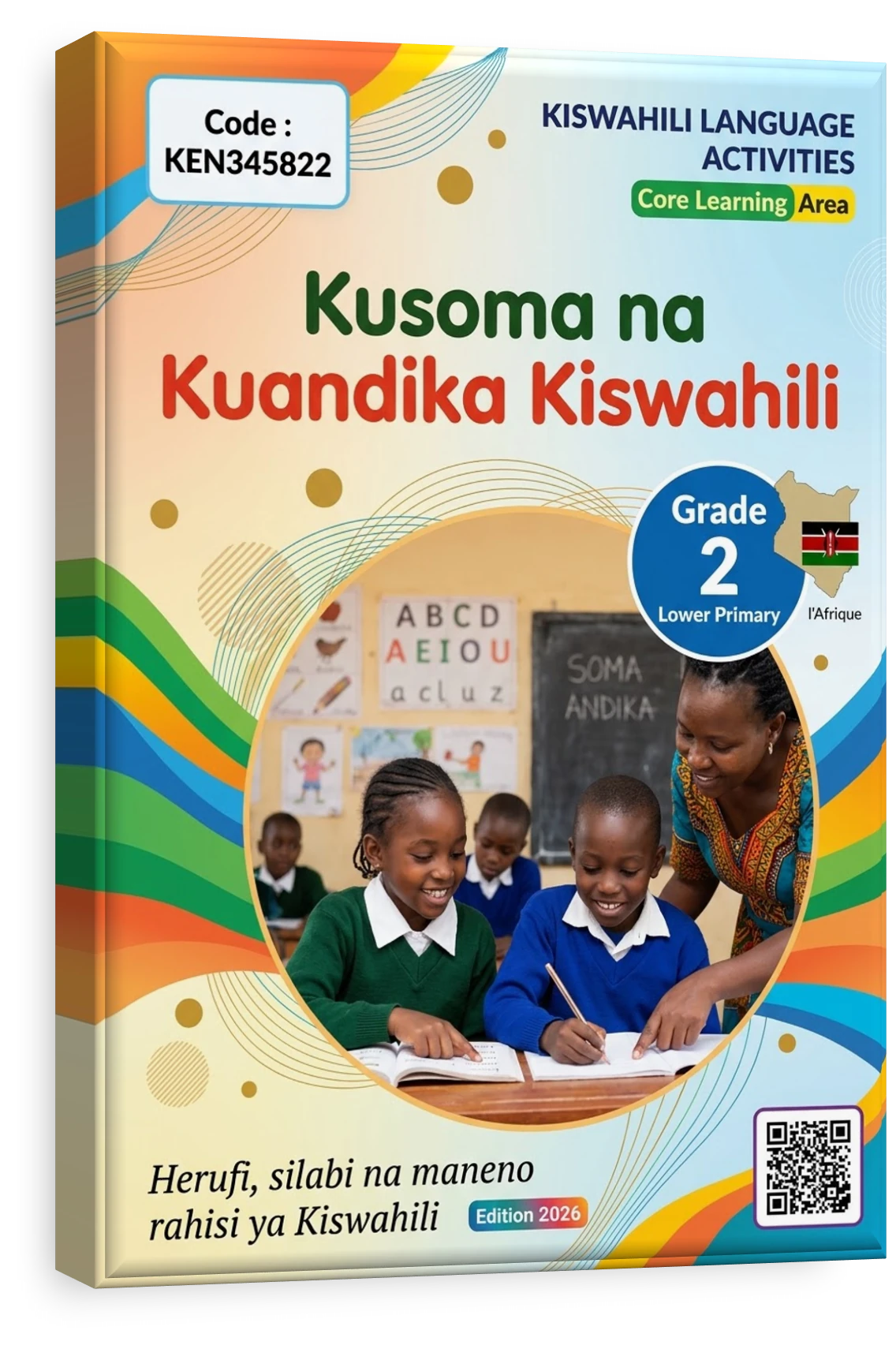
Kusoma na Kuandika Kiswahili
Level: Grade 2 (Lower Primary) — Core Learning Area
Official Curriculum – Competency-Based Curriculum (CBC) – Kenya Institute of Curriculum Development (KICD).
PRELIMINARIES
1. Welcome to Kusoma na Kuandika
Every Grade 2 learner across Kenya already speaks Kiswahili fluently at home, in the village market, or near the matatu stage close to school, yet reading and writing that same language on a page demands fresh, deliberate skills. This book builds on that spoken foundation, turning familiar sounds into recognised letters, syllables and words through daily, structured practice. Lesson objective: help teachers and parents see that oral fluency in Kiswahili already gives every learner a head start toward literacy. Operational benefit: recognising this strength early lets lessons feel achievable rather than foreign from the first page.
2. Our Syllable-Based Approach
Kiswahili reads and writes phonetically, so this book teaches literacy through silabi, pairing each consonant with the five vowels a, e, i, o and u until learners blend sounds automatically instead of guessing words from memory. Knowledge built this way mirrors how Kenyan teachers have long taught reading in Nyanza, the Rift Valley and coastal classrooms alike, chanting ba-be-bi-bo-bu before meeting a complete word. Lesson objective: establish the syllable, not the single letter, as the basic building block of confident reading. Operational benefit: learners who master syllables early decode unfamiliar words independently, reducing frustration during later reading tasks.
3. A Guide for Parents and Teachers
Parents without formal teaching training can still support this book meaningfully, since every chapter explains activities in plain language requiring no special equipment beyond a slate, an exercise book, or chalk and a cleared patch of ground. Guidance offered here suits a crowded Nairobi classroom equally well as a quiet homestead evening near Lake Victoria, where a parent and child sound out letters together by lamplight. Lesson objective: equip every caregiver, teacher or older sibling with simple steps for guiding daily reading and writing practice. Operational benefit: consistent support across home and school roots this skill firmly before Grade 3 begins.
Chapter I. Herufi za Kiswahili (The Letters of Kiswahili)
I.1 Irabu Tano za Kiswahili (The Five Kiswahili Vowels)
Kiswahili rests on only five vowel sounds, irabu: a, e, i, o and u, each pronounced clearly and consistently wherever it appears, unlike English vowels that shift unpredictably from word to word. Knowledge taught here has learners say each vowel aloud while tracing its shape on a slate, then matching it to familiar words such as asali, embe, iwe, oka and uji. Lesson objective: fix the five vowel sounds firmly before introducing any consonant blend. Operational benefit: steady vowel pronunciation gives learners a reliable anchor for sounding out every new syllable they meet.
I.2 Konsonanti za Kiswahili (The Consonants of Kiswahili)
Beyond the five vowels, Kiswahili consonants such as b, ch, d, j, k, m, n, p, sh and w each carry one dependable sound, giving learners fewer surprises than the irregular spelling patterns found in English words. Knowledge practised here pairs each consonant with a familiar Kenyan word, like ng’ombe for cattle grazing near a shamba or chai poured warm each morning before school. Lesson objective: help learners recognise and name consonant letters confidently before blending them with vowels. Operational benefit: solid consonant recognition speeds up every syllable-building exercise in later chapters.
I.3 Kutambua Herufi Kubwa na Ndogo (Recognising Upper and Lower Case Letters)
Printed Kiswahili text mixes herufi kubwa, capital letters opening sentences and names, with herufi ndogo used almost everywhere else, so learners must recognise both forms of every letter to read signboards, schoolbooks and matatu route names correctly. Knowledge built through matching games pairs capital A with lowercase a, capital M with lowercase m, using cards cut from old newspapers or cardboard boxes around the compound. Lesson objective: train learners to identify matching upper and lower case letter pairs reliably. Operational benefit: confident case recognition prevents confusion when learners later read shop signs and posters independently.
I.4 Kuandika Herufi kwa Mpangilio Sahihi (Writing Letters with Correct Formation)
Forming each Kiswahili letter correctly, starting strokes from the proper point and finishing with a steady hand, builds habits that carry a learner through every later writing task, from short notes home to compositions in upper primary. Knowledge practised through guided tracing on ruled exercise books, then free writing on a chalk slate, helps learners feel the shape of b, d, p and q without reversing them. Lesson objective: develop accurate, consistent letter formation through daily, supervised handwriting practice. Operational benefit: neat, correctly formed letters make a learner’s work easier for teachers and parents to read.
Chapter II. Silabi Rahisi (Simple Syllables)
II.1 Silabi za Herufi B na Irabu Tano (Syllables Formed with B and the Five Vowels)
Combining the consonant b with each of the five vowels produces the syllable chain ba, be, bi, bo, bu, a pattern every Kiswahili learner across Kenya chants aloud until the rhythm becomes automatic and effortless. Knowledge taught here uses this same pattern with other consonants, including m, k and t, letting learners discover that the method repeats predictably rather than demanding separate memorisation for every letter. Lesson objective: establish the consonant-plus-vowel pattern as the reliable key unlocking all future syllable reading. Operational benefit: mastering one chanted pattern equips learners to decode dozens of further syllables independently.
II.2 Kuunganisha Silabi Mbili (Joining Two Syllables Together)
Once individual syllables feel secure, learners begin joining two together, discovering that ba plus ba forms baba, meaning father, while ma plus ma forms mama, words already warmly familiar from home life long before they appear on a page. Knowledge practised through slow, deliberate blending, sounding each syllable before sliding smoothly into the next, prevents learners from guessing whole words incorrectly from memory alone. Lesson objective: build genuine blending skill by combining two known syllables into meaningful, familiar words. Operational benefit: successful blending gives learners an early, motivating taste of real, independent reading.
II.3 Kuhesabu Silabi katika Neno (Counting Syllables within a Word)
Clapping once for every syllable heard inside a spoken word, such as two claps for ku-ku or three claps for sha-mba, teaches learners to hear word structure before they ever attempt to read or spell it on paper. Knowledge built through this clapping game works equally well during a classroom lesson in Kisumu or a quiet evening game played on a mat near the Rift Valley escarpment. Lesson objective: strengthen phonological awareness by counting syllables heard in common, everyday Kiswahili words. Operational benefit: learners who hear syllable breaks clearly spell unfamiliar words more accurately afterward.
II.4 Mchezo wa Silabi na Nyimbo (Syllable Games and Songs)
Singing syllable songs during morning assembly or between lessons keeps practice lively, turning what could feel like repetitive drilling into a shared, joyful classroom moment that even shy or struggling learners join without hesitation. Knowledge reinforced through call-and-response games, where a teacher calls ta and learners answer with a matching word like taa, cements syllable patterns through rhythm, movement and friendly competition. Lesson objective: consolidate syllable recognition through musical repetition suited to active Grade 2 energy levels. Operational benefit: playful, repeated practice fixes syllable patterns firmly in memory without learners noticing the drilling.
Chapter III. Maneno Rahisi (Simple Words)
III.1 Maneno ya Nyumbani na Familia (Words about Home and Family)
Words naming close family members, baba, mama, kaka, dada and babu, give learners their very first reading vocabulary, since these words already carry deep emotional meaning long before any lesson introduces them formally on the page. Knowledge practised through matching family photographs or simple drawings to printed word cards helps learners connect sound, meaning and spelling simultaneously rather than memorising isolated letters. Lesson objective: build an early sight-reading vocabulary rooted firmly in familiar family relationships and home life. Operational benefit: strong emotional connection to these first words motivates learners to keep reading confidently.
III.2 Maneno ya Chakula na Afya (Words about Food and Health)
Everyday food words such as ugali, maziwa, sukuma wiki and maji safi introduce learners to vocabulary connected directly to nutrition and hygiene lessons taught elsewhere across the Grade 2 curriculum, reinforcing healthy habits while practising careful reading. Knowledge built through naming foods displayed on a classroom chart, then writing each word carefully beside a simple drawing, links literacy practice to daily wellbeing discussed at home and school. Lesson objective: expand vocabulary using food and health words learners encounter during every single mealtime. Operational benefit: reading familiar food words encourages learners to discuss nutrition confidently using new vocabulary.
III.3 Maneno ya Sokoni na Biashara (Words about the Market and Trade)
Visiting a local market with stalls selling nyanya, viazi and samaki introduces learners to trading vocabulary while also touching gently on numbers and Kenyan shillings, since a tomato might cost ten KES and a fish several hundred depending on size. Knowledge practised through simple pretend-shop role play, naming goods and prices aloud in Kiswahili, connects classroom reading directly to real transactions witnessed near home almost daily. Lesson objective: broaden vocabulary through market-related words while touching lightly on money concepts. Operational benefit: learners read and use practical vocabulary needed for genuine errands run for family.
III.4 Kuandika Maneno kwa Herufi Sahihi (Writing Words with Correct Spelling)
Spelling Kiswahili words correctly rewards careful listening, since nearly every letter written matches a sound heard clearly, unlike the irregular spelling patterns common in English that often puzzle young learners unnecessarily during early lessons. Knowledge practised through dictation exercises, where a teacher says a familiar word slowly and learners write it letter by letter, builds accuracy steadily without excessive correction or discouragement. Lesson objective: strengthen spelling accuracy by linking every written letter directly to its spoken sound. Operational benefit: learners gain confidence writing independently, trusting that careful listening usually produces correct spelling.
Chapter IV. Sentensi Fupi (Short Sentences)
IV.1 Kuunda Sentensi Fupi Sahihi (Forming Short, Correct Sentences)
Joining a simple subject and verb, such as Baba anakula or Mama anapika, teaches learners that a complete Kiswahili sentence needs only these two essential parts before any further detail gets added through practice. Knowledge built through arranging word cards physically on a desk, then rearranging them into new combinations, helps learners discover sentence structure through hands-on experimentation rather than memorised rules recited without real understanding. Lesson objective: introduce basic subject-verb sentence patterns using familiar household actions as examples. Operational benefit: learners begin constructing original sentences independently, moving confidently beyond copying from the board.
IV.2 Kusoma kwa Ufasaha na Sauti Nzuri (Reading Aloud with Fluency and Good Expression)
Reading short sentences aloud with appropriate pace, clear pronunciation and gentle expression transforms word-by-word decoding into genuine fluent reading, a skill this chapter builds through daily, supervised practice carried out in pairs or small groups. Knowledge strengthened through echo reading, where a teacher reads a sentence first and learners repeat it together, helps hesitant readers near Mombasa, Eldoret or Nairobi gain shared confidence. Lesson objective: develop reading fluency and expression through consistent, supportive oral practice sessions. Operational benefit: fluent reading frees mental effort for understanding meaning rather than struggling over individual sounds.
IV.3 Alama za Uandishi: Nukta na Alama ya Kuuliza (Punctuation: Full Stops and Question Marks)
Noticing a small dot, nukta, marking the end of a statement, or a curved alama ya kuuliza signalling a question, teaches learners that punctuation carries real meaning affecting how a sentence should sound when read aloud. Knowledge practised by sorting printed sentence strips into statement and question piles helps learners connect punctuation symbols to voice changes they already use naturally during ordinary conversation at home. Lesson objective: introduce basic punctuation marks and connect each symbol to its correct spoken intonation. Operational benefit: learners read sentences with appropriate rhythm and tone, improving comprehension for any listener.
IV.4 Kuandika Sentensi kwa Usafi na Mpangilio (Writing Sentences Neatly and in Order)
Copying then independently writing short sentences within ruled exercise book lines teaches learners spacing, letter size consistency and left-to-right direction, practical habits that noticeably improve how clearly a teacher or parent can read their completed work. Knowledge reinforced through gentle correction, praising improved neatness rather than criticising early mistakes harshly, keeps learners motivated throughout repeated handwriting practice sessions scheduled across the week. Lesson objective: build neat, well-spaced sentence writing habits suited to formal Grade 2 standards. Operational benefit: consistently neat written work earns clearer teacher feedback, supporting faster improvement across every subject.
Chapter V. Kusoma kwa Ufahamu (Reading Comprehension)
V.1 Kusoma Hadithi Fupi za Kikenya (Reading Short Kenyan Stories)
Short stories describing familiar scenes, a goat escaping near a shamba fence, or children walking safely past a busy matatu stage on the way to school, hold learner attention far better than abstract text imported from elsewhere. Knowledge built through guided group reading, pausing to discuss pictures and predict what happens next, develops comprehension skills alongside the basic decoding already practised in earlier chapters. Lesson objective: apply accumulated letter, syllable and word skills toward reading connected, meaningful short stories. Operational benefit: enjoyable, relatable stories build genuine reading motivation that carries learners into Grade 3.
V.2 Kujibu Maswali Kuhusu Hadithi (Answering Questions about a Story)
Answering simple questions after a story, naming who appeared, where events happened or what occurred first, teaches learners that reading demands active thinking rather than merely sounding out words without absorbing meaning. Knowledge practised through oral questioning before gradually introducing written answers helps teachers across crowded classrooms in Nakuru or Kakamega gauge genuine understanding without relying on lengthy written tests unsuitable for Grade 2. Lesson objective: strengthen comprehension by practising question-answering routines immediately following every short story read. Operational benefit: learners develop thinking habits supporting stronger academic performance across every future subject.
V.3 Kuandika Sentensi Kuhusu Picha (Writing Sentences about a Picture)
Describing a picture, perhaps children fetching water, farmers tending a shamba, or a busy classroom scene, in one or two original written sentences pushes learners gently beyond copying toward genuine independent composition, a meaningful step forward this late in the year. Knowledge supported through guided brainstorming, listing useful words aloud together before anyone writes individually, reduces anxiety while building creative confidence among hesitant or quieter learners. Lesson objective: encourage independent sentence composition inspired by familiar, locally relevant pictures and scenes. Operational benefit: early composition practice prepares learners gradually for longer creative writing tasks in upper primary.
V.4 Tathmini na Maonyesho ya Kujifunza (Review and Showcase of Learning)
Gathering the whole class to showcase favourite letters, words or short sentences learned throughout the term, perhaps written neatly onto shared charts displayed along the classroom wall, celebrates genuine progress achieved since the very first lesson on simple vowels. Knowledge reviewed informally through this showcase, rather than through stressful formal testing, lets every learner, strong or still developing, demonstrate real growth proudly before classmates and parents. Lesson objective: consolidate an entire term of letter, syllable, word and sentence learning through joyful, low-pressure demonstration. Operational benefit: visible celebration of progress motivates learners toward continued confident reading.
ANNEXES
A. Mwongozo wa Mazoezi ya Nyumbani (Home Practice Guide)
Home practice need not wait for special materials, since a clean patch of swept ground, a stick for tracing letters, or chalk on a flat stone lets any family continue Kiswahili literacy practice begun during the school day without further cost. Knowledge organised into this guide suggests short, daily five-minute routines: naming objects around the compound, reading signboards during a walk, or reciting syllable chants together before supper. Lesson objective: equip parents and guardians with simple, low-cost strategies extending classroom literacy practice reliably at home. Operational benefit: brief daily repetition at home measurably accelerates reading and writing progress achieved at school.
B. Orodha ya Ukaguzi wa Silabi na Maneno (Syllable and Word Checklist)
A simple checklist tracking which syllable patterns and basic words a learner reads confidently, from ba-be-bi-bo-bu through full family and food vocabulary, helps teachers and parents notice specific gaps rather than assuming vague general weakness across an entire subject. Knowledge organised into this tracking format supports targeted revision, returning briefly to a weak syllable pattern before moving further into longer words and sentences. Lesson objective: provide a structured tool for monitoring individual syllable and word mastery across the term. Operational benefit: targeted tracking lets teachers address specific gaps quickly, preventing small difficulties from compounding into larger reading struggles.
C. Mwongozo wa Ushirikiano kati ya Mwalimu na Mzazi (Teacher-Parent Partnership Guide)
Regular brief conversations between teacher and parent, whether during school pick-up, a parents’ meeting, or a short note carried home inside an exercise book, keep everyone informed about a learner’s genuine progress through letters, syllables, words and sentences covered in this book. Knowledge shared through this partnership guide suggests simple questions parents might ask teachers, and small observations teachers appreciate hearing from home regarding reading practised there. Lesson objective: strengthen consistent communication supporting every learner’s literacy journey across both classroom and home settings. Operational benefit: coordinated support between teacher and parent sustains steady reading and writing progress all year.
Discussion (0)
Aucune intervention pour le moment. Soyez le premier à contribuer.
Votre intervention Annuler la réponse