
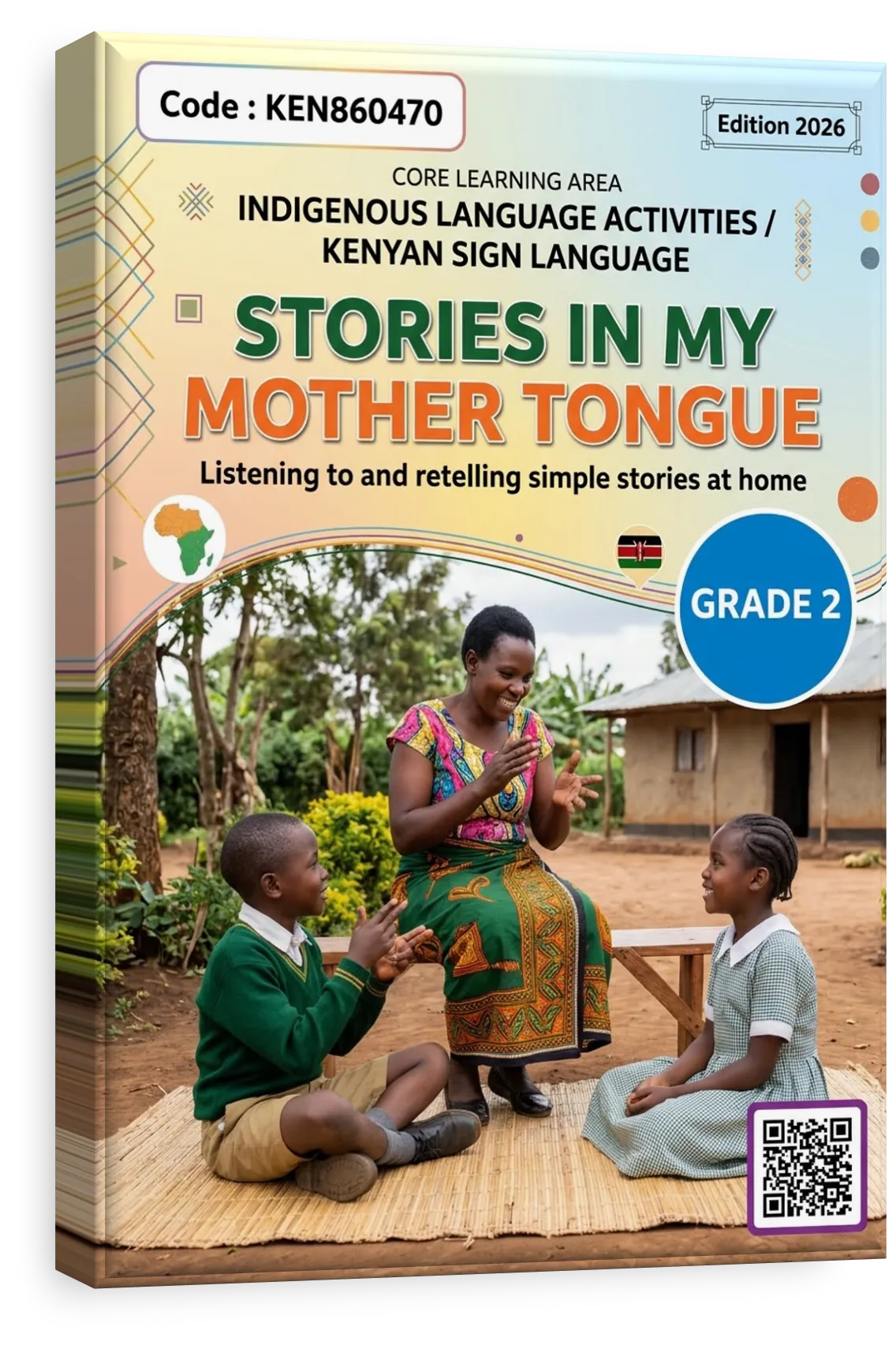
Stories in My Mother Tongue
Level: Grade 2 (Lower Primary) — Core Learning Area
Official Curriculum – Competency-Based Curriculum (CBC) – Kenya Institute of Curriculum Development (KICD).
PRELIMINARIES
1. Welcome to Stories in Our Home Language
Every Kenyan community keeps a treasury of stories passed from grandparent to grandchild beside an evening cooking fire, during a long walk to fetch water, or while shelling maize together under the compound light. This book gathers that living oral tradition into structured Grade Two lessons built around the exact mother tongue spoken at home, whichever of Kenya’s many languages that happens to be, from Kikuyu to Dholuo to Maasai. Lesson objective: introduce learners to the purpose of listening carefully and retelling simple stories using words and rhythms already familiar from daily family conversation. Operational benefit: children feel proud hearing their own home language valued inside a formal school textbook.
2. How This Book Supports Listening and Retelling
Listening and retelling form two halves of one skill: a Grade Two learner first receives a story quietly with open ears, then returns it confidently using personal words, gestures and remembered details. Lessons inside this book move gradually from short, one-event stories told at home to slightly longer stories shared at a village gathering or classroom corner. Lesson objective: build learners’ ability to follow a story’s order of events before practising spoken or signed retelling aloud. Operational benefit: learners strengthen memory, vocabulary and confidence that support every other learning area, including mathematics word problems and social studies discussions.
3. A Guide for Parents, Teachers and Signing Families
Parents, teachers and signing family members all share responsibility for keeping storytelling alive beyond the classroom walls, since a single weekly lesson cannot replace daily practice woven into ordinary household routines across Kenya. Some learners in this class communicate primarily through Kenyan Sign Language rather than spoken mother tongue, and every activity described can be adapted using signed storytelling instead of spoken words. Lesson objective: equip every caregiver, hearing or signing, with simple ways to continue storytelling practice at home each evening. Operational benefit: consistent practice across home and school settings deepens retention and strengthens a learner’s sense of belonging.
Chapter I. Listening Carefully to Spoken Stories
I.1 Sitting Still and Listening with Our Ears
Good listening begins with a quiet body: hands resting still, eyes watching the storyteller’s face, and ears catching every word spoken slowly during family time in the sitting room or under a mango tree outside the home compound. Knowledge taught trains learners to recognise when a story begins, usually through a traditional opening phrase used widely across many Kenyan communities before the storyteller continues. Lesson objective: develop sustained attention and quiet listening posture lasting through one complete short story told aloud. Operational benefit: calmer listening habits learnt here transfer directly into classroom attention during every other lesson taught throughout the school day.
I.2 Remembering Who Is in the Story
Every story introduces characters a listener must remember clearly: perhaps a clever hare, a tired old woman, or two quarrelling brothers sharing one small shamba near a river. Knowledge taught guides learners to name each character aloud immediately after listening, checking whether they remember who appeared first and who appeared last within the story heard. Lesson objective: strengthen character recall through guided questioning following each storytelling session at home or school. Operational benefit: learners build comprehension skills needed later for retelling accurately and for understanding longer stories encountered in upper primary reading lessons.
I.3 Remembering Where and When the Story Happens
Stories unfold somewhere specific, whether beside Lake Victoria where fishing families mend their nets, inside a Rift Valley homestead surrounded by grazing cattle, or within a busy market where traders call out prices loudly. Knowledge taught asks learners to notice such details, naming the place and time mentioned near a story’s opening before events begin unfolding further. Lesson objective: develop setting awareness that helps learners picture a story clearly inside their minds during listening. Operational benefit: strong setting recognition later supports geography and social studies lessons describing Kenya’s varied landscapes and communities.
I.4 Listening for Feelings in a Story
A storyteller’s changing voice, from a loud excited shout to a soft worried whisper, carries feeling that a careful listener learns to notice alongside the words themselves spoken during any home or classroom storytelling moment. Knowledge taught helps learners name feelings experienced by characters, such as fear, joy or disappointment, discussing briefly why a character might feel that particular way within the story. Lesson objective: build emotional understanding through guided discussion following each listening session completed together. Operational benefit: learners develop empathy and vocabulary describing feelings, skills valuable across friendships, family life and future storytelling of their own.
Chapter II. Retelling Stories in Our Own Words
II.1 Telling the Story from Beginning to End
Retelling a story in correct order challenges a Grade Two learner more than simply listening, since remembering what happened first, next and last demands careful mental organisation practised repeatedly with patient encouragement. Knowledge taught guides learners through three simple retelling steps: naming the beginning, describing the middle events, then finishing with the story’s ending clearly stated. Lesson objective: build sequencing skill through guided retelling practice performed individually or within small supportive pairs. Operational benefit: ordered retelling strengthens thinking skills useful later for explaining instructions, directions and procedures accurately at home and school.
II.2 Using Our Own Words to Retell
Retelling does not mean memorising a story word for word; instead, a confident retelling uses the learner’s own vocabulary while keeping every important event and character included accurately. Knowledge taught encourages learners to change minor details freely while protecting the story’s core message, much as different grandmothers across one village might tell a shared story slightly differently. Lesson objective: build flexible language use through practice retelling the same story using varied personal wording each time attempted. Operational benefit: learners gain vocabulary range and speaking confidence that support classroom discussion across every subject studied.
II.3 Using Our Hands and Face While Telling
Gestures, facial expression and changing tone of voice bring a retold story alive, whether performed through spoken mother tongue or through Kenyan Sign Language, where handshape, movement and facial grammar carry essential meaning together. Knowledge taught invites learners to practise showing a character’s size, mood or action through simple movement, mirroring storytellers observed at home gatherings or community celebrations. Lesson objective: develop expressive performance skill supporting clearer communication during any retelling attempt made before an audience. Operational benefit: expressive retelling captures listener attention and builds performance confidence valuable for future public speaking opportunities.
II.4 Retelling to a Younger Brother or Sister
Retelling a classroom story later to a younger sibling at home gives every Grade Two learner a real, meaningful audience eager to listen, unlike a classroom exercise performed only for marking purposes. Knowledge taught encourages learners to simplify complicated parts further when a younger listener seems confused, practising patience and clear explanation throughout the retelling attempt. Lesson objective: extend classroom retelling practice naturally into genuine home conversation shared with family members each week. Operational benefit: teaching a younger child deepens the older learner’s own understanding while strengthening family bonds around shared storytelling time.
Chapter III. Stories from Our Family and Village
III.1 Grandmother’s Stories by the Evening Fire
Many Kenyan families still gather stories around an evening cooking fire after a shared meal of ugali and sukuma wiki, when grandparents recall tales passed down across many earlier generations within that same homestead. Knowledge taught invites learners to collect one such family story weekly, asking a grandparent or older relative to retell it slowly for careful listening and later classroom sharing. Lesson objective: connect classroom storytelling skills directly to genuine family oral history preserved within each learner’s own household. Operational benefit: learners strengthen family bonds while gathering cultural knowledge that might otherwise fade unrecorded between generations.
III.2 Stories About Animals and Clever Tricks
Animal characters such as a cunning hare, a slow tortoise or a greedy hyena appear across countless Kenyan oral stories, each one teaching a lesson about cleverness, patience or the danger of greed through entertaining adventure. Knowledge taught helps learners identify the lesson hidden inside such animal stories, discussing what the clever character did differently from the foolish one within each tale. Lesson objective: build moral reasoning through guided discussion following animal story retellings shared in class. Operational benefit: learners connect entertainment with ethical thinking, remembering lessons more readily than through direct instruction alone.
III.3 Proverbs and Short Wise Sayings
Short proverbs spoken by elders during family gatherings compress an entire lesson into a handful of memorable words, often describing patience, cooperation or respect using imagery drawn from farming, rivers or everyday village life. Knowledge taught introduces several simple proverbs translated or spoken directly in the learner’s home language, discussing briefly what practical advice each saying offers to someone facing a similar situation. Lesson objective: build appreciation for concise traditional wisdom through guided proverb discussion each lesson. Operational benefit: learners gain cultural vocabulary and reasoning skills valued highly within Kenyan community conversation and decision-making.
III.4 Riddles That Make Us Think
Riddles exchanged playfully between children waiting outside a classroom or resting after farm chores challenge quick thinking through clever wordplay describing ordinary objects in surprising, puzzling ways familiar across many Kenyan communities. Knowledge taught teaches learners to pose and solve simple riddles in their home language, taking turns within small groups while celebrating correct guesses enthusiastically together. Lesson objective: develop quick thinking and vocabulary flexibility through enjoyable riddle exchange practised regularly during group activities. Operational benefit: riddle practice sharpens reasoning skills that support later problem-solving across mathematics and science lessons.
Chapter IV. Stories from Kenya’s Lakes, Hills and Markets
IV.1 Stories About Lake Victoria and Fishing Families
Stories told among communities living beside Lake Victoria often describe fishermen setting out at dawn, nets cast carefully across calm water, and the careful sharing of a catch among neighbouring families once boats return safely. Knowledge taught introduces learners to such lake-centred stories, discussing the courage, patience and cooperation fishing families display daily while earning a modest living in Kenyan shillings from their catch. Lesson objective: connect storytelling practice to real economic activity familiar within lakeside Kenyan communities. Operational benefit: learners appreciate how stories preserve knowledge about work, weather and water safety passed between generations.
IV.2 Stories About the Rift Valley and Herding Life
Communities herding cattle, goats and sheep across the wide Rift Valley tell stories celebrating bravery during long grazing journeys, respect for rain and grass, and gratitude toward animals providing milk, meat and hides for daily family life. Knowledge taught invites learners to retell one herding story, naming the challenges a young herder faces and the wisdom an elder shares along the journey described. Lesson objective: broaden learners’ story knowledge beyond their immediate home region using guided classroom sharing. Operational benefit: exposure to varied Kenyan lifestyles builds respect and curiosity toward communities different from one’s own.
IV.3 Stories Heard at the Local Market
A busy local market, filled with traders selling tomatoes, maize flour and woven baskets while calling out prices in Kenyan shillings, provides countless small stories worth retelling: a clever bargain struck, a lost coin recovered, or a kind stranger helping carry a heavy load. Knowledge taught encourages learners to observe such everyday market moments carefully, then retell one briefly using sequence words like first, next and finally. Lesson objective: connect storytelling skill to real observed experience gathered during ordinary family errands. Operational benefit: learners practise turning daily life into shared narrative, a skill supporting confident classroom and community communication.
IV.4 Stories About Staying Safe Near the Matatu Stop
Short cautionary stories about waiting safely near a busy matatu stop, looking carefully both ways before crossing, and holding a trusted adult’s hand teach road safety through memorable narrative rather than dry rules recited without context. Knowledge taught guides learners to retell such safety stories accurately, explaining clearly what the careful child did differently from a character who acted carelessly near moving traffic. Lesson objective: combine storytelling practice with genuine road safety learning relevant to daily journeys to and from school. Operational benefit: memorable safety stories protect learners practically while reinforcing retelling and sequencing skills taught throughout this book.
Chapter V. Sharing Our Stories with Others
V.1 Practising a Story Before Telling It
Confident storytelling rarely happens without quiet rehearsal beforehand, whether whispered alone under a tree, practised before a patient parent after chores, or rehearsed silently using hand movements for a learner communicating through Kenyan Sign Language. Knowledge taught encourages learners to practise a chosen story at least twice before any classroom performance, checking that beginning, middle and ending remain clear and complete. Lesson objective: build rehearsal habits supporting calmer, more organised storytelling performance later. Operational benefit: practised learners feel less nervous and perform more clearly, encouraging shy classmates toward similar confident preparation.
V.2 Telling a Story Aloud to the Class
Standing before classmates to tell a rehearsed story aloud builds courage that serves a Grade Two learner well beyond this single lesson, since clear public speaking remains valuable throughout schooling and later working life across Kenya. Knowledge taught guides learners to speak at a steady pace, face their audience and pause briefly between major story events for listeners to follow comfortably. Lesson objective: develop public speaking confidence through regular, low-pressure classroom storytelling opportunities offered weekly. Operational benefit: early public speaking practice reduces fear that often limits participation during later primary and secondary schooling.
V.3 Telling Stories Through Kenyan Sign Language
Learners who communicate through Kenyan Sign Language retell stories using handshape, facial expression and body movement instead of spoken words, following the identical sequencing and character skills practised throughout earlier chapters of this book. Knowledge taught encourages hearing classmates to learn a few basic signs themselves, watching signed storytelling respectfully and asking classmates to explain unfamiliar signs encountered during shared classroom sessions. Lesson objective: build an inclusive classroom where every learner retells and enjoys stories regardless of communication method used. Operational benefit: shared respect for signed storytelling strengthens classroom unity and widens every learner’s communication skills.
V.4 Keeping Our Stories Alive at Home
This final lesson invites every learner to become a small guardian of family storytelling, promising to retell at least one learnt story to a younger sibling, cousin or neighbour before the school term fully ends. Knowledge reviewed across this book consolidates listening, sequencing, expressive retelling and respectful attention to stories told through spoken mother tongue or Kenyan Sign Language alike. Lesson objective: assess learner confidence gently through informal storytelling demonstration rather than formal written testing unsuitable for this age group. Operational benefit: children leave this unit proud, eager to keep their community’s stories alive for future generations.
ANNEXES
A. Home Storytelling Kit Guide
A simple home storytelling kit costs almost nothing to assemble, needing only a quiet corner, a few minutes each evening, and willing family members ready to share one remembered story from childhood or community life. Knowledge offered suggests keeping a small notebook costing under fifty Kenyan shillings for jotting story titles collected weekly, alongside a short list of family members willing to be interviewed gently for stories. Lesson objective: equip every household with practical, low-cost tools supporting storytelling chapters described throughout this textbook. Operational benefit: consistent home storytelling practice reinforces classroom learning while preserving valuable family and community history.
B. Story Retelling Checklist
A short retelling checklist helps learners and parents confirm that a retold story includes every essential part: a clear beginning, correctly ordered middle events, a satisfying ending, and at least one expressive gesture or sign used naturally throughout. Knowledge organised into this simple checklist format supports busy parents extending classroom retelling lessons without requiring lengthy preparation or specialised training beforehand. Lesson objective: provide a structured yet flexible home extension reinforcing retelling skills taught earlier across this entire textbook. Operational benefit: regular checklist use sharpens learners’ self-assessment habits, building independence in storytelling practice over time.
C. Parent-Teacher Observation Guide
Simple observation notes help teachers and parents track a learner’s growing listening and retelling confidence informally, recording small milestones such as remembering character names, retelling events in correct order, or performing expressively before classmates. Knowledge structured into this guide avoids formal examination entirely, favouring gentle weekly notes kept beside the classroom register or family calendar at home. Lesson objective: support continuous, low-pressure assessment appropriate for Grade Two developmental stages across an entire school term. Operational benefit: caregivers notice genuine storytelling progress clearly, celebrating small victories that build lasting confidence and cultural pride.

Discussion (0)
Aucune intervention pour le moment. Soyez le premier à contribuer.
Votre intervention Annuler la réponse