
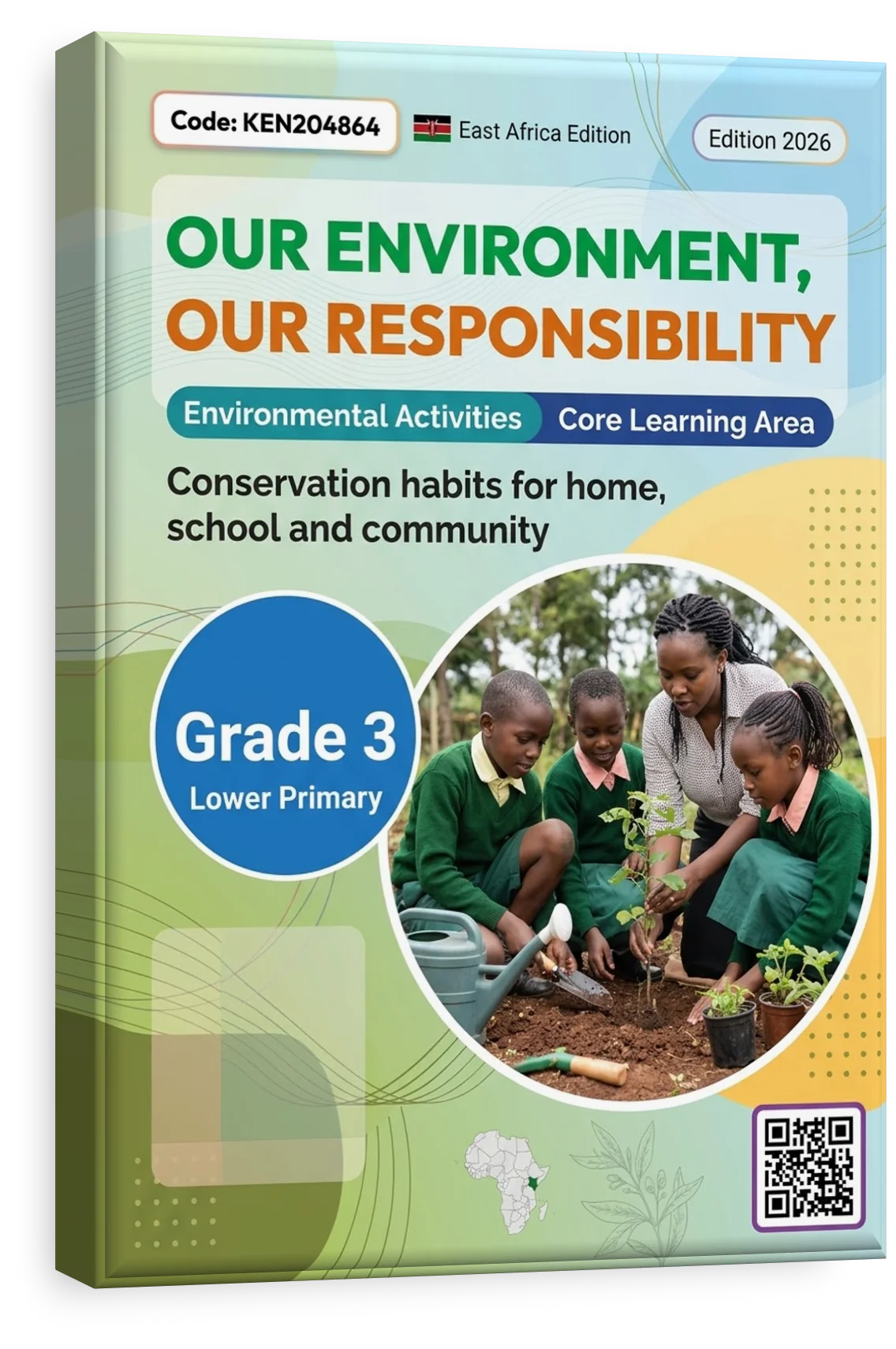
Our Environment, Our Responsibility
Level: Grade 3 (Lower Primary) — Core Learning Area
Official Curriculum – Competency-Based Curriculum (CBC) – Kenya Institute of Curriculum Development (KICD).
PRELIMINARIES
1. Why Our Environment Comes First
Every heavy shower in Nairobi washes plastic bags from Gikomba market into Nairobi River, turning the water black with rubbish. A Grade 3 learner crossing the footbridge to school sees fish struggling and smells what rain alone cannot explain. Environmental Activities begins right there, with eyes that notice before anyone else points it out. By the last page of this book, noticing has grown into doing something about it, at home, at school and along that same riverbank.
2. Look, Learn, Try, Keep: The Four Steps of Every Chapter
Open any chapter and the same four steps appear, like the stages of planting a sack of maize in Nyeri. First comes a real problem to look at closely. Next, the idea behind it, explained in plain words. Then a small hands-on try, with soil, water or a bottle top, not just listening. Finally, the skill is kept and carried home, ready for the next shamba, market stall or rainy morning that needs it.
3. Teaching Forty Pupils With a Handful of Bottle Tops
In a Kakamega classroom built for forty, seventy pupils now share desks, yet the teacher still turns bottle tops, stones and dry leaves into counters and samples. No laboratory is needed to study environment; the compound outside the door supplies it free. Parents can repeat each activity at home with the same ordinary objects, asking one question after: what did you find, and what will you do differently now?
Chapter I. Knowing Our Compound Before We Explore It
I.1 The Thorn Bush Near Kiambu’s Pit Latrine
A boy in Kiambu once ran barefoot behind the house and landed in a nettle bush nobody had warned him about. The sting taught him something no textbook could: not every corner of a compound is safe without first looking. Firewood piles hide snakes, jiko embers stay hot long after cooking ends, and broken bottles wait in overgrown grass. Before any environmental activity begins, a learner must read the compound like a map of risks and safe paths.
I.2 Sorting What Lives From What Does Not
Behind a homestead in Murang’a, chickens scratch near stones that never move and ants march past a fence post that will never grow. Living things breathe, feed, grow and produce young; non-living things like stones, fences and jikos do none of these. A short walk around the compound, naming each object as one or the other, turns an ordinary yard into a classroom. Knowing the difference matters later, when deciding which things need care and which simply need looking after.
I.3 Drawing a Safety Map of the School Compound
A school in Nyandarua sends learners out in pairs, chalk and paper in hand, to mark the water point, the pit latrine, the firewood store and the shaded play area. Green marks a safe spot, red marks one needing an adult’s permission, such as the kitchen fire. The finished map goes up on the classroom wall for everyone to check. Making it forces a question every learner must answer: which parts of this ground have I never looked at closely?
I.4 The Habit That Keeps Little Sisters Safe
Back home in Nyahururu, an older sister checks the yard before letting a toddler loose to play, scanning for broken glass, open jikos and loose firewood the way her class map taught her. That quick scan takes under a minute but has already stopped one fall near the cooking fire. Safety, once a list of warnings from adults, becomes a skill the learner owns and passes on. What changed is a pair of eyes trained to read the compound first.
Chapter II. Following Water From Source to Tap
II.1 Three Kilometres for a Jerrican in Kitui
When the short rains fail in Kitui, a seasonal river turns to cracked mud within weeks, and girls as young as nine walk three kilometres each morning for a jerrican of water. That long walk steals time that could go to homework, play or sleep. Grade 3 learners who hear this story start asking where their own water comes from, and whether it is always there. A problem that began as someone else’s walk becomes a question about the tap closer to home.
II.2 Rain, River, Borehole, Lake: Where Water Really Comes From
Kisumu families drink from Lake Victoria, Nakuru homes from a borehole, and a Nyeri shamba collects rain off the roof into a tank. Each source follows a different route before it reaches a cup: rain falls, soaks or runs off; rivers and lakes carry it onward; boreholes draw it up from deep underground. None of these waters is automatically clean. Naming the exact source feeding one’s own home is the first fact every learner needs before trusting any water as safe.
II.3 What a Clear Bottle Reveals About Dirty Water
Two samples sit side by side on a Nakuru classroom desk: river water in one clear bottle, rainwater in another. Held up to the window, one shows floating specks the other does not. A kettle then brings both to a rolling boil, the simplest way to kill germs no eye can see. Watching steam rise teaches more than any poster: clear does not always mean clean, and heat, kept up long enough, is a weapon every household already owns.
II.4 Boiling Before Drinking Becomes Family Rule
A Machakos family now keeps one kettle boiling every evening before the water pot is filled for the next day, a habit started after a Grade 3 learner brought the classroom demonstration home. Fewer stomach upsets followed within a month, proof enough for grandparents who needed more than a teacher’s say-so. Saving water matters too: the family now reuses rinse water on the kitchen garden instead of pouring it away. One lesson, repeated at home, quietly changed two habits at once.
Chapter III. From Seed to Sukuma Wiki
III.1 Why the Terraces Above Lake Baringo Stopped Holding Rain
Steep farms above Lake Baringo once lost whole rows of sukuma wiki whenever heavy rain arrived, the topsoil sliding downhill in muddy streams. Bare slopes without terraces or grass strips cannot hold water where young roots need it most. A single storm proved the point, washing a planted bed away while a neighbouring, terraced one survived untouched. That difference raised a question every farmer’s child eventually asks: what, besides rain, decides whether a crop lives or dies on a hillside?
III.2 Roots Drink, Leaves Breathe: What a Plant Actually Needs
In a Meru school garden, a wilting sukuma wiki plant gets three things back within days: water poured at the root, not the leaves; sunlight it was shaded from; and soil loosened so air reaches underground. Roots pull up water and minerals, stems carry them upward, and leaves use sunlight to make food. Removing one ingredient slows growth; removing two stops it. Naming each part and its job turns a sickly plant into a short checklist anyone can follow.
III.3 A Tin, a Bean and a Watering Timetable
At a Nyamira primary school, every learner plants one bean in a recycled tin, then signs a timetable promising water every second morning, not every day. Overwatered tins rot their seeds within a week; the properly timed ones push up a pale shoot by day five. Measuring height with a ruler each Friday turns waiting into recorded science. The tin on the sunniest windowsill always wins the race, settling an argument no paragraph could close as convincingly as the plants themselves.
III.4 The Kitchen Garden That Pays for Itself
An Embu family now harvests sukuma wiki from a strip of ground beside the kitchen that used to grow only weeds, started after a learner copied the bean-tin method on a larger scale. The weekly market spending on vegetables has dropped, and leftover peelings go back into the soil as compost. What began as one planted tin at school now feeds a household and teaches younger siblings the same four steps. A shamba, however small, rewards the attention it receives.
Chapter IV. Rubbish, Sorted and Put to Use
IV.1 The Drain That Mombasa’s Rain Could Not Clear
After a short, heavy downpour, the drains around Kongowea market in Mombasa backed up within the hour, choked by plastic wrappers nobody had bothered to bin. Ankle-deep water spread across the market floor, ruining sacks of onions and tomatoes traders could not afford to lose. The flooding was not only about rain; it was about rubbish left uncollected for weeks beforehand. A market that floods every season raises one question: who decides where that plastic ends up?
IV.2 Banana Peel or Plastic Bag: Which One Rots?
Banana peels dropped on bare soil near a Kisii market stall shrink to nothing within weeks, while a plastic bag buried beside them stays whole for years. Things that rot naturally, like peels, leaves and ugali scraps, are biodegradable; things that do not, like plastic and glass, are not. Sorting a basket of mixed rubbish into two piles makes the difference obvious without any technical word needed first. Afterwards, reduce, reuse and recycle stop sounding like slogans and start sounding real.
IV.3 A Football Stitched From Forty Plastic Bags
Learners at a Kibera primary school collect forty discarded plastic bags, roll them tight into a ball, and bind it with strips cut from an old inner tube until it bounces like a shop-bought football. Every bag used is one less bag blocking a drain or drifting into a river. The craft costs nothing and takes a single afternoon, using only patience and a method passed from class to class. Waste, looked at differently, becomes raw material waiting for a second job.
IV.4 Mathare’s Saturday Morning Without Rubbish
Once a month, families around Mathare set aside Saturday morning to sweep their own stretch of street, sorting what they collect into sacks for burning, composting or the council truck, just as Grade 3 learners now do at school each Friday. Neighbours who once stepped over the same rubbish for weeks now compete, half-seriously, over whose section looks cleanest by midday. Segregating waste at the source, rather than after it piles up, is the habit every speaker insists on.
Chapter V. Watching the Sky, Protecting the Land
V.1 When Turkana’s Rains Forget to Arrive
Herders in Turkana once counted on short rains falling every October without fail; now entire seasons sometimes pass dry, and wells that fed whole herds of goats run empty months early. Families who used to move camp twice a year now move four or five times, chasing grass and water that keep retreating further. A Grade 3 learner hearing this story starts to see weather as something worth recording, not just enduring. Can watching the sky help plan ahead now?
V.2 Reading Clouds and Wind Before the Rain Gauge Arrives
Learners at a school near Narok study the sky each morning before any lesson begins: dark, low clouds and a shift in wind usually mean rain within hours, while a clear dawn with no breeze often means another dry day ahead. A simple rain gauge, a plastic bottle marked with a ruler, later confirms what eyes alone suspected. Weather is not random guesswork once a few signs are known. Seasons, too, follow a rough pattern worth tracking term after term.
V.3 A Weather Diary and a Row of Seedlings
For one full term, a class near Mount Kenya records rainfall, cloud cover and wind in a shared notebook each morning, then plants a row of indigenous tree seedlings along the compound fence during the wettest week the diary predicts. Seedlings planted on a guess, learners discover, die far more often than those timed to real rain. Keeping the record and keeping the seedlings alive turn into the same patient project, each entry quietly deciding whether the next one survives.
V.4 One Tree, One Learner, One Promise
On national Tree Planting Day, learners who once only visited Karura Forest on a school trip now plant and name a seedling of their own near the school gate, promising to water it through the next two dry seasons. A forest, this book’s final lesson insists, is simply many such promises kept at once over many years. From a polluted river on page one to a named tree at the gate, one question has run through every chapter: what now?
ANNEXES
A. Glossary: Mazingira Words Worth Knowing
This annex lists twelve words from the book in English beside their Kiswahili equivalent: environment (mazingira), waste (taka), water source (chanzo cha maji), biodegradable (inayooza), drought (ukame), terrace (tuta) and seedling (mche), among others a learner meets outside class. Each entry gives a short example sentence using the word correctly, not just a translation. Teachers can call out either language during revision and expect the same answer, while Kiswahili-speaking parents can still follow what their child is learning.
B. Home Activity Sheet and Simple Marking Guide
This sheet sends five short tasks home across the term: mapping one safety hazard in the compound, naming the household’s water source, planting one seed in any container, sorting one week of rubbish into two piles, and recording three days of weather. A parent or older sibling signs each completed task and adds one sentence on what the learner noticed. The attached rubric scores each task out of four marks, covering accuracy, neatness, correct vocabulary, and whether the learner explained it unprompted.
C. The Project Log Every Chapter Feeds
One single notebook, started in Chapter I and carried through to Chapter V, holds every map, planting record, water test result and weather entry made across the term in date order. Nothing gets copied twice; each chapter simply adds its own page to a growing record of one learner’s environment. By the final week, flicking back through earlier pages shows progress no single test could capture: messier handwriting at first, more exact language and tidier diagrams by the last entry.

Discussion (0)
Aucune intervention pour le moment. Soyez le premier à contribuer.
Votre intervention Annuler la réponse