
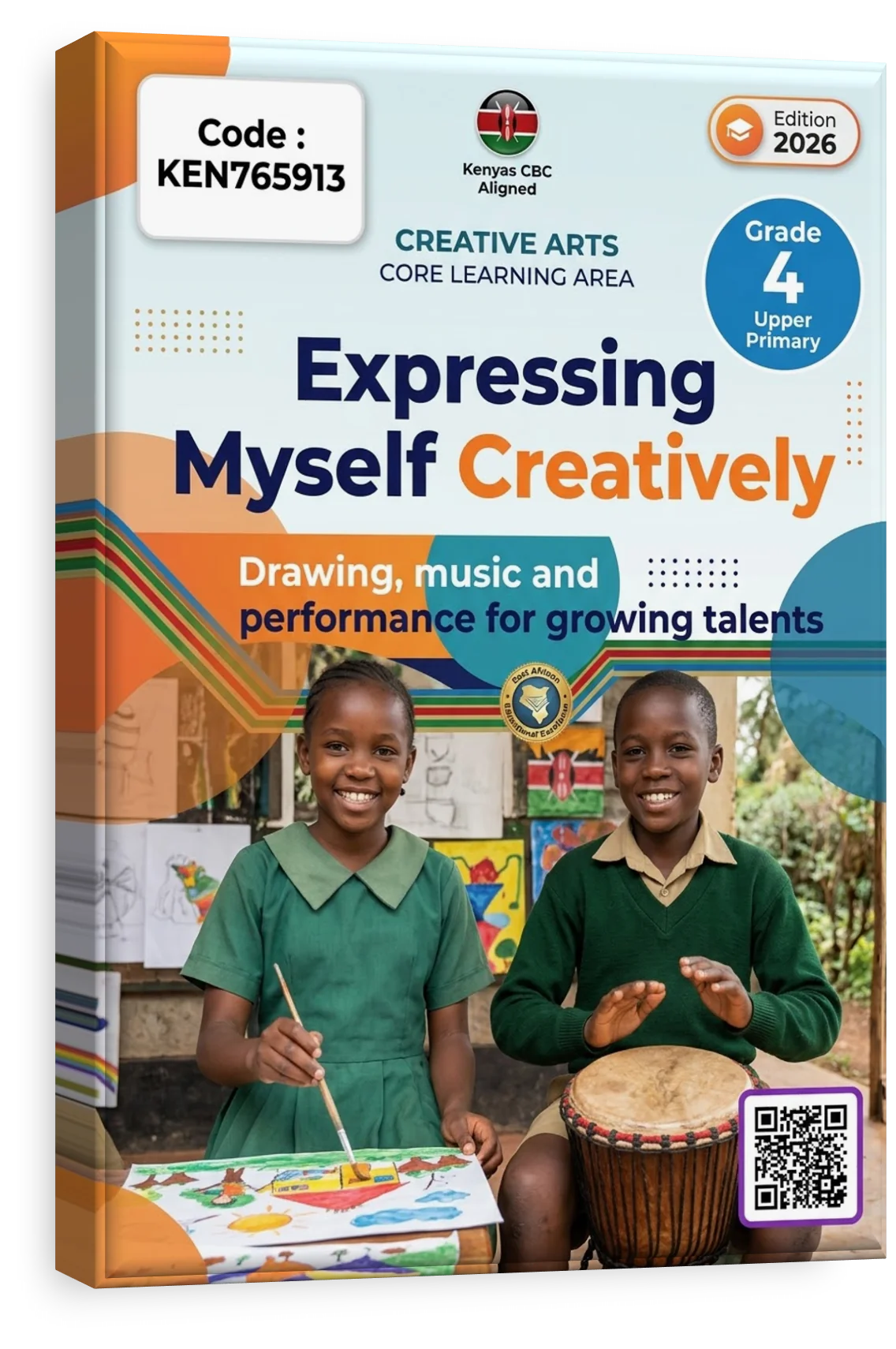
Expressing Myself Creatively
Level: Grade 4 (Upper Primary) — Core Learning Area
Official Curriculum – Competency-Based Curriculum (CBC) – Kenya Institute of Curriculum Development (KICD).
PRELIMINARIES
1. A Shaker Made From Five Bottle Tops
A shaker made from five bottle tops nailed onto a stick can turn a quiet afternoon into a concert. That is creative arts in Grade 4: looking, listening and making with whatever a Kenyan home already holds — cloth, clay, tins, voices. Every picture drawn, song sung or story mimed trains one skill: noticing detail and shaping it into something others can see or hear. By the end of this book, drawing, pattern, rhythm and performance stand as four tools for saying an idea clearly.
2. Four Steps in Every Lesson: Spark, Learn, Make, Show
Spark, learn, make, show — that order never changes in this book. Each chapter opens on a Kenyan situation worth puzzling over, moves to the idea behind it, then hands out materials for a short exercise, and closes on a finished piece or performance that shows the skill at work. A forty-minute period rarely finishes all four steps at once, so a teacher is free to spread them across two sittings. What matters is that making always follows understanding, never replaces it.
3. Forty Learners, One Paintbrush
Forty exercise books but only three paintbrushes: that is the real Grade 4 classroom this book was written for. Pair and group work turn scarcity into an advantage — one learner mixes colour while another times the turn, and both watch closely enough to learn from mistakes that are not their own. At home, a parent needs no art supplies at all: a stick in wet soil, a tin lid as a drum, a blanket as a stage curtain are enough to keep practising between lessons.
Chapter I. Setting Up a Creative Corner With What We Already Have
I.1 A Classroom With No Art Shop for Forty Kilometres
Forty kilometres past the last matatu stage, sometimes further, sits the nearest shop selling paint and brushes for some Kenyan primary schools. So where does a creative arts lesson begin? Not with a shopping list, but with a walk around the compound: charcoal from the cooking fire, red soil for paint, banana fibre for brushes, cartons from the shopkeeper. Before anything is drawn or sung, the class agrees on one question — what do we already have, and what can it become?
I.2 Naming Our Tools and Marking the Danger Line
A scissor blade, a sharpened pencil, a shard of broken tile for scraping — every art tool can also cut a finger. Grade 4 learners sort their materials into two piles: safe to pass hand to hand, and needing an adult or a steady desk. A red string laid across the table marks where sharp tools stay until called for. Naming each tool aloud, in English and Kiswahili, before touching it builds a habit that protects every lesson that follows: look first, then reach.
I.3 Building a Shared Art Box From Carton and Sisal String
One carton, sisal string, and whatever scraps a week of lunches produced become a classroom art box with four labelled sections: cutting tools, colouring tools, paper, and found objects. Building it is itself the first project — measuring the carton’s flaps, cutting dividers, tying a sisal handle so it can hang off a nail. A class of forty decides together where it lives and whose turn it is to check it closes properly before the next rains threaten the roof.
I.4 A Corner That Opens Itself Every Monday Morning
By the second week, the art box no longer needs instructions — a monitor unlocks it, checks the inventory list taped inside the lid, and reports any missing brush before the bell even rings. That small routine is the real outcome of this chapter: a shared space cared for without being told to, and tools respected because their danger and their value were both named out loud. Every later chapter in this book assumes that corner is ready and safe to use.
Chapter II. Lines, Shapes and Colours Borrowed From Home
II.1 Counting the Shapes Hiding on a Kitenge Wrapper
Look closely at any kitenge wrapper hanging on a line in Kisumu or Nakuru and triangles, diamonds and stripes appear everywhere, repeating in bands of colour. Before Grade 4 learners pick up a pencil, they hunt for five shapes on their own clothes or a classmate’s. The question that follows carries the whole chapter: if shape is everywhere already, what turns a few lines and three colours into a picture that says something, rather than just marks on a page?
II.2 Three Colours That Make All the Others
Red, yellow and blue cannot be mixed from other colours — everything else on a paintbox comes from combining them. Mix red and yellow for the orange of a ripe mango, blue and yellow for the green of maize leaves, red and blue for jacaranda purple. Lines can be straight, curved or broken, and shapes built from them can be geometric like a chapati or organic like a cloud over the Aberdares. Naming both gives a learner a vocabulary for any picture still to come.
II.3 Painting the Walk to School in Three Colours Only
Using red, yellow and blue paint and nothing premixed, each learner paints the walk from home to school: the colour of the road, a neighbour’s gate, the sky at seven in the morning. Every other shade on the paper must be mixed on the spot, which forces a decision at every brushstroke rather than a guess from a ready tube. Some learners discover their road is greyer than they thought; others find a neighbour’s purple gate needs far more blue than red to turn out right.
II.4 A Picture That Proves a Mixed Colour Was Chosen on Purpose
When the paintings are pinned along the chalkboard, each learner defends one mixed colour choice aloud — not a guess, a decision. « I added more blue because the gate looked cold in the morning » is the kind of sentence this exercise is built to produce. The skill now sitting with every learner is a working eye for colour mixing, ready for the next chapter’s patterns and for any poster, chart or classroom display still waiting to be painted this term.
Chapter III. Pattern, Texture and Printing From the Shamba
III.1 Why a Kiondo Never Looks the Same Twice
No two kiondo baskets from a Machakos market carry the identical pattern, yet every one is instantly recognisable as a kiondo. What makes a pattern a pattern if it still allows variation? Grade 4 learners examine a real kiondo, a khanga cloth and a woven sisal mat side by side, tracing where a shape repeats and where the weaver changed colour on purpose. That single question — repeat, but never identical — carries straight into this chapter’s printing and texture work.
III.2 Repeating a Shape Until It Becomes a Pattern
A pattern is one shape repeated with a rule: same spacing, same rotation, or alternating colours in a fixed order. Texture is what a surface feels like under a finger — rough as sisal, smooth as a banana leaf, bumpy as sukuma wiki. Printing is a shortcut for repeating a shape exactly: press the same object in ink or paint again and again, and the pattern appears almost by itself, far faster than drawing each shape by hand, one at a time.
III.3 Printing With a Sweet Potato and a Mukinduri Leaf
Half a sweet potato carved into a triangle, a mukinduri leaf dipped flat in paint, a bottle cap pressed in rows: three stamps, three different textures on one sheet of paper. Grade 4 groups agree on a spacing rule before starting — every stamp one thumb-width from the last — and keep it even when the paper runs out of space and the pattern must turn a corner. The leaf print alone reveals veins no drawing from memory had shown clearly.
III.4 A Printed Cloth Panel Ready for the Classroom Wall
Trimmed and stitched edge to edge onto an old flour sack, the best print from each group becomes one classroom wall panel by the end of the week. Walking past it, a visitor can read the rule each group chose without being told — rotation here, alternating colour there. The skill carried forward is pattern logic: once a learner can describe the rule behind a design, copying, continuing or inventing a new pattern stops being guesswork.
Chapter IV. Rhythm Without a Single Drum
IV.1 A Church Choir Keeps Time With Nothing But Hands
Watch a church choir in rural Kenya and the feet move before any drum does — clapping, stamping and swaying keep the beat even when no instrument is in the room. Grade 4 learners test the same idea: can the class keep a steady beat for one full minute using only hands and feet, no counting aloud? Most groups speed up without noticing. The problem this chapter solves is simple to state and surprisingly hard to do: staying exactly together.
IV.2 Beat, Rest and the Pulse Under a Song
A beat is the steady pulse under any song, the thing a foot taps to without being told. A rest is silence that still counts — one beat of nothing, held as carefully as a beat of sound. Body percussion turns both into a vocabulary: a clap for a loud beat, a pat on the knee for a soft one, open hands for a rest. Written as claps and dots on the board, a four-beat pattern becomes something a whole class can read together.
IV.3 Turning Bottle Tops and a Tin Into a Kayamba
Five bottle tops nailed loosely to a flat stick, or dry maize seeds shaken inside a closed tin, both produce a shaker close enough to a kayamba for any Grade 4 band. Building one takes a single lesson; tuning it — tightening or loosening the nails until the sound stops rattling and starts shaking cleanly — takes patience. Each group builds exactly one instrument and names it, because an instrument nobody has named is an instrument nobody will care for.
IV.4 Four Bars That Finally Stay Together
By the end of this chapter, four groups each holding a different homemade instrument — shaker, tin drum, clapping hands, stamping feet — hold a steady four-bar rhythm without rushing or dragging. Getting there took counting aloud, then counting silently, then not counting at all. What stays with every learner afterwards is less the rhythm itself than the discipline behind it: listening to the group’s pulse rather than only to one’s own hands.
Chapter V. Melody and Singing in Two Parts
V.1 A Harambee Song Starts Low and Finishes High
At a harambee fundraising gathering, a leader’s call often starts on a low note and climbs by the final verse, pulling the whole crowd’s voices upward with it. Grade 4 learners notice the same climb in songs they already know and try humming it with a hand tracing the rise in the air. Why does a song climb instead of staying flat throughout? Answering that question opens this chapter’s real subject: pitch, the difference between a low sound and a high one.
V.2 Up, Down and the Line Between Them
Pitch is how high or low a sound is, and melody is a sequence of pitches moving up, down or staying level, one note after another. A simple way to see it: draw a line on the board that rises when the voice rises and falls when it falls, turning sound briefly into a shape anyone can read. Call-and-response, where a leader sings a line and the group answers with a fixed one, is the easiest structure for practising pitch together without reading any notation.
V.3 Learning a Call-and-Response Song Line by Line
One learner sings the call, the rest answer with the same short response every time, and only after three rounds does the group add the next new line. Grade 4 classes build an entire folk song this way, phrase by phrase, never asked to read all the words at once. Mistakes surface immediately because forty voices rarely land on the wrong note together — a wobble is heard, corrected, and the next round starts cleaner than the last.
V.4 Singing the Chorus While the Shaker Keeps Count
Now the chapter’s two skills meet: the song learned line by line gets a kayamba shaker underneath, keeping the steady beat from the rhythm chapter while voices carry the rising and falling melody on top. Coordinating both at once is genuinely harder than either alone, and the first attempt usually falls apart within four bars. The second attempt rarely does. What a learner owns by the end is a short performed song, rhythm and melody held together rather than taught apart.
Chapter VI. Mime, Storytelling and a Class Showcase
VI.1 Grandmother Never Needed Words to Scare Off Hyena
A grandmother telling the story of Sungura the hare barely needs words — her hands become Hyena’s jaws, her shoulders droop for his hunger, her eyebrows alone can make a room of children laugh before a sentence finishes. Grade 4 learners try the same test: tell thirty seconds of a familiar story using only the body, no sound at all. Most freeze after ten seconds, unsure what a face or a hand can actually say without a voice behind it.
VI.2 A Frozen Face, A Raised Hand: Mime Has Its Own Grammar
Mime has rules worth naming: a frozen pose can mark surprise, a slow turn of the head can mark suspicion, and a single raised hand can mean stop without a word spoken. Stage directions add a second layer — enter from the left, cross to centre, exit right — that keeps four performers from colliding in a space the size of a classroom corner. Learning both together turns a shy performer’s stillness into a choice rather than an accident.
VI.3 Rehearsing Sungura’s Escape Without Saying a Word
Working in groups of five, learners choose one scene from a Sungura tale — the trap, the trick, the escape — and block it out in complete silence first, deciding exactly where each character enters, freezes and exits. Only after the silent version holds together does dialogue get added back, now carried by bodies that already know where they stand. A backdrop painted in Chapter II and a shaker built in Chapter IV often find their way into the same scene.
VI.4 The Hall Goes Quiet for the Final Bow
On showcase afternoon, parents and younger classes gather as each group performs its folktale scene complete with painted backdrop, printed costume patches and a kayamba keeping the beat. The hall goes quiet exactly when a rehearsal hoped it would, and loud again at the bow. What closes this book is not one skill but four working at once — drawing, pattern, rhythm and mime — proof that a term’s practice holds up in front of a real audience.
ANNEXES
A. Words an Artist Needs, in English and Kiswahili
This glossary gathers every term the book uses for quick reference: rangi (colour), mstari (line), mdundo (rhythm), wimbo (song), igizo (performance), pumziko (rest, a silence in music). Each entry gives a one-line meaning plus the chapter where it was first used, so a learner reviewing before an assessment can find the word fast. A short safety list sits alongside it: scissors closed when passed, red-string line respected, wet-paint hands kept away from eyes and electrical switches.
B. A Family Art Evening, Mark by Mark
A home activity sheet invites one evening of family creative arts: naming three shapes found in the house, mixing one new colour from whatever paint or soil is available, and clapping a four-beat rhythm together after supper. A simple rubric alongside it scores three things out of three each — accuracy of the shape or colour named, steadiness of the rhythm, and willingness to try a second attempt after the first one falters, which counts for as much as getting it right straightaway.
C. The Notebook That Remembers Every Rehearsal
A project log, one page per chapter, records what was built, what failed the first time, and what changed before it worked — the leaky art box lid, the shaker that rattled instead of shook, the mime scene that collided twice before blocking fixed it. Kept honestly, it becomes more useful than the finished pieces themselves, because it shows a learner’s own problem-solving in their own words. Teachers use it at term’s end to see growth that a single final picture cannot show.
Discussion (0)
Aucune intervention pour le moment. Soyez le premier à contribuer.
Votre intervention Annuler la réponse