
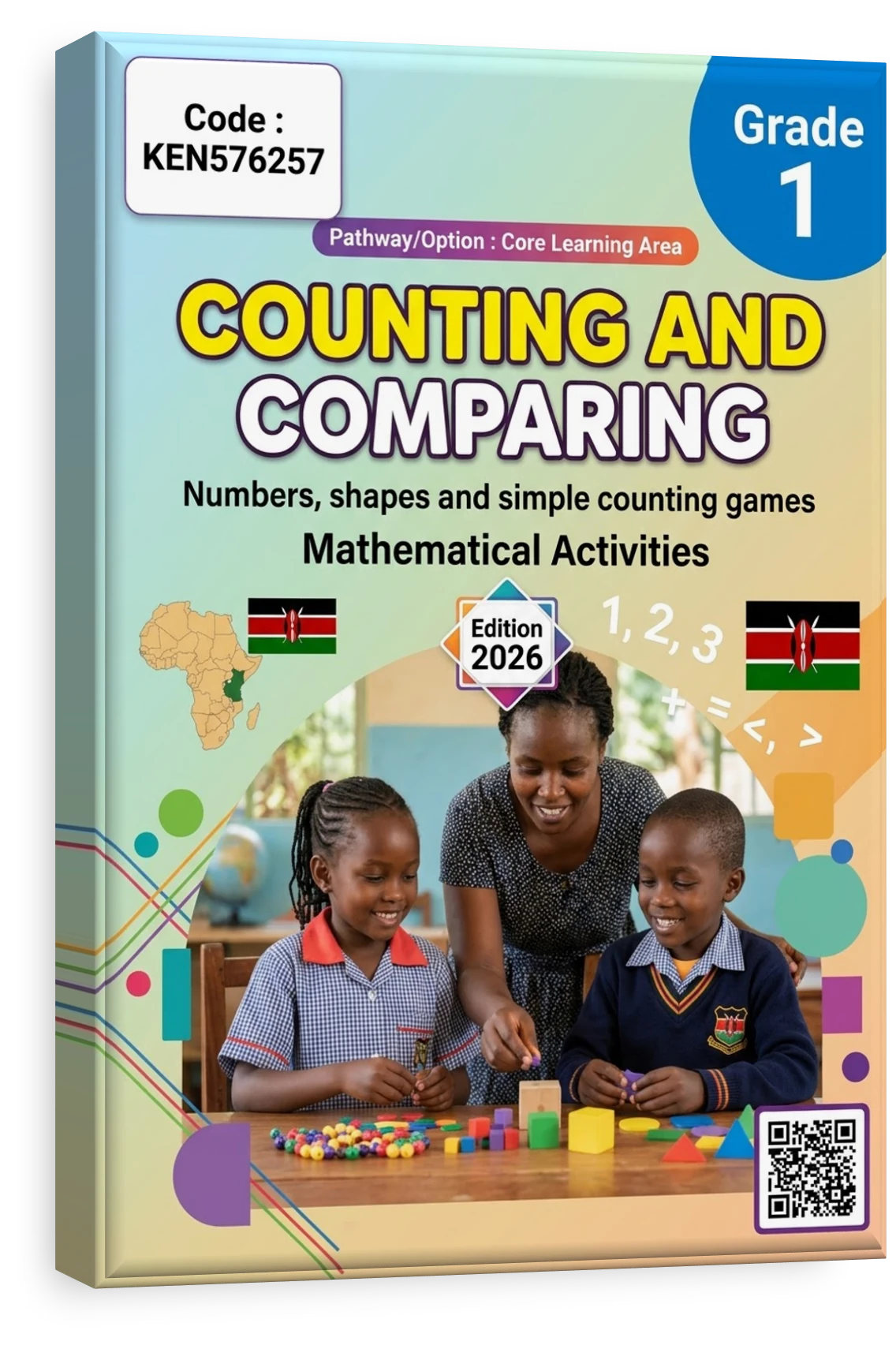
Counting and Comparing
Level: Grade 1 (Lower Primary) — Core Learning Area
Official Curriculum – Competency-Based Curriculum (CBC) – Kenya Institute of Curriculum Development (KICD).
PRELIMINARIES
1. Why Counting the Eggs Matters Before School Even Starts
A hen in the backyard lays five eggs by Friday, and a boy selling them at the gate must work out whether five is enough for an order of eight. That small gap between what he has and what is asked for is where mathematics begins for a Grade One learner. Counting decides whether a harvest or a family meal adds up correctly, long before any sum appears on paper. This book starts there, with numbers a six-year-old already meets every day, at home and at the market.
2. From a Real Problem to a Skill You Can Use
Every chapter in this book follows the same four turns, like a game with clear rules. First comes a real situation from Kenyan life: a queue at the matatu stop, a basket of tomatoes, a row of sticks. Second, the idea behind it gets named and explained plainly, with no shortcuts. Third, hands get busy: counting, sorting, comparing, drawing. Fourth comes the payoff, the moment a child uses the new skill to answer the very question that opened the chapter, at home or in class.
3. Forty Children, One Chalkboard: Teaching This Without Fancy Resources
Thirty or forty six-year-olds sharing one chalkboard and a handful of counters is the normal Kenyan classroom, not the exception. Bottle tops, maize grains, stones and sticks from the compound replace plastic counters without losing a single idea in this book. Pairing a confident counter with a shy one turns a large class into many small ones working at once. At home, a parent or an older sibling can repeat the same exercises using beans from the kitchen or coins from a pocket.
Chapter I. Counting the World Around Us
I.1 How Many Eggs Did the Hen Lay Today?
Grandmother keeps twelve hens behind the house, and every morning the eggs must be counted before anyone can sell, cook or save them. Guessing is tempting but costly: a wrong guess means a cracked egg discovered too late, or a buyer shortchanged at the gate. Touching each egg once while saying one number keeps the count honest and prevents either skipping one or counting it twice. The same careful touch-and-say method works just as well on goats in the boma, pencils in a desk or buses passing the school fence.
I.2 What a Number Really Stands For
A number is not a decoration on the chalkboard; it is a short way of saying « this many » without listing every single thing. Three mangoes, three buttons and three fingers held up all share the same number three, however different the objects look. Matching objects to counters, then to fingers, then to the written digit shows a child that symbol and pile mean exactly the same amount. Numbers then stop being shapes to memorise and become tools for answering real questions.
I.3 A Counting Hunt Around the School Compound
Armed with nothing more than a scrap of paper and a pencil, pairs of children go hunting for sets of things around the compound: window panes, trees, bicycles leaning against the fence. Each pair counts carefully, writes the number beside a quick drawing, and checks the total against a partner’s before reporting back. Mistakes surface fast when two counts of the same window disagree, and sorting out whose count is right becomes the real lesson of the morning.
I.4 From Guessing to Knowing: Counting With Confidence
By the end of this chapter, the hesitation of the first lesson has mostly gone. A tray of twenty counters no longer needs three attempts and a worried face; one steady pass, touching and saying each number, settles the question. That same calm now travels home: counting change from a shopkeeper, counting plates before a family meal, counting goats back into the boma at dusk. Nothing about the skill has changed since the first hen’s eggs, except that the child now trusts it completely.
Chapter II. More, Less or the Same?
II.1 Two Baskets of Tomatoes at Gikomba Market
Two traders set out baskets of tomatoes side by side at the market, each certain theirs is the fuller one. A quick glance is not proof, and a customer deciding where to buy wants more than an opinion. Placing tomatoes from each basket into matching rows, one against one, finally shows without any doubt which basket runs out first and which has tomatoes to spare. The same trick settles arguments over sweets shared between friends or firewood split between two homes.
II.2 Comparing Two Groups Without Counting Either One
Counting every item is not always the fastest way to know which group is bigger; lining them up often answers the question before the counting even finishes. Two rows of mango seeds, matched one against one, leave either an empty gap on one side or a tidy, even finish, and that gap alone tells the whole story. Once this pairing method is trusted, children stop reaching for numbers out of habit and start choosing the quickest honest way to compare two sets of real things.
II.3 Lining Up Bottle Tops to Find the Bigger Pile
Two piles of bottle tops collected around the compound look almost equal until they are lined up into neat columns, side by side on the desk. Whichever column runs out of tops first belongs to the smaller pile, with no counting of either pile required at all. Repeating the lineup with stones, pencils and leaves proves the method works well beyond bottle tops. By the final round, children call out « more », « less » or « the same » with real certainty, backed by proof they can show.
II.4 Choosing the Better Deal With One Glance
A shopkeeper offers six sweets for ten shillings at one stall and eight sweets for the same ten shillings at another, and a sharp buyer notices the difference before handing over any coins. Comparing matters for more than stones on a desk; it decides real choices with real money at a real stall. Practising with pretend shillings and sweets in class builds the same quick judgement a child later uses at an actual counter. Knowing which price is genuinely better becomes a daily, useful habit.
Chapter III. Tens and Ones: Numbers Beyond Twenty
III.1 A Matatu Queue Too Long for Ten Fingers
Thirty passengers waiting at a matatu stop in the early morning rush are far too many to count on ten fingers alone, and counting one by one all the way up invites mistakes. Something smarter is needed once a group grows past twenty, and this chapter supplies it. Grouping the queue into tens, then counting the remaining loose passengers, turns an overwhelming crowd into a manageable, trustworthy number. The same grouping trick will soon make sense of eggs, pupils, goats and coins in far larger amounts than before.
III.2 Bundling Loose Sticks Into Tens
A heap of forty loose sticks collected from the compound is hard to judge at a glance, but ten sticks tied firmly into one bundle changes everything. Four bundles plus however many loose sticks remain tell the total far faster than counting stick by stick ever could. Children build their own bundles with string or rubber bands, checking each one holds exactly ten before moving to the next. The bundle becomes a trusted unit, a small parcel of ten that can be counted like a single thing.
III.3 Building Numbers With Bundles and Loose Sticks
Three full bundles of ten sticks and five loose ones sitting beside them spell out the number thirty-five without a single stick being counted individually again. The written number mirrors the pile exactly: the first digit names the bundles, the second names what is left over, loose and uncounted into tens. Swapping the loose pile for a slightly bigger or smaller one and rewriting the number each time turns an abstract rule into something a child can see, touch and rebuild with their own hands on the desk.
III.4 Reading the Big Numbers on the School Register
The class register lists forty-two names in a single straight column, and the teacher calling the roll needs a number everyone instantly trusts, not a slow recount every single morning. Reading forty-two as four bundles of ten plus two loose ones connects the written figure on the page to the same sticks and stones used earlier in the term. A learner who understands the register can soon make sense of a shopping bill, a bus fare chart or the page numbers in their own exercise book.
Chapter IV. Shapes in the Classroom and the Compound
IV.1 Why the Chapati Will Not Roll Like the Ball
A football rolls smoothly across the compound no matter which way it is kicked, but a folded chapati set rolling the same way simply flops over and stops. Something about their shapes, not their size or their weight, explains the difference completely. Curved surfaces roll; flat corners and straight edges do not, and naming that difference is the real beginning of geometry for a six-year-old. Touching a ball, a book and a plate while naming what makes each one roll grounds the idea in objects already known.
IV.2 Naming Circles, Squares, Triangles and Rectangles
A clock face, a chapati and a coin share one name despite their different sizes: circle. A window pane and a square of kitchen tile share another: square, with four equal sides and four corners that match exactly. A roof truss and a folded ugali-wrapper corner share a third: triangle, three straight sides meeting at three sharp points. Sorting a mixed pile of classroom objects into these named families, out loud and without hesitation, turns a vague sense of « roundish » or « cornery » into exact, shareable vocabulary.
IV.3 A Shape Hunt Across the School Compound
Clipboard in hand, pairs of children set off across the compound hunting for one example each of a circle, a square, a triangle and a rectangle hiding in plain sight: a wheel, a window, a roof beam, a door. Spotting a shape in an unexpected place, like a triangular shadow under a mango tree at midday, earns real excitement and a quick sketch. Back in class, comparing lists shows the same four shapes holding up buildings, vehicles and furniture across the whole school grounds.
IV.4 Building a Pattern With Shapes That Repeat
Kiondo baskets woven by hand often repeat the same shapes in a careful rhythm: triangle, square, triangle, square, around the rim without a single break in the order. Cutting paper shapes and arranging a similar repeating line, then predicting which shape comes next before placing it, trains an eye that notices order, not only separate objects. By the chapter’s end, a child can read a pattern already made and continue one correctly, a skill that carries into beadwork and fencing designs seen every day.
Chapter V. Measuring Length, Time and Money
V.1 Whose Maize Stalk Grew the Tallest?
Two cousins tending neighbouring maize plots both insist theirs grew taller this season, and neither owns a tape measure to settle the argument on the spot. Standing the stalks side by side against a straight wall, bases touching the ground, shows instantly whose top reaches higher, no ruler required at all. The same side-by-side trick compares pencils, exercise books or even the heights of two classmates lining up for assembly. Length, this chapter shows, can be judged fairly long before any numbers or units get involved.
V.2 Measuring Without a Ruler: Hands, Feet and Strides
Long before shops sold rulers, people measured a field in strides, a plank in hand spans and a rope in arm lengths, and those old methods still work perfectly well for a Grade One classroom. Pacing the length of the classroom in heel-to-toe steps and comparing the count with a neighbour’s result reveals a problem worth discussing: bigger feet give smaller numbers for the very same floor. That puzzle opens the door, gently, to why the whole country eventually agreed on one shared, unchanging unit for everybody to use.
V.3 Counting Coins Into a Piggy Bank Debe
A tin debe with a slot cut in the lid collects coins dropped in after each small errand, and by the end of the month a child wants to know exactly how much has gathered inside. Sorting the coins first into piles of the same value, then counting each pile before adding the piles together, avoids the confusion of counting mixed coins one by one. Watching the total grow week after week turns an abstract number into visible, countable proof that small savings really do add up over time.
V.4 Telling a Ten-Shilling Coin From a Fifty
Two coins of almost the same size sit on the desk, and only a careful look at the printed number tells a ten-shilling coin apart from a fifty. Confusing the two at a market stall costs real money, so this distinction matters well beyond the classroom. Sorting a mixed handful of play coins by value, then checking totals against a partner’s count, builds the habit of reading money carefully instead of guessing from size or colour. By the chapter’s end, handling real shillings feels ordinary rather than risky.
ANNEXES
A. A Kiswahili-English Counting Glossary for the Classroom Wall
This glossary lists the core counting and comparison words of the chapter in English beside their Kiswahili equivalents: number/nambari, more/zaidi, less/pungufu, same/sawa, ten/kumi, circle/duara, square/mraba, triangle/pembetatu. Pinned to the classroom wall at child height, it lets a learner who thinks first in Kiswahili find the English word without waiting for the teacher to translate it aloud. A parent unsure of classroom English can use the same sheet at home, pointing to a word and asking the child to explain its meaning using real objects from the house.
B. A Home Counting Sheet for Market Day
This sheet gives a family five short counting tasks for an ordinary trip to buy food: counting tomatoes into tens, comparing two bunches of sukuma wiki without weighing them, counting coins before paying, naming the shape of a chapati, and measuring a queue in strides. Each task takes under two minutes and needs nothing beyond what the stall already has. A small box beside each task lets a parent tick off what was tried, turning an everyday errand into practice at no extra cost.
C. A Simple Rubric for Watching a Child Count
This rubric helps a teacher or parent judge counting skill from watching, not from a written test a six-year-old cannot yet manage. It scores four things on a short scale from « not yet » to « confident »: touching each object once while counting, matching a spoken number to its written digit, comparing two groups without recounting, and grouping a pile into tens unprompted. Filled in every few weeks, it shows real progress in plain language and points straight to the skill needing more practice.

Discussion (0)
Aucune intervention pour le moment. Soyez le premier à contribuer.
Votre intervention Annuler la réponse