
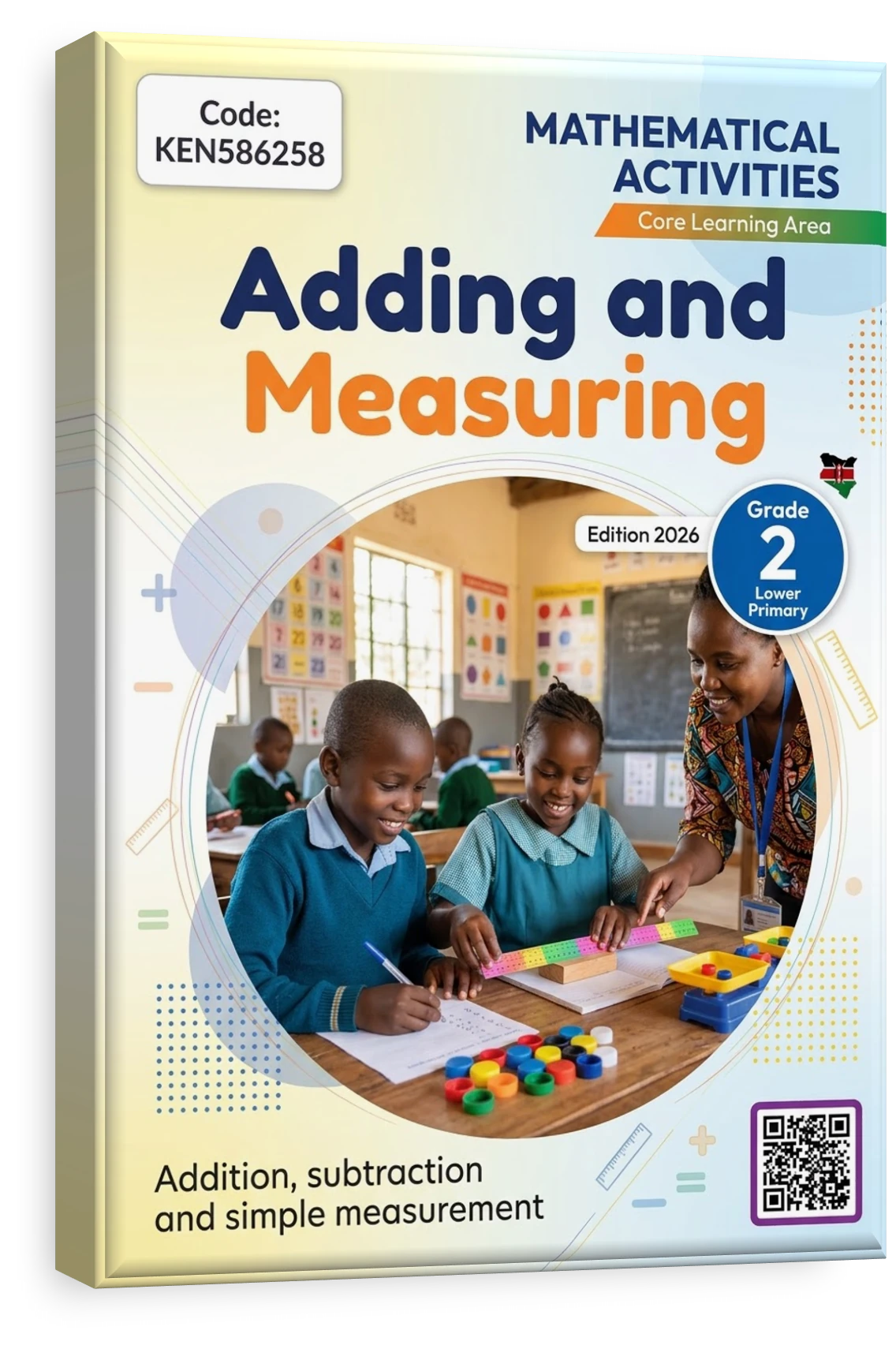
Adding and Measuring
Level: Grade 2 (Lower Primary) — Core Learning Area
Official Curriculum – Competency-Based Curriculum (CBC) – Kenya Institute of Curriculum Development (KICD).
PRELIMINARIES
1. Welcome to Grade Two Mathematics
Grade Two learners across Kenya move from simple counting toward real calculation, using numbers met daily at a village market or while sharing ugali and sukuma wiki with family at supper time. This book introduces addition, subtraction and measurement as connected skills, showing how a number problem traces back to something a child already sees or counts at home. Lesson objective: help learners view mathematics as a tool explaining ordinary Kenyan life, not an abstract subject confined to a chalkboard. Operational benefit: confident number sense built now supports later lessons in measurement and money.
2. Learning Through Objects and Practice
Learning addition, subtraction and measurement works best when a Grade Two classroom mixes explanation with hands-on practice, since seven-year-old learners still reason more confidently with real objects than with numbers alone on a page. Counters made from maize grains, bottle tops or small stones let every child model a sum before writing it down formally in an exercise book. Lesson objective: build a steady bridge from concrete counting toward written number work expected later. Operational benefit: learners who touch and move objects first make fewer errors once working purely with digits.
3. A Guide for Parents and Teachers
Parents and teachers share equal responsibility for a Grade Two learner’s progress in addition, subtraction and measurement, and this book offers guidance usable equally well beside a classroom chalkboard or a kitchen table in a rural or urban Kenyan home. Every activity names ordinary materials already available nearby, such as maize cobs, exercise books, a kitchen weighing scale or coins kept in a tin. Lesson objective: equip every caregiver, however busy, with clear steps requiring no special purchase or training. Operational benefit: steady practice across home and school closes gaps quickly between school terms.
Chapter I. Addition of Numbers up to 999
I.1 Adding Numbers without Renaming
Adding two-digit numbers without renaming begins this chapter, using everyday Kenyan quantities such as forty-three mangoes added to twenty-five groundnuts counted at a family stall near a village market. Knowledge taught lines ones under ones and tens under tens in a vertical column, adding each place separately before writing the total beneath a drawn line. Lesson objective: master place value by adding ones first, then tens, without carrying across columns. Operational benefit: learners build the exact habit required before tackling harder sums involving renaming in later lessons.
I.2 Adding Numbers with Renaming
Adding numbers that require renaming, sometimes called carrying, challenges learners once ones added together pass nine, forcing one extra ten to move into the tens column during a sum such as thirty-eight plus twenty-six. Knowledge presented shows learners to write the small carried ten above the tens column neatly before adding it into that column’s total. Lesson objective: practise renaming confidently using sums drawn from real quantities, such as eggs collected from hens kept near a rural homestead. Operational benefit: mastering carrying now prevents repeated errors once three-digit addition begins in later chapters.
I.3 Addition Word Problems in Daily Life
Addition word problems drawn from daily Kenyan life teach learners to decide when a situation calls for adding, such as counting total passengers after a matatu stops twice near a busy road junction to collect more riders. Knowledge taught guides learners to underline important numbers, write a matching number sentence, then solve it using column addition learned earlier. Lesson objective: connect addition skill to real reasoning about quantities changing in a story. Operational benefit: learners gain confidence solving problems appearing later in assessments and everyday life.
I.4 Checking Our Addition Answers
Checking an addition answer carefully prevents a small mistake from spoiling an entire calculation, so learners practise re-adding a sum from bottom to top after first solving it from top to bottom, catching errors made during a noisy lesson near an open classroom window. Knowledge taught also introduces estimating a rough total beforehand, comparing it against the exact answer to judge whether the final figure seems reasonable. Lesson objective: build a lasting habit of verification rather than trusting a first attempt blindly. Operational benefit: careful checkers lose fewer marks during timed classroom tests.
Chapter II. Subtraction of Numbers up to 999
II.1 Subtracting Numbers without Renaming
Subtracting two-digit numbers without renaming follows naturally once addition feels secure, using situations such as a shopkeeper near Kisumu selling thirty-six oranges from a basket holding fifty-nine at the start of a market morning. Knowledge taught arranges the larger number above the smaller one in columns, subtracting ones first and then tens, writing each remaining digit neatly beneath its line. Lesson objective: strengthen column subtraction technique before harder renaming sums are introduced. Operational benefit: learners build accuracy that supports every future money and measurement calculation.
II.2 Subtracting Numbers with Renaming
Subtracting numbers that require renaming, often called borrowing, happens whenever the ones digit on top is smaller than the ones digit being subtracted, such as in sixty-two minus thirty-seven, forcing one ten to be exchanged for ten extra ones. Knowledge presented shows learners to cross out a borrowed ten neatly, writing the new reduced tens figure above the column before completing the subtraction. Lesson objective: practise borrowing steadily using quantities like sacks of maize counted on a family farm near the Rift Valley. Operational benefit: confident borrowing prevents confusion once three-digit subtraction appears later.
II.3 Subtraction Word Problems in Daily Life
Subtraction word problems rooted in familiar Kenyan situations teach learners to notice language signalling a decrease, such as spent, remaining or sold, during a story about sukuma wiki bundles sold gradually from a roadside stall throughout a busy afternoon. Knowledge taught guides learners to write a clear number sentence from the story before solving it using the column method practised earlier in this chapter. Lesson objective: connect subtraction skill firmly to real reasoning about quantities decreasing over time. Operational benefit: learners read and solve story problems confidently during classroom assessments.
II.4 Relating Addition and Subtraction
Relating addition and subtraction helps learners see both operations as two sides of one idea, since any subtraction fact can be checked instantly by adding the answer back to the number subtracted, confirming that the original total near a family shamba returns correctly. Knowledge taught introduces fact families, grouping three related numbers such as twenty-four, sixteen and forty into both an addition and a subtraction sentence. Lesson objective: deepen number sense by practising fact families rather than memorising operations separately. Operational benefit: learners check their own work independently, building self-reliance and accuracy.
Chapter III. Measuring Length
III.1 Measuring Length with Non-Standard Units
Measuring length using non-standard units opens this chapter gently, asking learners to measure a classroom table or path using handspans, footsteps or sisal string before any ruler appears, much as farmers near Lake Victoria once paced out plots of land. Knowledge taught highlights why answers differ between a tall and a short learner measuring the same object, preparing ground for standard units. Lesson objective: discover the need for a fixed, agreed unit through honest comparison of differing results. Operational benefit: learners appreciate why standard units matter before memorising them.
III.2 Measuring Length in Metres and Centimetres
Measuring length in metres and centimetres introduces the standard ruler and the metre rule, tools learners use to measure a desk or the width of a classroom doorway with precise, repeatable results unlike earlier handspan guesses. Knowledge taught explains that one metre equals one hundred centimetres, practised by measuring a sisal rope cut to exactly one metre against a labelled metre rule. Lesson objective: read a ruler accurately in centimetres and relate small lengths to the larger metre unit. Operational benefit: learners measure classroom and home objects with confidence and correct units.
III.3 Comparing and Ordering Lengths
Comparing and ordering lengths teaches learners to arrange several measured objects, such as three sugarcane sticks cut at a family farm, from shortest to longest using recorded centimetre measurements rather than guesswork alone. Knowledge taught practises vocabulary including longer than, shorter than and equal to, applied consistently while learners record each measurement neatly inside a simple table drawn in an exercise book. Lesson objective: strengthen comparison skills using exact numbers rather than visual estimation only. Operational benefit: accurate ordering supports fair decisions, such as choosing the correct rope length for tying a bundle.
III.4 Length Word Problems
Length word problems bring measurement skill into believable Kenyan situations, such as calculating the total distance walked by a learner travelling three hundred metres from home to a bus stop near a matatu stage, then two hundred further metres to reach the school gate safely. Knowledge taught guides learners to add or subtract metre and centimetre measurements correctly within one story problem. Lesson objective: apply addition and subtraction skills learned earlier directly to everyday length situations. Operational benefit: learners plan safe, sensible routes and tasks using accurate measurement reasoning.
Chapter IV. Measuring Mass and Capacity
IV.1 Measuring Mass Using a Balance
Measuring mass using a simple balance introduces the idea that heavier objects press one side downward while lighter objects rise, demonstrated by balancing a bag of maize flour against several smaller stones gathered near a family compound. Knowledge taught lets learners predict which of two objects feels heavier before testing their guess directly on a classroom balance built from a stick and two tins. Lesson objective: connect physical experience of weight to the mathematical language of mass before introducing standard units. Operational benefit: learners reason sensibly about mass before memorising kilogram and gram figures.
IV.2 Measuring Mass in Kilograms and Grams
Measuring mass in kilograms and grams introduces the kitchen weighing scale found in many Kenyan homes and shops, used to weigh sugar, rice or sukuma wiki bundles sold near a busy roadside market. Knowledge taught explains that one kilogram equals one thousand grams, practised by weighing a one-kilogram packet of maize flour and comparing it against several smaller grocery items. Lesson objective: read a weighing scale correctly and relate grams sensibly to the larger kilogram unit. Operational benefit: learners estimate and check shopping quantities confidently using correct mass units.
IV.3 Measuring Capacity in Litres
Measuring capacity in litres teaches learners how much liquid a container such as a cooking pot or a water jerrycan can hold, a skill practised daily by families fetching water from a well, river or tap near many rural Kenyan homesteads. Knowledge taught explains that a litre is divided into one thousand millilitres, demonstrated by pouring water from a labelled one-litre bottle into smaller cups and counting how many fill. Lesson objective: connect litres and millilitres to familiar household containers. Operational benefit: learners judge water and food quantities accurately at home and school.
IV.4 Mass and Capacity Word Problems
Mass and capacity word problems combine earlier measurement skills with addition and subtraction, such as finding the total mass of two flour bags bought at a shop near Nakuru, or the litres of milk remaining after some is poured into cups for breakfast. Knowledge taught guides learners to identify the correct unit, write a matching number sentence, then solve it using methods practised earlier. Lesson objective: apply mass and capacity reasoning within realistic shopping and household stories. Operational benefit: learners manage family food and water resources with greater numerical confidence.
Chapter V. Time and Money
V.1 Telling Time to the Hour and Half Hour
Telling time to the hour and half hour introduces the analogue clock face, teaching learners to read the short hour hand and the long minute hand together, deciding whether school assembly begins at a whole hour or at half past, matching the bell heard across the compound each morning. Knowledge taught practises drawing clock hands correctly for given times before reading real classroom and home clocks aloud. Lesson objective: read and draw analogue time confidently to the nearest half hour. Operational benefit: learners arrive punctually for lessons, meals and family routines throughout each day.
V.2 Days, Weeks and Months
Days, weeks and months organise a learner’s calendar sense, naming the seven days from Monday through Sunday and counting how many weeks pass before a school holiday allows a visit to grandparents living near the Rift Valley or along the shores of Lake Victoria. Knowledge taught practises reading a simple wall calendar, circling important dates such as a market day, a church service or a national examination week. Lesson objective: build calendar reasoning connecting days, weeks and months into one ordered system. Operational benefit: learners plan ahead confidently for school and family events.
V.3 Identifying Kenyan Currency
Identifying Kenyan currency introduces the coins and notes used daily across the country, from the five-shilling and ten-shilling coins to the fifty, one hundred, two hundred, five hundred and one thousand shilling notes exchanged at any local market or shop. Knowledge taught lets learners sort real or photocopied currency by value, arranging pieces from smallest to largest while naming each one correctly in shillings. Lesson objective: recognise every common Kenyan coin and note confidently by sight and value. Operational benefit: learners handle pocket money and small errands with growing independence and care.
V.4 Adding and Subtracting Money
Adding and subtracting money applies earlier number skills directly to shopping, such as calculating the total cost of buying tomatoes for thirty shillings and sukuma wiki for twenty shillings at a stall near a busy matatu stage, then working out change expected from a one-hundred shilling note. Knowledge taught guides learners through writing a money number sentence before solving it using addition or subtraction methods practised earlier. Lesson objective: apply column methods accurately to real shilling and cent amounts. Operational benefit: learners shop sensibly and check change received without being cheated.
ANNEXES
A. Home Flashcard Practice Kit
A home practice kit built from flashcards made of cut cardboard helps a Grade Two learner rehearse addition and subtraction facts daily without needing any shop-bought material beyond scissors and a marker pen borrowed from an older sibling. Knowledge offered suggests writing one sum per card, shuffling the set weekly, and timing how quickly a learner answers ten cards correctly during evening practice at home. Lesson objective: build calculation speed and accuracy through short, repeated practice sessions outside school hours. Operational benefit: steady home drilling complements classroom teaching, strengthening number fact recall before examinations.
B. Making Simple Measuring Tools at Home
Making simple measuring tools at home costs little and reinforces every measurement lesson taught here, since a metre marked on sisal string, a balance built from a stick and two tins, or a labelled litre bottle all work as well as costly shop equipment. Knowledge offered explains how a parent or older sibling can construct each tool safely using materials found around a typical rural or urban Kenyan home. Lesson objective: extend classroom measurement practice into ordinary household activity. Operational benefit: regular home measuring sharpens accuracy and confidence shown later in school assessments.
C. Parent-Teacher Progress Checklist
A parent-teacher progress checklist tracks a Grade Two learner’s growing skill across addition, subtraction, measurement, time and money, noting small milestones such as confident column addition, accurate ruler reading or correct identification of Kenyan coins and notes. Knowledge structured into this simple format avoids heavy formal testing, favouring brief notes written weekly inside a notebook kept beside the classroom register or a kitchen calendar. Lesson objective: support continuous, low-pressure monitoring of progress across an entire school term. Operational benefit: caregivers notice genuine improvement clearly, celebrating steady growth in mathematical confidence.

Discussion (0)
Aucune intervention pour le moment. Soyez le premier à contribuer.
Votre intervention Annuler la réponse