
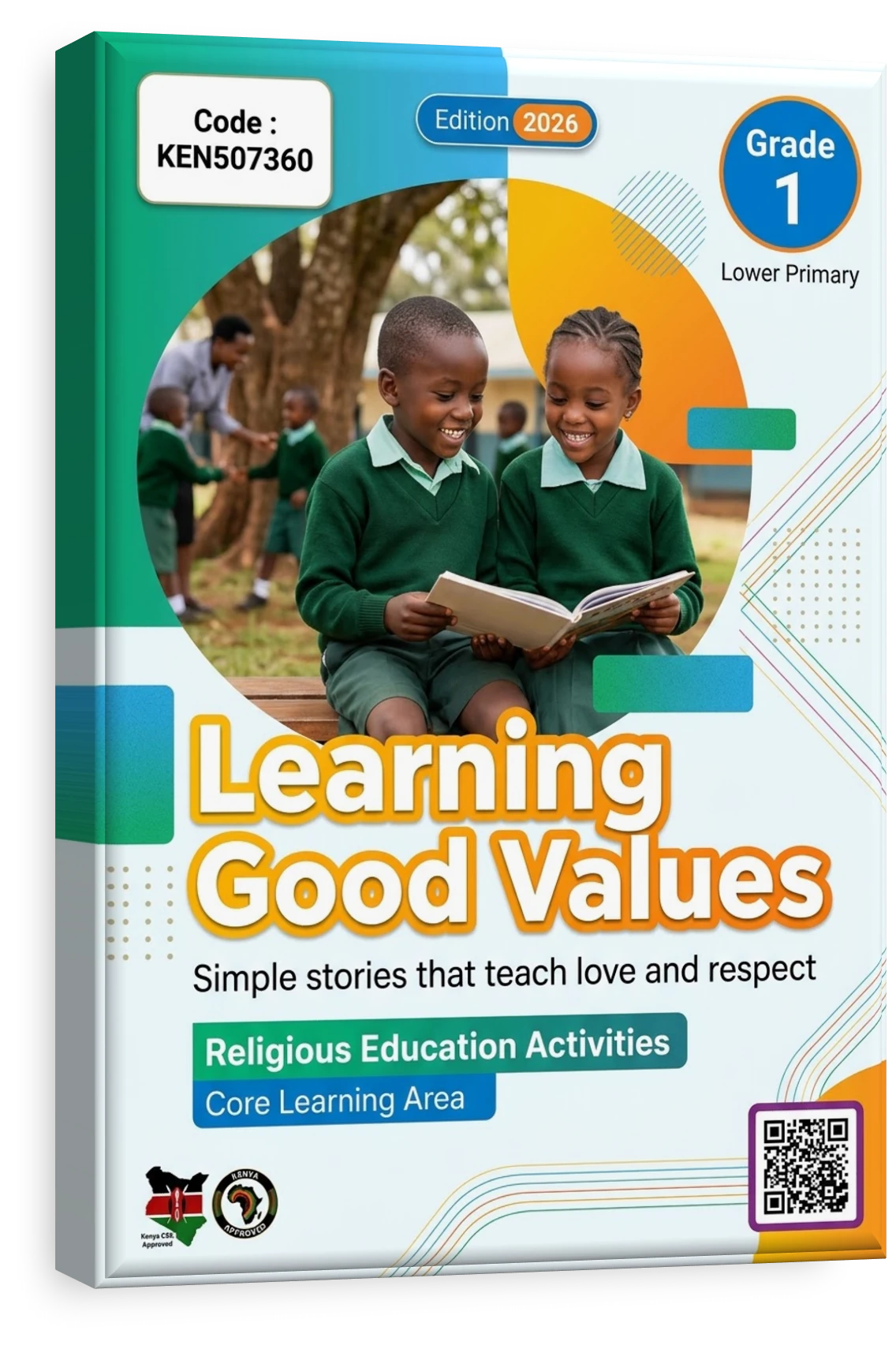
Learning Good Values
Level: Grade 1 (Lower Primary) — Core Learning Area
Official Curriculum – Competency-Based Curriculum (CBC) – Kenya Institute of Curriculum Development (KICD).
PRELIMINARIES
1. Welcome to Religious Education Activities in Grade One
Grade One learners across Kenya open Religious Education Activities by discovering that God’s love fills ordinary village life, from a homestead near Lake Victoria to a busy roadside market selling bananas and sukuma wiki. Knowledge introduced here presents God as a loving Creator and Father who watches over every family, whether living beside a shamba or near a matatu stop. Lesson objective: help learners recognise God’s goodness inside everyday moments at home and school. Operational benefit: a gentle start builds eagerness for stories, songs and values explored ahead.
2. Learning Values Through Stories and Play
Young children absorb values more readily through stories, songs and play than through long explanations, so lessons here hide ideas about love, honesty and sharing inside familiar Kenyan scenes like family meals, village gatherings and market visits. Knowledge offered blends simple Bible stories with role play, drawing and group singing, letting learners act out kindness rather than merely hearing it described. Lesson objective: introduce playful, story-based methods matching a six-year-old’s attention span and curiosity. Operational benefit: values practised through enjoyable activity are remembered and repeated long after the lesson ends.
3. A Guide for Parents and Teachers
Parents and teachers share equal duty in nurturing a Grade One learner’s character, so this guide offers simple instructions usable beside a classroom chalkboard or a kitchen table, whether in town or village near the Rift Valley. Knowledge presented names ordinary moments, washing hands before eating ugali, greeting elders politely, waiting safely near a matatu stop, as natural settings for teaching values. Lesson objective: equip every caregiver with practical tools regardless of resources. Operational benefit: consistent guidance at home and school reinforces the same good values daily.
Chapter I. God Our Creator and His Wonderful World
I.1 God Created the Heavens and the Earth
Grade One learners begin the creation story by hearing how God made the sky, the sun, the rain and the earth, including landscapes they recognise such as Lake Victoria’s waters and the green slopes of the Rift Valley. Knowledge taught walks learners through each day of creation using simple words and pictures, pausing so children can name things God made that they see around their own home. Lesson objective: build early appreciation for God as Creator through familiar scenery. Operational benefit: learners connect faith confidently to the world they know.
I.2 God Created Plants and Animals
Maize growing in a shamba, goats grazing near a village path and fish swimming within Lake Victoria become living evidence that God filled the earth with plants and animals for every family’s benefit. Knowledge presented encourages learners to name plants and animals seen at home or market, then discuss how each provides food, like sukuma wiki, milk or eggs, for daily meals. Lesson objective: deepen gratitude for creation through observation within the learner’s own community. Operational benefit: children learn to value and protect living things that sustain families.
I.3 God Created People in His Image
Every learner, whether living beside Lake Victoria, within a busy Nairobi estate or along a quiet Rift Valley farm, hears that God created each person specially, giving every child worth and dignity regardless of background or ability. Knowledge taught uses gentle mirror and partner activities, inviting learners to notice differences and similarities among classmates while affirming that each person remains precious to God. Lesson objective: build early self-worth and respect for others through simple reflection. Operational benefit: learners carry confidence and kindness into friendships and classroom teamwork.
I.4 Caring for God’s Creation
Since God entrusted people with caring for plants, animals, rivers and land, Grade One learners practise small acts of responsibility, such as not littering near a market, planting a seedling at school or keeping a compound near Lake Victoria tidy. Knowledge delivered connects caring for creation to hygiene habits already taught, like washing hands and covering food, protecting both health and environment. Lesson objective: introduce simple stewardship practices learners can repeat at home and school. Operational benefit: children grow into responsible citizens who protect Kenya’s land, water and creatures.
Chapter II. Belonging to a Loving Family
II.1 My Family is a Gift from God
Every Grade One learner belongs to a family God designed specially, whether a large extended household gathered in a village compound or a smaller family sharing one room near a busy matatu stop. Knowledge presented invites learners to draw their own family and name each member aloud, discussing warmly how God placed them together to love and support one another. Lesson objective: help learners appreciate their family structure without comparing it to classmates’ families. Operational benefit: children develop secure identity and gratitude for the relatives who care for them.
II.2 Love Within the Family
Family love shows itself through small daily actions familiar to every Kenyan household: a mother preparing ugali and sukuma wiki after a long day, an older sibling walking a younger one past a matatu stop, grandparents sharing stories beside the evening fire. Knowledge taught names such ordinary acts as real expressions of love, helping learners notice love already present rather than imagining it as distant. Lesson objective: strengthen recognition of love expressed through service and shared mealtimes. Operational benefit: learners begin imitating these loving actions at home.
II.3 Roles and Responsibilities at Home
Every family member, including a young Grade One learner, carries small responsibilities that keep a household running smoothly, whether sweeping a compound, fetching water near a village well or helping arrange vegetables bought from the local market. Knowledge delivered discusses age-appropriate chores learners can manage safely, linking each small task to the wider value of caring for one’s family through willing cooperation. Lesson objective: encourage learners to accept simple home responsibilities cheerfully. Operational benefit: children build early discipline and belonging through meaningful participation in family life.
II.4 Respecting Parents and Elders
Respect for parents, grandparents and elders remains a value cherished across Kenyan communities, shown through greeting an elder politely at the market, listening attentively during instruction and obeying reasonable household rules without arguing. Knowledge taught practises greetings, polite listening and simple obedience scenarios through role play, helping learners rehearse respectful behaviour before facing it in real family situations near home. Lesson objective: build consistent habits of respectful speech and action toward elders. Operational benefit: respectful children enjoy stronger family bonds and wider community trust.
Chapter III. Learning to Love and Share
III.1 Loving God and Loving Others
Building on earlier lessons about creation and family, learners now connect loving God with loving the people met daily, classmates at school, neighbours near a village path and strangers encountered briefly at a busy local market. Knowledge presented introduces the teaching that love for God shows itself through kindness toward others, illustrated through short relatable scenes drawn from everyday Kenyan community life. Lesson objective: help learners understand love as both a feeling and a practical action. Operational benefit: children begin treating classmates and family members with greater patience and warmth.
III.2 Sharing with Friends and Neighbours
Sharing a mandazi, a pencil or a seat on a crowded school bench teaches generosity more effectively than any lecture, especially when learners practise sharing repeatedly during guided classroom games and snack times through the week. Knowledge taught uses real sharing moments, splitting fruit bought at a village market or offering sukuma wiki from one’s own plate, to show generosity as a value lived, not merely discussed. Lesson objective: build consistent sharing habits through supervised practice among classmates. Operational benefit: generous learners build friendships easily and strengthen classroom harmony.
III.3 Helping Those in Need
Noticing a classmate without lunch, an elderly neighbour struggling to carry water or a stranded traveller near a matatu stop teaches learners that helping others forms a central part of good values lived daily in any Kenyan community. Knowledge delivered presents safe ways a six-year-old can help, fetching water, informing a teacher or sharing a snack, without placing the child at risk. Lesson objective: cultivate compassionate awareness of others’ needs suited to the learner’s age. Operational benefit: children grow into caring community members who respond kindly to need.
III.4 Forgiveness and Kindness
Disagreements inevitably arise between young learners sharing a classroom or a crowded village compound, so this lesson teaches forgiveness as saying sorry sincerely, accepting an apology graciously and choosing kindness again rather than holding a grudge against a friend. Knowledge taught uses short conflict scenarios familiar from playground life, a borrowed toy broken or a turn missed during a game, practised through guided role play. Lesson objective: build early conflict-resolution skills grounded in forgiveness and renewed kindness. Operational benefit: forgiving learners maintain happier friendships and a calmer classroom.
Chapter IV. Growing in Good Values Every Day
IV.1 Obedience at Home and School
Obedience protects a young learner’s safety, whether following a parent’s instruction to wash hands before eating ugali, a teacher’s direction during a fire drill or a guardian’s warning about waiting carefully near a busy matatu stop before crossing. Knowledge presented explains obedience as trusting those who love and protect a child, distinguishing it clearly from blind fear through warm, reassuring classroom discussion. Lesson objective: help learners understand obedience as trust and safety, not mere control. Operational benefit: obedient learners stay safer at home, at school and on the road.
IV.2 Telling the Truth Always
Telling the truth, even when admitting a mistake such as spilling water fetched from a village well or losing a borrowed pencil, builds character far more valuable than any short-term advantage gained through lying to a parent or teacher. Knowledge taught uses gentle storytelling and puppet scenarios to show how honesty, though sometimes uncomfortable, earns lasting trust from family, classmates and teachers. Lesson objective: encourage learners to choose honest speech through supportive, non-punitive practice. Operational benefit: honest learners build reputations of trustworthiness valued throughout school and family life.
IV.3 Being Patient and Thankful
Waiting one’s turn at a busy local market stall, standing patiently in a queue near a matatu stop or sharing limited classroom materials teaches patience, while naming daily blessings such as food, family and friends teaches gratitude side by side. Knowledge delivered pairs these two values deliberately, showing learners that patience often makes space for noticing blessings easily missed when rushing or complaining. Lesson objective: cultivate patience and thankfulness through daily practice and reflection. Operational benefit: patient, grateful learners cope calmly with everyday waiting and sharing situations.
IV.4 Prayer in Our Daily Life
Simple prayer said quietly before meals of ugali and sukuma wiki, upon waking in a village home or before beginning lessons at school introduces learners to communicating with God as a natural, comforting daily habit rather than a formal or distant ritual. Knowledge presented offers short, memorable prayers suited to a six-year-old’s vocabulary, practised together through repetition until learners recite them confidently and calmly. Lesson objective: build a simple, consistent prayer habit for early childhood. Operational benefit: learners gain a comforting routine connecting faith to ordinary family life.
Chapter V. Bible Stories that Teach Us Values
V.1 The Story of Creation Retold
Returning to the creation story once more, learners now retell it in their own words, using drawings of Lake Victoria, the Rift Valley hills or a familiar village compound to represent what God made during each remembered day. Knowledge reviewed strengthens memory of earlier lessons while building early storytelling confidence, as learners stand before classmates to narrate a favourite part of the creation account. Lesson objective: consolidate creation knowledge through learner-led retelling and illustration. Operational benefit: confident storytelling strengthens both faith understanding and public-speaking skill.
V.2 Noah’s Ark and Trusting God
The story of Noah building a great ark before heavy rains flooded the earth teaches learners about trusting God’s instructions even when neighbours doubt or mock, illustrated through simple drama using cut-out animals and a model boat built from cardboard. Knowledge taught links Noah’s patient obedience to situations familiar at home, continuing a task faithfully even when it feels slow, such as finishing chores before playing. Lesson objective: introduce trust and perseverance through a dramatised Bible narrative. Operational benefit: learners gain an early model of faithful obedience under difficulty.
V.3 Baby Moses and God’s Care
Baby Moses hidden safely in a basket among river reeds, then found and cared for by a kind family, shows learners that God protects the vulnerable through ordinary people willing to help, much as neighbours near a village river might rescue a stranded child. Knowledge delivered uses this gentle story to discuss safety and kindness toward babies and younger siblings, and trust that care arrives during difficult moments. Lesson objective: build empathy and awareness of protective care through a well-loved story. Operational benefit: learners develop compassion toward younger, vulnerable children.
V.4 Celebrating What We Have Learnt
Gathering for a joyful closing celebration, perhaps sharing roasted maize or mandazi from a nearby market, learners recall favourite stories and values explored across this textbook, from creation and family love through sharing, honesty and prayerful trust in God. Knowledge reviewed consolidates the year’s Religious Education content through informal demonstration, singing and short sharing rather than formal written testing unsuitable for Grade One. Lesson objective: assess growth gently through joyful recall of values learnt. Operational benefit: learners leave the year confident and eager to keep practising good values.
ANNEXES
A. Guide for Parents on Nurturing Values at Home
Parents extend classroom lessons by weaving values into routines familiar at home, reminding a child to share food fairly, greet elders respectfully near the village path and wait patiently beside a matatu stop rather than pushing ahead of others. Knowledge offered lists simple, low-cost suggestions requiring no special materials beyond consistent words and example, such as praying together before meals of ugali and sukuma wiki. Lesson objective: equip busy caregivers with practical, repeatable ways to reinforce lessons at home. Operational benefit: consistent home practice deepens every value taught in class.
B. Simple Prayers and Bible Verses for Grade One
A short collection of simple prayers and memorable Bible phrases, suited to a six-year-old’s limited vocabulary, gives teachers and parents ready material for opening lessons, morning assembly or quiet bedtime moments shared within any Kenyan home. Knowledge gathered here favours short, rhythmic wording easily memorised through repetition, chosen to match themes already covered across creation, family, sharing and trust explored throughout this textbook. Lesson objective: provide accessible devotional material requiring no further research from busy teachers. Operational benefit: regular recitation builds comforting routine and reinforces core values memorably.
C. Teacher’s Assessment and Values Checklist
A simple observation checklist helps teachers track each learner’s growing understanding of creation, family, sharing, honesty, obedience and prayer throughout the term, noting small milestones such as retelling a Bible story confidently or sharing willingly without prompting during snack time. Knowledge structured into this format avoids formal written examinations, since Grade One assessment favours gentle, continuous observation recorded inside a teacher’s notebook kept near the chalkboard. Lesson objective: support fair, developmentally appropriate assessment suited to early Religious Education learning. Operational benefit: teachers identify struggling learners early, offering timely extra support.
Discussion (0)
Aucune intervention pour le moment. Soyez le premier à contribuer.
Votre intervention Annuler la réponse