
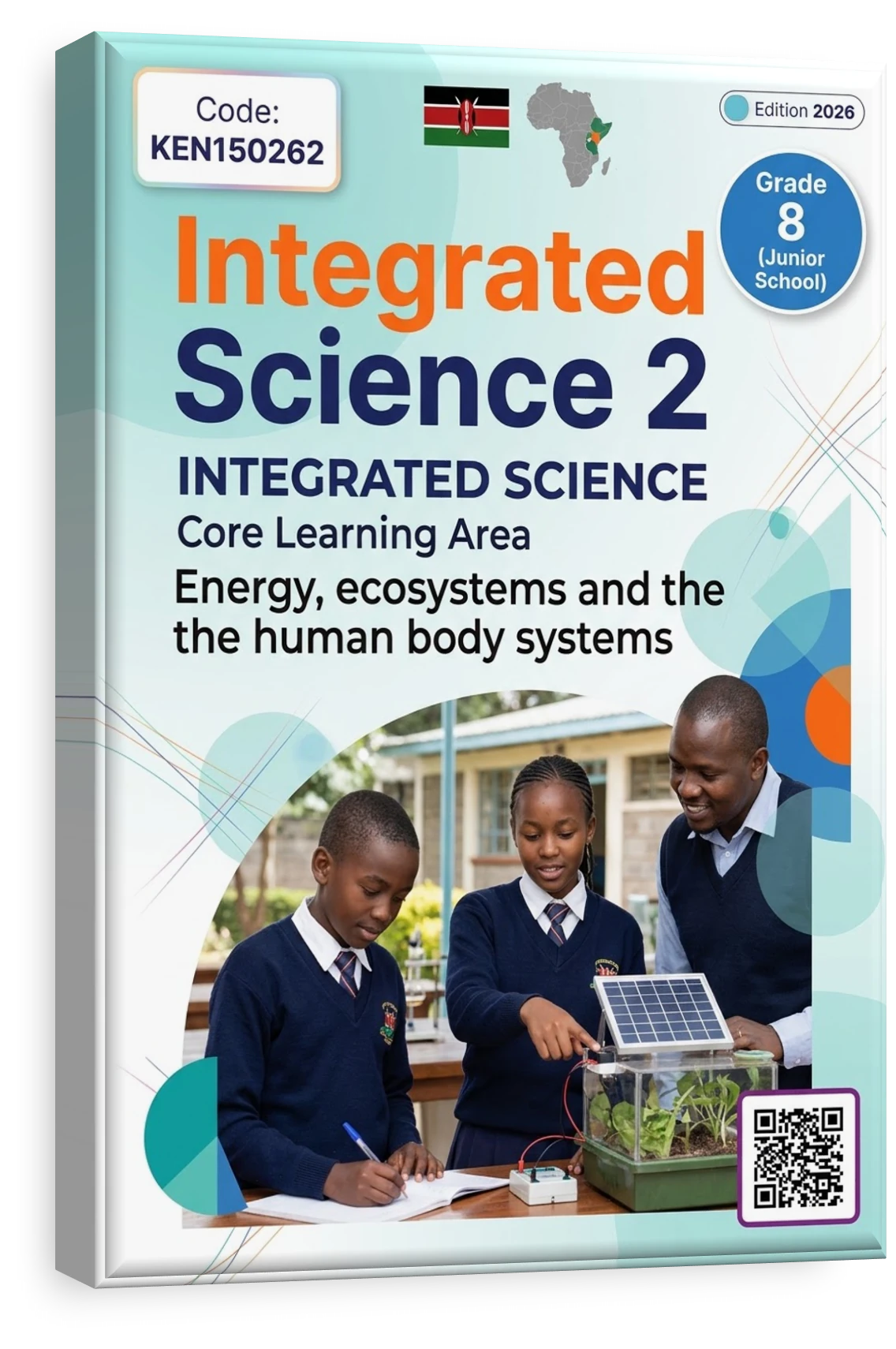
Integrated Science 2
Level: Grade 8 (Junior School) — Core Learning Area
Official Curriculum – Competency-Based Curriculum (CBC) – Kenya Institute of Curriculum Development (KICD).
PRELIMINARIES
1. Why Science Explains Your Own Backyard
A matatu stalls in the Likoni ferry queue and the conductor blames « bad fuel » without knowing why. Grade 8 Integrated Science answers exactly that kind of question: what is inside the fuel, inside a mosquito net, inside a DAP fertiliser bag from an Eldoret agrovet. Energy, matter and living things are not separate shelves in a textbook. They are the same forces deciding whether a harvest survives a dry spell, or a pump keeps running on a hot afternoon.
2. How Every Chapter Works: Problem, Idea, Trial, Skill
Each chapter opens on a real situation from Kenyan life, a stalled engine, a shrinking forest, a sick goat, something a learner could actually meet on the way home. The next section names the science behind it precisely, with its correct terms and figures. A short investigation or build follows, using sticks, tins, water or soil rather than imported kits. The chapter closes on the skill now in the learner’s hands and one place it already applies outside school.
3. Teaching Grade 8 Science With Forty Learners and One Beaker
One beaker, no electricity some afternoons, and forty names on the register: that is the honest starting point for many classrooms, not a shortage to apologise for. Group work of six, one set of materials shared on a rota, and demonstrations done once at the front while others sketch and predict keep a lesson moving without equipment for everyone. Parents without any science background still help by asking a learner to explain the day’s idea out loud, in Kiswahili.
Chapter I. Sorting Sembe from Stones
I.1 The Miller’s Sieve and the Bag of Maize
A posho mill in Eldoret jams twice in one morning because small stones travelled in with the maize from the store. The owner wants to clean the grain fast without picking out each stone by hand, and wonders whether the same trick would work on a bucket of river water cloudy with silt. Both problems come down to one question Grade 8 learners now get to answer properly: how do you pull apart things that are mixed but not joined?
I.2 Mixtures, Elements and the Names Science Gives Them
A mixture keeps the separate identities of its parts, which is why maize, stones and husks can always be told apart again, unlike a compound such as water, where hydrogen and oxygen have reacted into something new. Elements are the single substances nothing simpler can be chemically split into; compounds and mixtures are built from them. Knowing which one you are holding, a pure substance, a compound, or a mixture, decides which separation method will actually work.
I.3 A Bench Trial: Sand, Salt and Iron Filings
Working safely in pairs, goggles on, hair tied back, sleeves rolled, learners mix sand, table salt and iron filings in a jar, then plan how to pull each one out again. A magnet lifts the iron filings cleanly. Water dissolves the salt, which filtration then separates from the sand; gentle evaporation over a low flame, never left unattended, recovers the salt as dry crystals. Every step is recorded with what went wrong before it went right.
I.4 The Skill That Follows You Home
Choosing filtration over evaporation, or a magnet over a sieve, is no longer guesswork once the properties behind each method are clear: particle size, solubility, magnetism, density. That judgement travels straight into daily life, boiling and filtering drinking water drawn from an unprotected spring, sieving stones from flour before ugali is cooked, or picking plastic out of compost before it reaches the shamba.
Chapter II. Light Without Kerosene
II.1 A Household Choosing Between Two Lamps
A family in a Nakuru estate weighs a kerosene lamp costing fifty shillings a week in fuel against a solar lantern bought once for eight hundred shillings. One burns and smokes; the other sits in the sun all day and lights the room for free that night. Deciding well means knowing what each lamp is actually doing with energy, where that energy came from, and why one of the two choices eventually pays for itself.
II.2 Forms of Energy and Where Kenya Gets Its Power
Energy shows up as heat, light, sound, kinetic, chemical, and electrical forms, each able to change into another without ever being created or destroyed. Kenya’s grid draws on sources that are renewable, geothermal steam at Olkaria, wind turbines at Lake Turkana, falling water at the Seven Forks dams, and non-renewable ones such as imported diesel burned in backup generators. A solar lantern simply stores sunlight as chemical energy, then releases it as light on demand.
II.3 Building and Testing a Tiny Solar Circuit
Working in groups of six around one small solar panel, an LED, and wires, learners connect the circuit in sunlight, in shade, and under a cloth, timing how brightly the LED glows in each case and recording the pattern on a shared chart. A second trial swaps the solar panel for a dry cell to compare steady output against the sun’s changing supply. Every reading is logged before learners discuss why the two power sources behaved so differently.
II.4 Reading an Energy Bill Like a Scientist
Once a learner can name where household energy comes from and how it converts, an electricity token receipt or a charcoal sack stops being just a cost and becomes evidence: units bought, units likely used, and where waste is hiding, a bulb left on, a phone charger drawing power with nothing plugged in. That reading skill helps a family choose, with real numbers, between kerosene, charcoal, solar and the grid.
Chapter III. The Boda Boda’s Gear Change
III.1 Why a Rider Drops Gear on Kiambu Road
Climbing the steep stretch of Kiambu Road, a boda boda rider drops to a lower gear long before the engine strains, trading speed for pulling power. Passengers often ask why slowing down the wheel makes the climb easier rather than harder. The honest answer involves force, distance and a machine hidden inside the gearbox, the very idea Grade 8 learners are about to unpack with levers and pulleys instead of an engine.
III.2 Simple Machines, Mechanical Advantage and Friction
A lever, pulley, wheel and axle, or inclined plane all do the same basic job: they change the size or direction of a force so a smaller effort can move a larger load, at the cost of moving through a greater distance. Mechanical advantage measures exactly how much easier the task becomes. Friction, meanwhile, quietly eats part of every effort as heat, which is why a rusty pulley or a dry gearbox always feels harder to turn.
III.3 Lifting a Water Bucket With a Homemade Pulley
Using a rope slung over a smooth stick fixed between two posts, learners lift a ten-litre bucket of water first by hand, then through the pulley, recording the force needed on a simple spring scale each time. A second trial adds a second pulley to build a block-and-tackle and compares the effort again. Results go onto a shared table before the class argues out loud why the numbers changed the way they did.
III.4 Choosing the Right Machine for the Job
Knowing that a longer lever arm, a pulley system, or a gear ratio each trade distance for force in a predictable way turns heavy work into a design problem rather than a matter of strength. That thinking shows up directly at a borehole where a pulley eases the rope, on a farm where a wheelbarrow balances a load over its wheel, and on any hill where the right gear saves a rider’s knees and fuel.
Chapter IV. The Lake That Feeds a Region
IV.1 Fewer Fish, More Weed on Lake Victoria
Fishermen near Kisumu are pulling up smaller catches of Nile perch and tilapia each season, while thick mats of water hyacinth choke the landing bays and tangle their nets. Something in the lake’s community of plants, fish, insects and microscopic algae has shifted out of balance, and nobody can fix what they cannot first explain. Grade 8 learners now have the tools to trace exactly how energy and nutrients move through a system like this one.
IV.2 Producers, Consumers and the Ten Percent Rule
A food chain begins with producers such as algae and water hyacinth, which capture the sun’s energy, and moves through consumers that eat them, herbivorous fish, then predators such as Nile perch, before decomposers break down what remains. At every step, roughly ninety percent of the energy is lost as heat or waste, so only about a tenth passes to the next level, which is exactly why top predators are always the scarcest organisms in any ecosystem.
IV.3 Mapping a Food Web Behind the School
Around the school compound or a nearby pond, learners spend a lesson listing every organism they can find, from grass and algae to ants, frogs, birds and spiders, then draw arrows showing who eats whom until a tangled food web appears on the board. Removing one organism from the diagram and tracing what happens next turns the drawing into a working model rather than a static picture, revealing effects nobody expected on the first try.
IV.4 Explaining Why the Lake Changed
Tracing the web this way explains, in terms a fisherman can test against what he actually sees, why fertiliser runoff feeding extra algae and hyacinth starves other species of oxygen and light further down the chain, leaving fewer fish for every net cast. The same reasoning explains a sudden locust surge, a crash in frog numbers after a pond is filled in, or why planting trees upstream can change a river’s fish population years later.
Chapter V. A Forest in Retreat
V.1 A River That Used to Run All Year
Elders around the Mau escarpment remember streams that never dried, even in a hot February; many of those same streams now stop flowing by July. Charcoal burning, farms creeping uphill, and tea estates expanding have all eaten into forest that once held rainwater in its soil and released it slowly. Grade 8 learners are asked to work out what, precisely, a forest was doing hydrologically that a cleared hillside no longer does.
V.2 Deforestation, Pollution and the Idea of a Catchment
A forest catchment slows rainwater, lets it soak into soil and feed springs gradually instead of rushing straight into rivers as silty flood water. Clearing trees, draining wetlands, and dumping plastic or untreated waste into rivers such as the Nairobi River all break that slow-release system in different ways. Conservation responses include gazetting forest boundaries, planting buffer strips along riverbanks, and building wetlands that filter water before it reaches a lake or dam.
V.3 A School Compound Waste and Water Audit
Over one week, learners count and sort the rubbish collected around the compound into plastic, paper, organic and other waste, weighing each category, while a second team tests the clarity and smell of water from the nearest tap, tank or stream. Comparing results against a neighbouring class’s compound turns a cleanup exercise into real data collection, with totals, percentages and a short written conclusion about where the school’s biggest environmental problem actually lies.
V.4 Turning Findings Into a Small Conservation Plan
Armed with an actual waste breakdown or water reading rather than a guess, a class can propose one specific fix: a compost pit for organic waste, a rule against burning plastic, or a planted buffer strip along a compound drain. That same habit, measure first, then act, is what a family uses when deciding whether to plant trees on a steep plot, fence off a spring, or simply stop throwing sachets into the nearest ditch.
Chapter VI. Feeding the Shamba, Feeding the Family
VI.1 Maize That Grew Tall but Yielded Little
A farmer in Kakamega did everything by the calendar, planting with the first rains and weeding on time, yet the maize grew tall, pale, and produced thin, half-filled cobs. Fertiliser prices have pushed a full bag of DAP beyond many smallholders’ reach this season, so simply buying more is not always an option. Grade 8 learners take on the real question behind the disappointing harvest: what, exactly, was the soil failing to supply?
VI.2 Photosynthesis, Soil Nutrients and a Balanced Plate
Photosynthesis lets a plant build its own sugars from carbon dioxide, water and sunlight, but growth also needs nitrogen, phosphorus and potassium drawn from the soil for leaves, roots and seeds respectively, which is exactly what DAP and CAN fertilisers supply when soil runs short. Human nutrition mirrors this logic: a plate of ugali, sukuma wiki, beans and a little fish supplies carbohydrates, vitamins, protein and minerals together, and missing any one group shows up in the body eventually.
VI.3 Testing Soil and Planning a School Lunch
One group builds a simple compost heap from maize stalks and kitchen peelings, testing its rising heat with a stick over two weeks as a sign of active decomposition, while another group prices a balanced lunch for the class using only foods sold at the local market within a fixed budget of fifty shillings per learner. Both groups present numbers, not opinions, on what their soil or their menu was actually missing before any fix was applied.
VI.4 From Compost Heap to Family Harvest
Reading a plant’s pale leaves or a child’s swollen belly as a nutrient deficiency, rather than bad luck, turns farming and feeding into problems with traceable causes and affordable fixes: a compost heap instead of a costly fertiliser sack, a handful of groundnuts added to a meal instead of extra ugali. That same reading carries straight home, to a family shamba or a kitchen deciding what goes into tomorrow’s pot.
Chapter VII. One Body, Many Systems
VII.1 A Week of Stomach Upsets in Kibera
During one rainy week in a crowded Kibera estate, three children from the same compound fall sick with stomach pain and watery stools after the shared water point runs low and families fetch from a nearby stream instead. A community health volunteer wants a clear answer for worried parents: how does dirty water actually make a body sick, and which organs are involved between the mouth and the symptoms everyone can see?
VII.2 How Digestion, Breathing and Circulation Work Together
Food broken down by the digestive system releases nutrients that the circulatory system carries, in blood pumped by the heart, to every cell in the body, while the respiratory system supplies the oxygen those cells need to release energy from that food. Pathogens such as cholera bacteria hijack this same chain, entering through contaminated water, damaging the gut lining, and triggering the diarrhoea that drains the body of the fluid and salts its systems depend on.
VII.3 Feeling Your Own Systems at Work
Learners count their own pulse at rest, then again straight after running on the spot for one minute, charting how heart rate and breathing both rise together to deliver more oxygen to working muscles. A second activity builds a simple model gut from a stocking and mashed banana, squeezing it along its length to show peristalsis in action. Both activities make invisible organ systems something a learner has actually watched, timed and felt.
VII.4 Advice a Learner Can Actually Give at Home
Able to trace a symptom back to the system behind it, a learner can explain to a worried family why boiling drinking water for one minute, washing hands before meals, and treating diarrhoea with oral rehydration salts rather than simply resting matters far more than it first sounds. That same explaining skill, naming cause and effect inside the body instead of guessing, is the one Grade 8 Integrated Science is really handing over.
ANNEXES
A. Glossary and Safety Card, in English and Kiswahili
This two-page card lists forty key terms from the book, mixture (mchanganyiko), ecosystem (mfumo wa ikolojia), energy (nguvu), photosynthesis (usanisinuru), circulatory system (mfumo wa mzunguko wa damu), each with a one-line Kiswahili gloss a learner can say aloud at home. The reverse side carries six non-negotiable lab rules: goggles for heating, no tasting unknown substances, hair tied back, reporting every spill, and the two steps for a burn or a splash in the eye.
B. A Family Science Log for Home Investigations
Across eight weeks, this log gives one short home task per chapter: timing how fast a solar lantern charges on a cloudy versus a sunny day, or counting a family member’s pulse after a short walk, with space for one sentence on what surprised the learner. A matching one-page rubric lets a teacher mark each entry out of four marks for accuracy, honesty, and clear reasoning rather than tidy handwriting.
C. Formula Sheet and Project Record Book
One side lists every quantity introduced in the book in its correct unit, mechanical advantage as load over effort, energy in joules, nutrient ratios for fertiliser bags such as 18:46:0 for DAP, with a worked example for each. The record book half gives one page per chapter investigation, headed Problem, Method, Result, Conclusion, so that by December a learner holds a complete, dated logbook of every mixture separated, machine tested, and system explored across the year.

Discussion (0)
Aucune intervention pour le moment. Soyez le premier à contribuer.
Votre intervention Annuler la réponse