
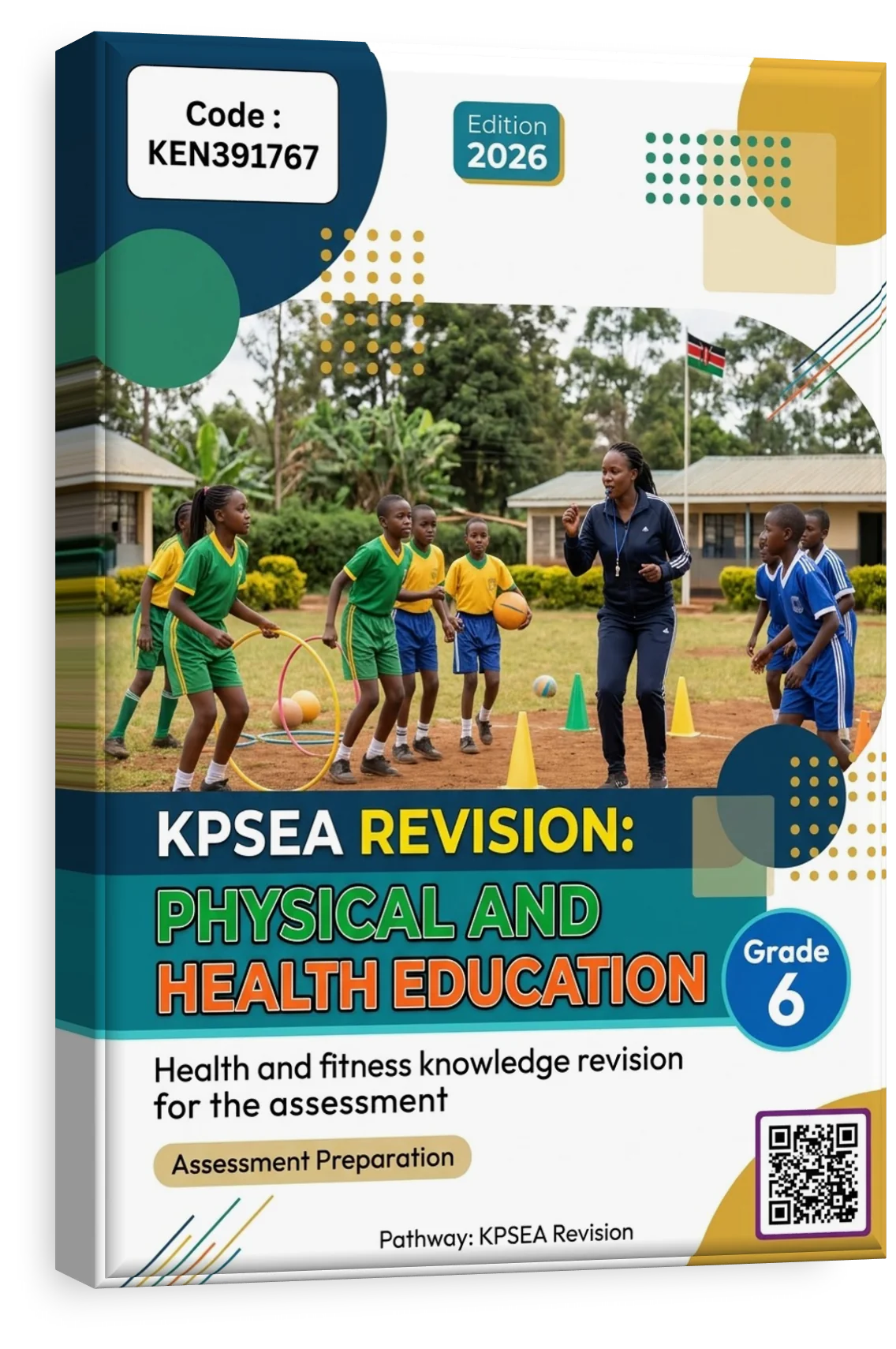
KPSEA Revision: Physical and Health Education
Level: Grade 6 (KPSEA) — KPSEA Revision
Official Curriculum – Competency-Based Curriculum (CBC) – Kenya Institute of Curriculum Development (KICD).
PRELIMINARIES
1. The Days Nakuru School Lost to Diarrhoea
When a diarrhoea outbreak swept a Standard Six class in Nakuru last rainy season, over half the pupils missed a full week of lessons. Amina had not: she washed her hands with soap before every meal, a habit her Physical and Health Education lessons had drilled into reflex. She then taught her little brother the same routine at home. That is what this subject is really for — keeping a Kenyan child well enough to learn, not only fit enough to run.
2. How This Book Breathes: Question, Idea, Try It, Own It
Every chapter in this book moves through the same four beats: a real problem, the idea that explains it, a hands-on try, and a skill kept for life. KPSEA questions work the same way — a short scenario first, then a question testing one fact or skill. Reading a chapter from start to finish is, in effect, rehearsing how the exam itself is built, scenario by scenario, answer by answer.
3. Big Classes, Few Balls: What a Teacher and a Parent Can Still Do
Eighty pupils and one netball is normal in many Kenyan upper-primary classrooms, so this book assumes nothing extra on hand. Stones for markers, sacks for relay bags, a rope for skipping: each activity names a free substitute. At home, a parent need not buy equipment either — fetching water at a steady jog, sweeping a compound, or walking an errand to a Huduma Centre already trains the same muscles and habits this subject is built on.
Chapter I. Warming Up Without Waiting for an Injury
I.1 The Ankle That Gave Way at Nanyuki
At a Nanyuki primary school sports day, a sprinter rolled her ankle before the gun even fired — she had gone straight from the classroom to the start line, muscles cold and stiff. The injury kept her out of every race that term. A warm-up is not a formality coaches invented to waste time; it raises muscle temperature and heart rate so joints move safely under sudden strain. Skipping it is how a promising morning ends on crutches.
I.2 Four Things a Fit Body Needs
Physical fitness is not one quality but four working together: strength to push and lift, speed to cover ground fast, endurance to keep going without tiring, and flexibility to bend and stretch without strain. A sprinter needs speed most, a long-distance runner needs endurance, a gymnast needs flexibility above all. Knowing which component a game demands lets a learner train smartly instead of just running laps until exhausted for no clear reason.
I.3 Ten Minutes on the Nyahururu School Field
Ten minutes before any game at a Nyahururu primary school now start the same way: a slow jog around the field, arm circles, high knees, then two short sprints to raise the pulse. A partner checks the time with a borrowed phone and counts pulse beats at the wrist for fifteen seconds. Comparing the number before and after the routine turns an abstract idea — heart rate — into something a ten-year-old can feel and count.
I.4 Carrying Firewood Like an Athlete in Embu
In Embu, a girl who fetches firewood every evening already trains the same muscles a games teacher would ask for: legs for the climb, back for the load, lungs for the distance. Once she understands warm-up and the four fitness components, that daily chore becomes a measured habit — she stretches first, paces herself on the slope, and notices her breathing easing within weeks. A real skill now has a name, and she owns it.
Chapter II. Running the Kerio Valley Way
II.1 Why Iten Produces Champions
Iten, a small town in Elgeyo-Marakwet, has sent more world-class distance runners to global podiums than most entire countries. Altitude explains part of it, but so does something a Grade Six learner can copy: a disciplined daily pattern of easy runs, strict rest and correct running form. Watching how a Kerio Valley athlete lands on the midfoot rather than the heel raises a real question — what exactly makes one runner faster than another?
II.2 Sprints, Distance, Jumps and Throws
Athletics groups events into four families. Sprints cover short distances at full speed; endurance races test pace held over longer ground; jumps — long jump, high jump — turn a run-up into measured height or distance; throws — javelin, discus, shot put — need technique as much as strength. Each event is scored differently: by time, by distance, or by height, which is exactly why a stopwatch and a tape measure matter so much on any school field.
II.3 The Stopwatch Never Lies in Kapsabet
At Kapsabet, a town known for producing champion runners, school coaches time every sprint to the tenth of a second and record it in a notebook kept for years. A Grade Six class can copy the method with one borrowed phone: four pupils sprint sixty metres in turn, times are written down, then the whole class practises passing a relay baton without breaking stride. The baton exchange, done badly, costs more time than running slower ever would.
II.4 Selected for the Kasarani National Games
Three months after that first timed sprint, the fastest pupil from the class earns a place at the county trials, then at the national primary school games held at Kasarani Stadium in Nairobi. Thousands of athletes from every county compete there each year. Winning a heat is no longer about raw talent alone — it rewards the pupil who warmed up properly, understood pace, and practised the baton exchange until it became automatic under pressure.
Chapter III. Fair Play on the Bungoma Pitch
III.1 The Foul Nobody Agreed On in Bungoma
During an inter-school match in Bungoma’s sugar belt, a striker went down inside the box and both teams argued for ten minutes about whether it was a foul or a dive. Neither coach could settle it because neither had actually read the rule being argued over. A game without agreed, understood rules stops being sport and becomes a shouting match — which is exactly the problem this chapter sets out to solve, one rule at a time.
III.2 Who Can Touch the Ball, and Where
Football, netball and volleyball each limit who may touch the ball and where on the court. A footballer may not use hands inside the field of play except as goalkeeper in the box; a netball player cannot step with the ball or hold it longer than three seconds; a volleyball side gets only three touches before sending it back over the net. Learning one rule at a time, sport by sport, replaces guessing with knowing.
III.3 Three-a-Side Practice in Mumias
A disused sugarcane weighing yard outside a Mumias primary school now hosts three-a-side practice every Friday: small teams, a small pitch, more touches of the ball per pupil than a full eleven-a-side match ever allows. Passing drills focus on one skill at a time — inside-foot passing, then first touch, then a give-and-go. Shrinking the game does not shrink the learning; it concentrates it, which is exactly why PE lessons favour small-sided football over full matches.
III.4 The Whistle That Settled a Busia Derby
Across the border at Busia, a friendly match between two primary schools nearly ended in a walkout when a goal was disallowed for offside. The referee, a Grade Six teacher who had studied the rule properly, explained it calmly: a player level with or behind the last defender is not offside, however close the ball seems. Fair play survived because someone actually knew the rule rather than just shouting the loudest about it.
Chapter IV. Finding Balance Without Fear
IV.1 The Roll Nobody Wanted to Try in Machakos
On the hard, dusty ground outside a Machakos classroom, no one wanted to go first when the teacher called for a forward roll — everyone pictured a scraped neck and a bruised back. Fear, not weakness, was stopping the class. Gymnastics asks a body to trust itself in unfamiliar positions, upside down and off balance, which is precisely why it frightens beginners more than running ever does. The real question becomes: how is that trust built safely?
IV.2 Tucking, Rolling, Balancing: the Grammar of Gymnastics
Gymnastics breaks down into a small set of building blocks: tucking the chin and chest to protect the spine, rolling along a rounded back rather than the bony parts, and balancing on a narrow base with the eyes fixed on one still point. Each movement has a correct shape before it has speed or flair. A learner who masters the tuck first removes the one mistake — a straight back — that causes almost every gymnastics injury in a classroom.
IV.3 A Spotter’s Hands in a Makueni Classroom
In a Makueni classroom cleared of desks, pupils work in pairs: one rolls, one spots, a steady hand ready near the shoulder in case balance fails. The spotter’s job is not to catch a fall but to soften the worst of it and to build the roller’s confidence enough to commit fully to the movement. Swapping roles every few turns teaches both halves of the skill — control of one’s own body, and responsibility for someone else’s safety.
IV.4 A Harambee Display Under the Kajiado Sky
By the end of term, what began as a reluctant forward roll becomes a short sequence — roll, balance, roll again — performed outdoors under the open Kajiado sky at a harambee fundraiser for new sports mats. Parents who contribute coins and cattle feed watch their own children move with a control nobody expected in April. The skill owned by the end of this chapter is not a trick; it is calm, deliberate control of one’s own body.
Chapter V. What Is Really on the Plate
V.1 Tired Before Break Time in Mathare
By mid-morning, a pupil in a Mathare classroom is yawning, restless and unable to concentrate on simple sums — breakfast that day was tea with nothing solid in it. Hunger, not laziness, is often the real cause of a flat performance in the second lesson of the day. A school feeding programme helps, but so does knowing which foods actually hold energy through a long morning rather than burning off within the hour after a sugary cup of tea.
V.2 Energy, Body-Building and Protective Foods
Kenyan food, sorted by what it does for the body, falls into three groups. Energy foods such as ugali, rice and chapati fuel movement and concentration. Body-building foods such as beans, eggs, milk and fish repair muscle and help a child grow. Protective foods — sukuma wiki, mangoes, carrots — fight off illness and keep skin and eyes healthy. A balanced plate borrows a little from each group rather than filling up on only one.
V.3 Pricing a Balanced Plate with Homa Bay Omena
Dried omena from the shores near Homa Bay sells for a fraction of the price of beef, yet delivers protein a growing body needs just as well. Pricing out a week’s balanced meals — ugali, omena, sukuma wiki, a banana — against the cost of meat every day shows a family how to eat well without overspending. The exercise turns nutrition from a poster on the wall into arithmetic a household budget actually has to solve.
V.4 A New Shopping List for a Meru Kitchen
Armed with the three food groups, a Meru household rewrites its weekly shopping list: arrowroots and bananas from the shamba for energy, beans and milk for growth, managu and avocado already growing nearby for protection. Nothing on the new list costs more than what was bought before — it is simply chosen with a reason now instead of habit. A plate that once held only ugali and tea now tells a small story about balance.
Chapter VI. Catching the Mosquito Before It Bites
VI.1 Fever Season Again in Migori
Every year after the long rains, clinics near the lake in Migori fill with children shivering under blankets despite the heat — fever, headache, and a test that confirms malaria almost every time. The mosquito responsible breeds in water no deeper than a bottle cap, left standing for just over a week. Before learning any cure, a Grade Six class needs to answer a sharper question first: where exactly is that water hiding around their own compound?
VI.2 Malaria, Cholera, Bilharzia: Knowing the Enemy
Three diseases common in Kenya share one lesson: know the cause, break the chain. Malaria spreads through an infected Anopheles mosquito’s bite; cholera through water or food contaminated with an infected person’s waste; bilharzia through bathing or wading in water holding a particular freshwater snail. Each has one matching prevention — sleeping under a treated net, boiling or treating drinking water, avoiding stagnant ponds — turning a frightening list of killers into a short, manageable checklist.
VI.3 Bandaging a Cut the Isiolo Way
A Red Cross volunteer visiting an Isiolo primary school demonstrates first aid on a volunteer’s arm: clean the wound with safe water first, never soil or ash despite what grandmothers sometimes still recommend, then cover it with a clean cloth and bandage firmly but not so tight that fingers turn pale. Pupils practise the same three steps on each other with strips of old cotton cloth until the sequence — clean, cover, check — becomes automatic rather than panicked.
VI.4 Boiling Water Before Breakfast in Marsabit
In Marsabit, where water often travels a long distance before reaching a jerrican, a family now boils it for a full minute or treats it with chlorine tablets before anyone drinks, cooks or brushes their teeth with it. That single habit, learned from this chapter, cuts the risk of cholera and diarrhoea dramatically for very little cost. Heading into the KPSEA paper, a learner who can explain why water must be treated has mastered more than one mark’s worth of health.
ANNEXES
A. Fifty Words Every PHE Learner Should Own
This glossary gathers the exact words a KPSEA paper expects a learner to recognise, each paired with its Kiswahili equivalent for revision at home: endurance (uvumilivu), hygiene (usafi), malaria (malaria), bilharzia (kichocho), first aid (huduma ya kwanza), balanced diet (lishe bora), offside (nje ya mchezo), warm-up (joto la mwili). A learner who can define a term in either language, out loud and without hesitating, is ready for the vocabulary half of any exam question on this subject.
B. A Stone-and-Sack Sports Kit for Home
This sheet lists a week of PHE practice using only what an ordinary home already owns: four stones as relay markers, a maize sack stuffed with rags as a soft gymnastics roll, a skipping rope twisted from old strips of cloth, and a jerrican of water measured out for a hygiene demonstration. Each day names one skill from the book to repeat at home and a simple way for a parent to confirm, by watching, that it was done correctly.
C. Twelve Questions Shaped Like the KPSEA Paper
Twelve practice questions here copy the KPSEA’s own style: a short scenario first, one clear question after it, covering fitness, athletics rules, game rules, gymnastics safety, food groups and disease prevention in the same proportions the real paper uses. A mark scheme beside each question shows exactly which word or fact earns the point, so a learner revising alone at home can self-mark honestly and discover which chapter of this book still needs another read before the exam.
Discussion (0)
Aucune intervention pour le moment. Soyez le premier à contribuer.
Votre intervention Annuler la réponse