
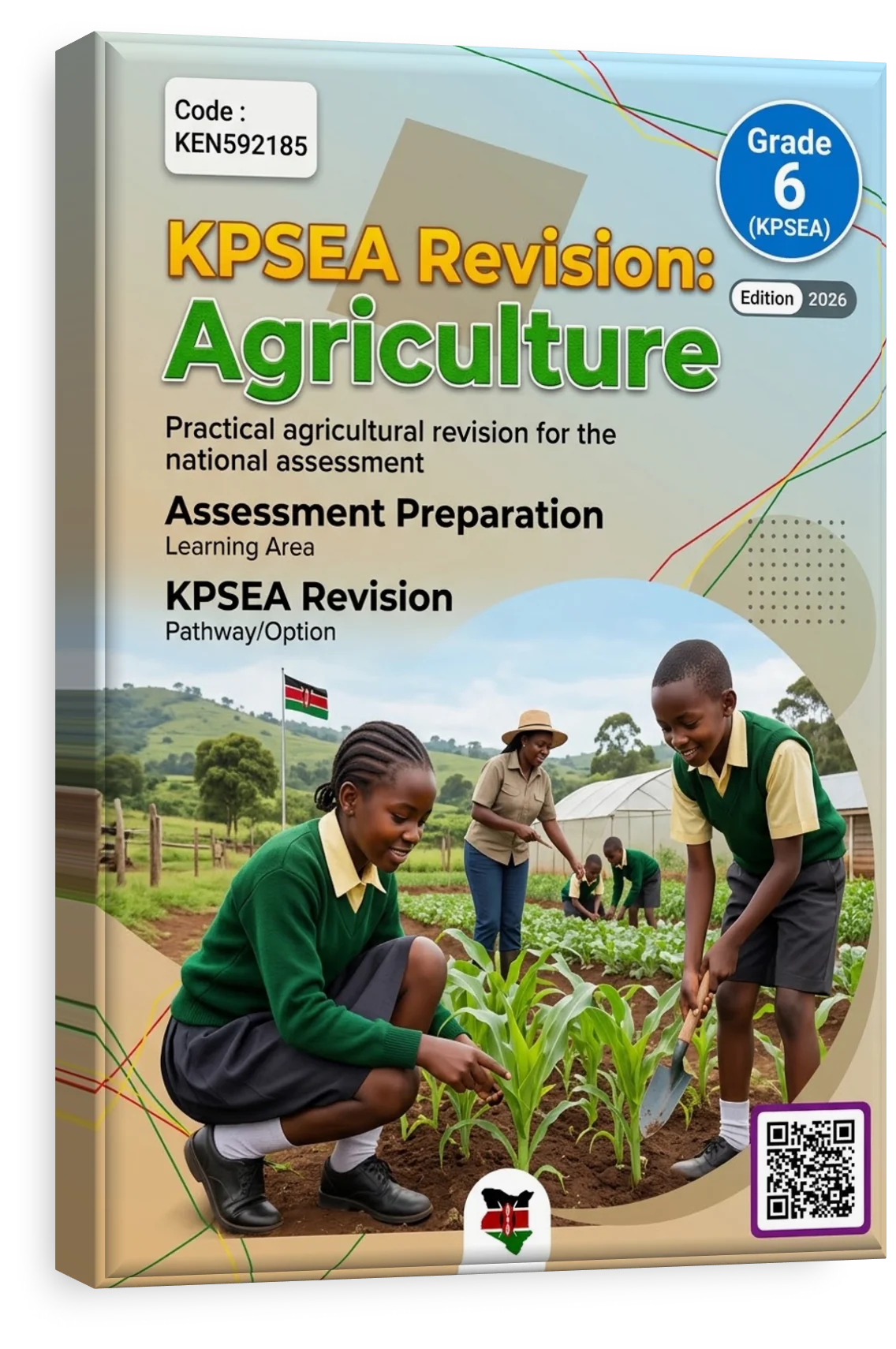
KPSEA Revision: Agriculture
Level: Grade 6 (KPSEA) — KPSEA Revision
Official Curriculum – Competency-Based Curriculum (CBC) – Kenya Institute of Curriculum Development (KICD).
PRELIMINARIES
1. Why a Handful of Soil Decides a Family’s Year
In Murang’a, a family’s school fees, milk money and harvest depend on decisions made on the shamba months earlier. Agriculture for a Grade 6 learner is not a subject closed at the school gate; it is the maize store at home, the cow in the shed, the coffee cherries counted at the factory weighbridge. Understanding soil, seeds and animals means reading the household budget itself. This book revises exactly what the Kenya Primary School Education Assessment expects, built from problems a real Kenyan farm already sets each season.
2. Four Steps Through Every Chapter, Shamba to Store
Every chapter walks the same path a real farm task follows. First, a problem lands on a Kenyan farm and raises a question nobody can skip. Second, the notion behind it is explained with exact figures and names, nothing vague. Third, a hands-on exercise, often using a stick, a jar or a tape measure, tests the idea where a classroom or school garden allows it. Fourth, the fix is named and tied back to a skill the pupil now owns for the KPSEA paper and for home.
3. Seventy Pupils, One Hoe: Teaching Agriculture Without a Lab
Near Marsabit, a Grade 6 classroom of seventy shares three jembes and no fenced garden plot. Agriculture still works at that scale: group pupils around one soil sample instead of needing one each, use a drawn diagram where a live animal is impossible, and let a single home shamba stand in for a class demonstration. Parents without a farming background can still help by asking a child to explain, out loud, what a term like top-dressing means before the KPSEA revision week arrives.
Chapter I. Reading the Soil Before It Washes Away
I.1 A River of Topsoil Leaving a Kitui Field
After one heavy storm, a Kitui farmer finds brown water running off his maize field, carrying the darkest, richest soil downhill with it. His neighbour’s terraced plot next door loses almost nothing. Why does bare, sloping ground give up its best layer so easily, while a few earth ridges stop the same rain cold? The answer decides whether next season’s crop has anything left to grow in, and it opens the whole study of soil and land.
I.2 Sand, Clay and Loam: What Each Handful Holds
Soil is not one thing. Sandy soil drains fast but holds little water or plant food; clay holds water and nutrients tightly but turns hard and sticky when wet; loam, a careful mix of sand, clay and silt, drains well while still feeding roots. Each type also carries humus, the dark decayed matter that feeds crops, plus air spaces roots need to breathe. Knowing which type lies under a given shamba decides which crop, and which conservation method, will actually work there.
I.3 The Jam-Jar Test That Sorts a Soil Sample
A clear jam jar, water and a handful of soil from three different spots settle the argument fast. Shake the jar, let it stand overnight, and the soil separates into layers: sand sinks first, then silt, then clay floats last on top. Measuring each layer with a ruler tells a pupil the exact proportions in that sample. Washing hands afterwards and keeping the jar away from food matters as much as the result, since safe handling is part of every soil exercise.
I.4 Terraces That Turned Machakos Hillsides Green Again
Decades ago, bare Machakos hillsides lost so much soil that the land looked close to ruin. Farmers who dug fanya juu terraces and contour bunds along the slopes, trapping rainwater and soil behind each ridge, turned the same hills productive again within a generation. The method is simple enough for a school garden slope: a ridge built across, not down, the gradient. The skill carried out of this chapter is choosing the right conservation structure before the first heavy rain, not after the damage.
Chapter II. From Seed to Shamba Row
II.1 Rice Seedlings Planted Too Close in Mwea
A new farmer in Mwea transplants rice seedlings almost touching each other, hoping a crowded paddy means a bigger harvest. By flowering time the stems compete for light and nutrients, and the grain fills poorly. Spaced correctly, the same paddy yields noticeably more rice from fewer plants. What looked like generosity toward the crop turned out to be its biggest handicap, and the question becomes exactly how much space each seedling genuinely needs to thrive.
II.2 Spacing, Seed Rate and the Maths of a Row
Maize is commonly planted at about 75 centimetres between rows and 25 centimetres between plants, giving roughly two seeds per hole after thinning. Beans need far less room, closer to 50 by 10 centimetres. Seed rate, the amount of seed needed per acre, follows directly from that spacing: wider gaps mean fewer kilograms bought at the agrovet. Getting these numbers right before planting saves money and avoids a crowded, underfed row later in the season.
II.3 Measuring a Trial Bed With String and Stick
Two beds dug side by side in the school garden settle the spacing question without guesswork. One bed follows the correct 75 by 25 centimetre maize spacing, measured out with a string stretched between pegs and a stick cut to length. The other is planted close together, as a careless farmer might. Both receive the same water and weeding, and a notebook records plant height weekly until the difference becomes obvious to the whole class.
II.4 Counting the Extra Cobs a Correct Row Produces
Weeks later the two trial beds tell their own story: the correctly spaced maize stands taller, with fuller cobs and fewer stunted plants, while the crowded bed shows yellowing leaves and thin, half-filled ears. Counting and weighing the harvest from each bed turns the comparison into a number a pupil can defend on paper. The skill now owned is choosing spacing by calculation, not habit, and explaining in one sentence why crowding a crop costs more than it saves.
Chapter III. The Cow, the Hen and the Record Book
III.1 A Nyandarua Zero-Grazing Unit’s Falling Milk Can
A Nyandarua dairy farmer’s zero-grazing unit once filled a twenty-litre can every evening; lately the can barely reaches halfway. The cow looks healthy, the shed is clean, yet the milk keeps dropping. Nothing about her care has obviously changed, which is exactly what makes the puzzle worth solving. Finding the cause, rather than guessing, means looking closely at what the animal eats, drinks and is fed, and when.
III.2 Breeds, Feeds and the Chicken That Lays Less Often
Friesian and Ayrshire cattle are bred for high milk yield but need reliable feeding, mainly napier grass plus dairy meal, to perform. A kienyeji hen lays fewer, smaller eggs than an exotic layer but survives on scraps and free range with little input. Matching breed to feed and housing is the whole decision a farmer makes before buying any animal. Choosing a demanding breed without the feed to support it explains more falling milk cans and thin hens than any disease ever does.
III.3 A Week of Napier Grass, Weighed and Recorded
A simple scale and a notebook turn guesswork into evidence. Weighing the napier grass cut and fed to one cow each morning and evening for a full week, then noting the milk collected daily, lets a pupil line the two numbers up side by side. A sudden thin week of fodder often lines up with a thin week of milk a few days later. Keeping that record, not memory alone, is the habit this exercise is really teaching.
III.4 A Vaccination Date That Saved the Whole Flock
When Newcastle disease reaches a village, unvaccinated kienyeji flocks can be wiped out within days while a vaccinated neighbour’s hens keep laying. Marking vaccination dates on a wall calendar, rather than trusting memory, is the difference between the two outcomes. The same discipline applies to deworming cattle and treating ticks before the rains bring an outbreak. The skill this chapter leaves behind is treating an animal health calendar as seriously as a school timetable.
Chapter IV. Trees, Water and the Energy They Save
IV.1 A Dry Season That Emptied a Makueni Water Pan
By August, a Makueni family’s hand-dug water pan, full after the long rains, has shrunk to a muddy puddle, and the shamba nearby is wilting. Nothing fell as rain for weeks, yet a neighbour with a bigger, lined pan and a row of shade trees around it still has water left. The difference lies in how the pan was built and what was planted near it, and that difference is worth tracing step by step.
IV.2 Catching Rain, Planting Grevillea, Naming the Benefit
A water pan lined with clay or plastic loses far less to seepage than a bare-earth one, and a roof catchment tank adds still more stored litres for free rainfall. Grevillea and the drought-hardy Melia volkensii, both common on Kitui and Makueni farms, cut wind, add shade and drop leaves that build soil, all while their roots hold the slope together. Agroforestry is simply growing the right tree alongside the right crop, each helping the other survive the dry months.
IV.3 Building a Model Water Pan on a School Slope
A scaled model, dug a metre wide in a corner of the school compound and lined with a sheet of plastic, shows how a real water pan traps run-off instead of losing it downhill. Marking the water level with a stick after each rain, and comparing it with an unlined control pit dug nearby, turns an abstract idea into a measurable fact. Spacing tree seedlings around the model at a sensible distance completes the same lesson in miniature.
IV.4 A Nyeri Biogas Digester Fed by the Cowshed
A dairy farmer outside Nyeri feeds cow dung and water into a sealed digester tank daily; within weeks it produces enough gas to cook the family’s meals without buying charcoal. The same dung that once sat as waste beside the shed now pays for itself twice, first as manure for the shamba, then as fuel for the kitchen. The skill carried forward is seeing water, trees and farm waste as resources to manage together, not separate problems.
Chapter V. The Thief in the Grain Store
V.1 Weevil Holes in a Trans Nzoia Maize Sack
A Trans Nzoia farmer opens a maize sack stored since harvest and finds small round holes through half the kernels, with a fine grey dust settled at the bottom. Nothing looked wrong on the day it was bagged. Three months later, a fifth of that harvest is unfit to sell or eat. Working out how an invisible pest did that much damage, and how it could have been stopped, is the problem this chapter sets out to solve.
V.2 Pests, Diseases and the Logic of Early Drying
Grain weevils and the larger grain borer breed fastest in maize stored above about 13 percent moisture, which is why proper drying before bagging matters more than any chemical added afterwards. Fall armyworm attacks the standing crop instead, chewing leaves and burrowing into the cob, and needs early spotting rather than late spraying. Maize streak virus, spread by leafhoppers, stunts whole patches of a field. Each threat has its own season, its own sign, and its own window for action.
V.3 The Salt Bottle That Tells a Grain’s Moisture
A handful of dry table salt sealed in a bottle with a maize sample gives a rough but useful moisture reading: if the salt clumps or sticks to the glass within minutes, the grain is still too wet to store safely. Checking a sample from each sack this way, before it goes into the store, costs nothing but a few minutes and an empty bottle. Inspecting kernels for weevil holes at the same time catches a second problem early.
V.4 A Harvest Saved Instead of Sold at a Loss
A farmer who dries maize to the right moisture, stores it in a hermetic PICS bag and checks it monthly for pest damage keeps nearly the whole harvest intact until prices rise later in the year. The same grain left loose in a damp store can lose a fifth of its value to weevils within a season. The skill now owned is treating storage as part of growing the crop, worth as much planning as planting ever was.
Chapter VI. Selling What the Shamba Grows
VI.1 Middleman or Sacco: A Homa Bay Market Dilemma
A Homa Bay fisherman and farmer is offered cash on the spot by a middleman at half the going market price, or a slower, fairer payment through his local cooperative sacco once the catch and produce are sold on. Choosing fast cash over fair value is tempting when school fees are due tomorrow. Working through both options with real shillings on paper is the only way to see which choice actually protects a family’s income over a full season.
VI.2 Value Addition From a Kilifi Cashew Shelling Table
Raw cashew nuts sold straight off a Kilifi tree fetch far less per kilogram than the same nuts shelled, roasted and packed for a shop shelf. The extra work, done by hand at a simple table with a basic cracking tool, is what economists call value addition, and it applies just as well to drying fruit or grinding grain into flour at home. Recognising which step in a crop’s journey from farm to shelf adds the most value is a skill with lifelong use.
VI.3 A Mock Stall Where Profit Is Worked Out in KES
A classroom mock market stall, stocked with priced cards for seed, fertiliser, labour and a final selling price in KES, forces a straightforward calculation: total cost subtracted from total sales equals profit, or loss. Running the numbers for a harambee-funded group project, rather than an individual farmer, shows how shared costs and shared returns work in a chama or cooperative. The exercise ends only when every pupil can show their working on paper, not just a final figure.
VI.4 What Food Security Means on a Grade 6 Exam
Food security means a household having enough safe, nutritious food available and affordable all year, not only at harvest time. A county growing one crop alone risks hunger if that single harvest fails, which is why mixed farming, proper storage and a working market link all matter together, not separately. Across this book, soil, crops, animals, trees, pests and selling have each played a part in that one idea, which is exactly how the KPSEA paper is likely to tie them together.
ANNEXES
A. A Farm Glossary in English and Kiswahili, Tools Included
This glossary lists forty key terms from every chapter side by side in English and Kiswahili: shamba for farm, mbolea for fertiliser, mifugo for livestock, kuhifadhi for storage, and more. A short safety sheet sits beside it, covering how to hold a jembe or panga, wash hands after handling soil or dung, and store any chemical away from food and children. A pupil stuck on a KPSEA term can check both lists in under a minute before moving on.
B. A Home Shamba Task and Its Marking Rubric
This sheet sends each pupil home with one small task: measure and record the spacing of three plants in a home shamba or a neighbour’s, or weigh a week’s fodder for any animal kept at home, whichever applies. A parent signs to confirm the measurement was taken, not assumed. The attached rubric scores accuracy of the measurement, clarity of the written record and one sentence explaining why the result matters, out of ten marks in total.
C. KPSEA-Style Agriculture Questions, Answered and Explained
Twelve practice questions, matched to the Kenya Primary School Education Assessment format, cover soil types, spacing calculations, animal feeding, pest identification and simple profit sums, each with a full worked answer rather than a bare correct letter. A question on terracing, for instance, asks a pupil to explain why a ridge built across a slope stops erosion better than one built down it. Marking notes beside each answer show exactly which word or figure a KPSEA examiner expects to see.



Discussion (0)
Aucune intervention pour le moment. Soyez le premier à contribuer.
Votre intervention Annuler la réponse