
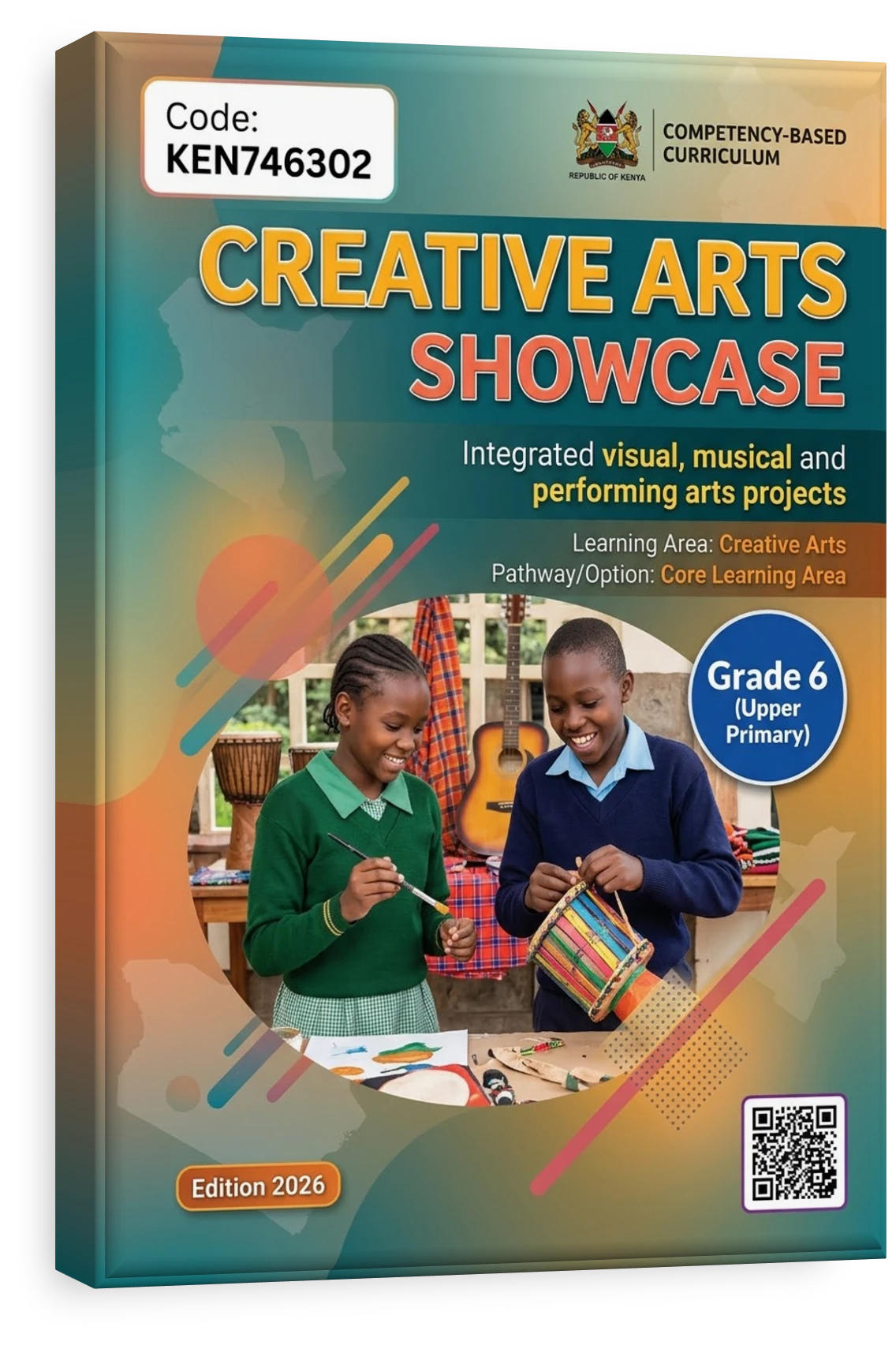
Creative Arts Showcase
Level: Grade 6 (Upper Primary) — Core Learning Area
Official Curriculum – Competency-Based Curriculum (CBC) – Kenya Institute of Curriculum Development (KICD).
PRELIMINARIES
1. Why a Grade 6 Classroom Needs Paint, Song and a Stage
At dawn on Lake Bogoria, flamingos lift off the shoreline in a wash of pink that no camera can hold. A Grade 6 learner who sketches that colour for the school’s harambee calendar is doing exactly what this subject is for: turning a Kenyan sight, sound or story into something others can see, hear or watch. Creative Arts is not decoration tacked onto real learning; by Grade 6 it is a way of thinking that mathematics and language also need.
2. The Four-Step Rhythm Behind Every Chapter
Open any chapter here and the same four beats repeat, like a drumline: a real problem to notice, the idea that explains it, a hands-on task with whatever is lying around – bottle tops, kitenge offcuts, an old sufuria – and finally a result the learner can show someone at home. Nothing here demands a shop-bought art kit or a music room. A stick in the dust, a voice, a body in space: that is enough equipment to start, and the book builds from there.
3. What a Teacher Facing Seventy Learners Can Actually Do
In a classroom outside Isiolo with seventy learners and no art cupboard, Creative Arts still works if it is planned in small stations: one group paints with crushed charcoal and water, another claps a rhythm, a third rehearses two lines of a skit. Parents at home can keep the momentum going with almost nothing – a call-and-response song while fetching water, a drawing on a flattened cardboard box. Marking should reward effort and a finished attempt over perfect technique every single time.
Chapter I. Looking, Shaping and Colouring the World Around You
I.1 A Blank Gate and a Harambee Deadline
The school gate in Kajiado needs repainting before Saturday’s harambee, and the head teacher wants it to look like it belongs to the Maasai families who are paying for it. Red, white and blue beadwork patterns from the market stalls nearby offer a ready answer, but copying them onto a flat wall raises a real question: how do you turn a necklace’s pattern into something that works at gate size, seen from a moving vehicle rather than held in the hand?
I.2 Line, Shape, Colour and Pattern, Named Precisely
Every image, however simple, is built from five tools: line (straight, curved, broken), shape (flat, geometric or organic), colour (warm or cool, mixed from three primaries), texture (how a surface looks like it would feel) and pattern (a motif repeated with a rule). A Kisii soapstone carver uses exactly these when deciding where a smooth curve meets a rough, chiselled edge. Naming each tool before using it means a learner can explain a choice, not just guess at one.
I.3 Dyeing Cloth with Cashew Apple from Kilifi
Kilifi’s cashew orchards drop ripe apples that most families discard, yet their juice stains cloth a deep reddish brown that does not wash out easily. Boiling the pulp, straining it and dipping folded cotton squares into the dye turns a farm leftover into a printing exercise: tie sections tightly with sisal string before dipping, and the untouched parts stay pale while the rest darkens. Comparing five squares tied five different ways shows pattern-making as a decision, not an accident, long before anyone touches a shop-bought dye.
I.4 Designing the Cover for the Nakuru County Show Programme
Every year the Nakuru county agricultural show prints a programme, and this year a Grade 6 class is asked to design its cover. The brief is specific: one dominant shape, two colours only, a pattern border, and the show’s date large enough to read from across a stall. Working from the five design tools learned earlier, in groups, the class drafts three covers, votes on one and sees it printed. That cover now travels to every household the show reaches, carrying a learner’s name.
Chapter II. Finding the Beat in Everyday Kenyan Sound
II.1 Counting Time at the Homa Bay Fish Landing
Before dawn at a Homa Bay beach, women hauling a loaded net chant together, each pull landing exactly on the strong word of the phrase. Nobody taught them music theory, yet their chant keeps forty hands pulling as one. Watching a recording of it raises the question a Grade 6 music lesson exists to answer: what makes a sound a beat, and a string of beats a rhythm, rather than just noise that happens to repeat?
II.2 Beat, Tempo and Rhythm Pattern, Defined
Beat is the steady pulse under any sound, like a heartbeat; tempo is how fast that pulse goes, counted in beats per minute; a rhythm pattern is a specific arrangement of long and short sounds laid over the beat. At a chama meeting, members often clap a simple four-beat pattern to welcome a late arrival without missing the song. Clapping that same pattern slowly, then twice as fast, shows tempo and rhythm as two separate things learners had been hearing as one.
II.3 Turning a Posho Mill’s Drone into a Rhythm Score
The posho mill on the edge of Nyahururu never stops droning while maize becomes flour, and underneath that drone sits a steady, countable beat. Recording it on a phone and clapping along gives every learner a free metronome. Groups then build a four-bar rhythm score using only objects found in the classroom – a jerry can thumped, two spoons clicked, a desk tapped – writing each sound as a symbol on a grid. Performed together, the found-object patterns layer into something closer to a song than noise.
II.4 Accompanying the Nyandarua Dairy Co-operative’s Monthly Song
Every month’s end finds a dairy co-operative near Nyandarua opening its meeting with a short song thanking members for their milk deliveries. A Grade 6 learner invited to accompany it on a shaker made from a tin and dried beans must first find the song’s beat, then choose a pattern that supports the singers rather than competing with them. Doing this well, and being asked back the next month, is proof that rhythm skill has left the classroom and found a real use.
Chapter III. Melody, Instruments and Writing Sound Down
III.1 A Nyatiti String Bends a Note at Bomas of Kenya
On the open stage at Bomas of Kenya, a nyatiti player’s thumb bends one string and the note slides upward before settling, drawing a gasp from the front row. That slide is not an accident; the player is choosing pitch, moving a sound deliberately higher or lower. Watching it closely raises a precise question for this chapter: what exactly separates a tune anyone can hum from the same notes played in the wrong order, and how is that difference written down?
III.2 Taarab’s High and Low Lines Along the Lamu Waterfront
Taarab music drifting from a Lamu courtyard layers a high, ornamented voice over a low, steady oud line, and the gap between the two is what musicians call pitch range. Melody is simply a sequence of these pitches moving up, down or staying level, with silence playing its own part between notes. Humming the first line of a well-known song and marking each note as up, down or same on a simple chart turns an invisible skill into something a learner can see and check.
III.3 Building a Bottle-Water Xylophone in a Thika Classroom
Eight identical bottles lined up on a desk in a Thika classroom, each filled to a different level with water, ring at eight different pitches when tapped with a pencil – more water, lower note. Learners tune the row by ear until it matches a known scale, then mark each bottle with the note it plays. Composing a four-note tune on this homemade xylophone and writing it using those same letters is a first, low-cost taste of notation that any school can afford to keep.
III.4 Playing a Four-Note Tune at the Nanyuki School Talent Day
Nanyuki’s school talent day gives every class five minutes on stage, and this year a group performs the tune it composed on the bottle xylophone, reading its own handwritten notation from a chart taped to a chair. Two members miss a note and recover without stopping, because they know the pattern, not just the sound. Afterwards, younger learners in the audience ask to see the chart: proof that writing music down lets a tune travel beyond the player who first found it.
Chapter IV. Voice, Gesture and the Stories We Tell
IV.1 An Elder’s Gabay Poem Holds a Wajir Classroom Still
When a respected elder visits a school near Wajir to recite a gabay, a long praise poem composed and memorised rather than written, seventy learners fall silent without being told to. No costume, no set, nothing but voice, pause and a steady hand gesture marking each line. Watching that performance raises the question this chapter answers: what exactly does a speaker do with voice and body to hold a room, and can a ten-year-old learn to do it on purpose?
IV.2 Voice, Gesture and Face: The Actor’s Three Tools, Named
A Nyeri drama club trains its members on three tools before any script: voice (loud or soft, fast or slow, the pitch of fear against the pitch of joy), gesture (what the hands and body do while speaking) and facial expression (what the face shows even in silence). The same line, where were you last night, becomes an accusation, a joke or a worry depending only on how these three are combined, proof that meaning lives in delivery as much as in words.
IV.3 Bargaining Without Words in a Kitale Market Scene
Working in pairs, learners mime a Kitale market bargaining scene – no words, only gesture and face – one holding up fingers for a price, the other shaking a head and offering fewer, until a deal is struck with a nod and a handshake. Adding dialogue only once the mime is clear and readable teaches a hard lesson: an audience must understand a scene through the body first, because words alone, without gesture, leave a watching audience guessing at what is happening.
IV.4 Taking a Skit to the Eldoret Drama Festival Round
The Kenya National Drama Festival’s zonal round in Eldoret gives each school four minutes to tell a story that an adjudicator has never seen before. A class that built its bargaining mime into a short skit about a cheated customer rehearses voice, gesture and face together for the first time under real pressure, with an audience that is not family. Placing third out of nine schools matters less than discovering that a scene built from scratch can hold a stranger’s attention.
Chapter V. Dance That Carries a Community’s Memory
V.1 Why Samburu Warriors Jump Straight Up Near Maralal
Near Maralal, young Samburu men form a circle and take turns leaping straight upward from standing, again and again, with no run-up and no sideways movement at all. The dance is not decoration; height shown this way has long marked status within the age-set performing it. Filming three jumps and asking why the dancers never travel sideways across the ground opens this chapter’s real question: what is a dance actually saying when every one of its movements is a deliberate choice?
V.2 Space, Level and Formation: Reading a Giriama Dance in Malindi
A Giriama dance performed for a wedding near Malindi uses three elements any dance can be read through: space (a tight circle or a spreading line), level (crouched low, standing, or lifted on the toes) and formation (dancers facing each other, facing the drum, or facing the audience). Changing just one of the three, dropping suddenly from standing to crouched, can shift a whole dance from celebration to mourning without a single step of footwork changing at all.
V.3 Setting an Isukuti Rhythm to New Steps in Vihiga
Borrowing the fast, driving Isukuti drum rhythm common around Vihiga, a Grade 6 group choreographs eight new counts of movement that were never danced to it before: four counts low and grounded, four counts rising onto the toes. Written down as a simple count sheet – which foot, which level, which count – the sequence can be taught to a second group purely from the page, without the choreographer present to demonstrate a single step by example in the room.
V.4 Beads, Cloth and the Marsabit Cultural Day Stage
Marsabit’s cultural day sees communities dance one after another on the same dusty field, each costume telling its own story before a single step is taken: beadwork, cloth wraps, ostrich feathers, each with its own meaning to the wearer’s community. A class performing its Isukuti-based choreography there, in borrowed cloth chosen to match the mood of the piece, learns that costume is not decoration added at the end but a choice as deliberate as any count in the dance itself.
Chapter VI. Putting It All Together: The Showcase
VI.1 What the Machakos County Show Gets Right About a Programme
At the Machakos county agricultural and cultural show, visitors never wonder where to go next: a printed programme lists every act, its stage, and its exact time, down to the five-minute gap for changing costumes. A school planning its own Creative Arts showcase without that discipline risks a drama group and a choir arriving on stage at once. Studying how the county show orders its day raises the real planning question: who decides what happens when, and how is it written down for everyone to trust?
VI.2 Roles Behind the Curtain: MC, Stage Manager, Usher
A showcase needs more hands than performers: an MC who keeps the programme moving and fills a late change with a joke rather than silence, a stage manager who signals each act on and off on time, ushers who seat a restless younger sibling without disturbing a quiet scene, and a props table where nothing goes missing between acts. Assigning these roles by name, written on a chart pinned near the hall door, turns a showcase from chaos waiting to happen into a managed event.
VI.3 Rehearsing the Full Running Order Near Kerio Valley
A primary school on the edge of the Kerio Valley sets its entire Grade 6 class the task of rehearsing a full mini-showcase back to back, exactly as it will run on the day: the Kajiado-style mural unveiled as a backdrop, the posho-mill rhythm piece, a short drama scene, an Isukuti-based dance. Running it twice without stopping, stopwatch in hand, reveals every gap, every missed cue and every scene that overruns, while there is still a week left to fix each one calmly.
VI.4 Curtain Up for Families Near Embu During Coffee Season
During the short lull between coffee-picking rounds near Embu, a school stages its full Creative Arts showcase for parents who rarely find a free afternoon otherwise. Every project built across this book appears in one running order: the mural, the found-object rhythm, the skit, the dance, judged gently by a rubric learners helped design themselves – effort, clarity, teamwork, finish. A grandmother who picks coffee for a living claps loudest for the mural, because she recognises, finally, exactly what her grandchild has been doing at school all term.
ANNEXES
A. Glossary: Creative Arts Words in English and Kiswahili
This glossary pairs each technical term used across the book with its everyday Kiswahili equivalent, because a learner who already knows the Kiswahili word understands the English one faster: rangi for colour, wimbo for song or melody, ngoma for drum and, by extension, dance itself, igizo for a short drama or skit, and mchoro for a drawing or design. Each entry gives a one-line definition and the chapter where the term first appears, so revision before a test means scanning one page, not nine chapters.
B. Home Activity Sheet and KPSEA Practice Questions
This sheet gives five short home tasks – sketch an object from the kitchen, clap a rhythm back correctly three times, mime an emotion for a family member to name, learn eight counts of a dance, retell a family story in two minutes – each one doable without extra materials. A second section holds twelve KPSEA-style practice questions covering design tools, rhythm and melody terms, drama vocabulary and dance elements, with short model answers so a parent with no arts background can still check a learner’s work honestly.
C. The Showcase Project Log and Assessment Rubric
This log is a six-week table, one row per week, where a learner records what was built, what went wrong and what changed before the next session, across the mural, the rhythm piece, the skit and the dance. Attached to it is the four-point rubric used on showcase day itself – effort, clarity, teamwork, finish – with a plain description of what each score actually looks like, so marking never depends on a teacher’s mood on the day but on evidence written down weeks before.

Discussion (0)
Aucune intervention pour le moment. Soyez le premier à contribuer.
Votre intervention Annuler la réponse