
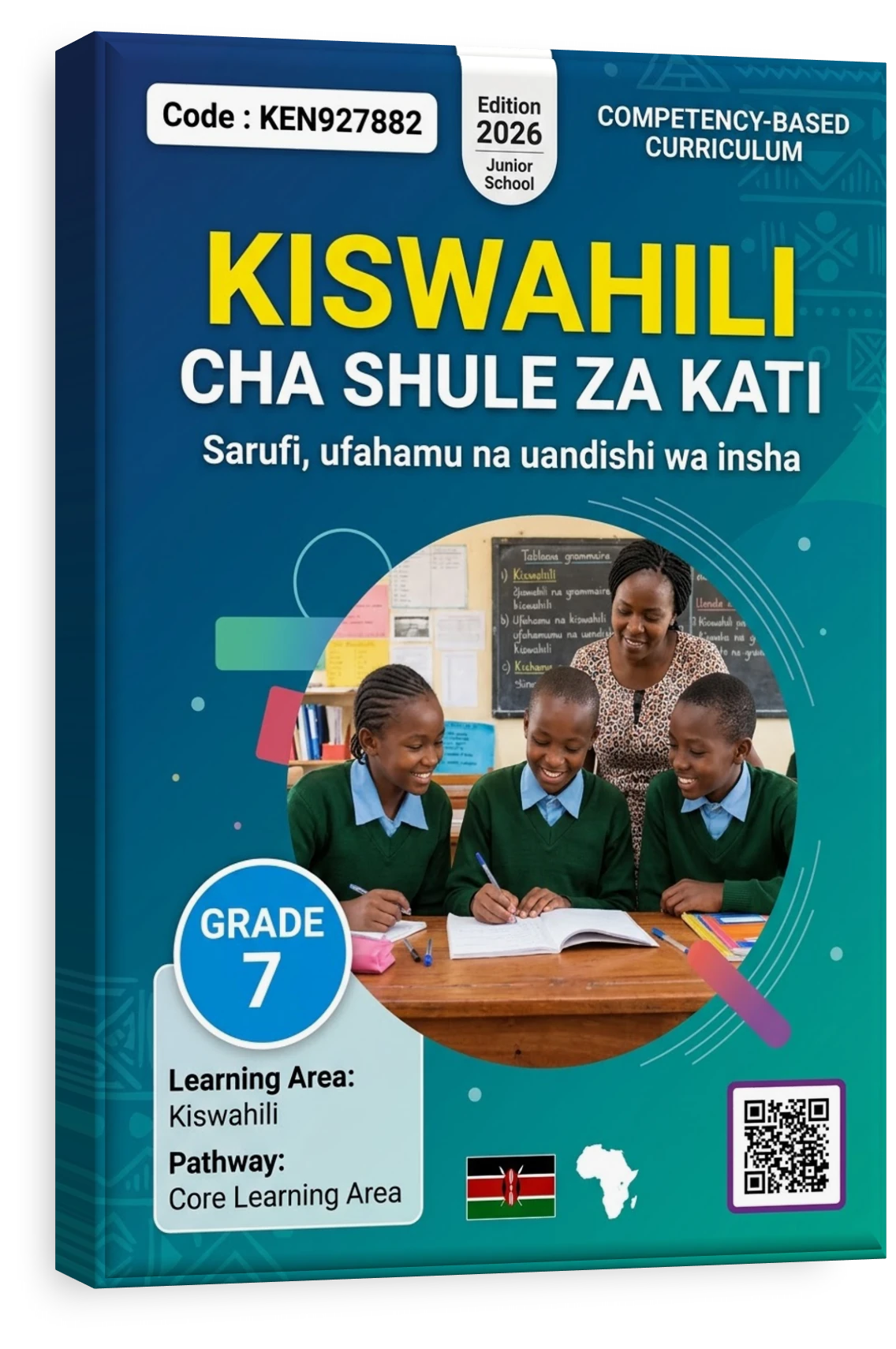
Kiswahili cha Shule za Kati
Level: Grade 7 (Junior School) — Core Learning Area
Official Curriculum – Competency-Based Curriculum (CBC) – Kenya Institute of Curriculum Development (KICD).
PRELIMINARIES
1. Why One Language Carries the Whole Country
A Grade 7 pupil who moves from Lodwar in the north-west to a new school on the Mombasa coast learns one thing within a week: it is Kiswahili, not her home language, that teachers, shopkeepers and new classmates understand straight away. The same standard Kiswahili reads a transfer letter, haggles at a market stall and wins a school debate, across counties that otherwise share little. For a twelve-year-old choosing friends, subjects and a future career, sharpening this one language opens almost every door at once.
2. Four Steps That Repeat in Every Chapter
Seven chapters share one steady rhythm so nothing feels like guesswork. Each opens with a real situation, a mixed-up shop sign, a confusing proverb, a jumbled essay, that raises a genuine question about language. Next comes the rule or skill behind it, explained in plain Kiswahili with an English gloss where it helps. A short exercise then tests the idea on real material from home, school or the county around it. Every chapter closes with that same problem finally solved, ready for the next one.
3. One Classroom, Sixty Grade 7 Learners, and a Family at Home
Sixty learners sharing four textbooks is normal in many Kenyan schools, and this book is built for that reality. Pair work turns a single newspaper clipping or exercise book into enough material for a whole row of desks, while oral drills need no equipment beyond a loud, patient voice. At home, a parent who corrects a letter, listens to Kiswahili news on the radio or settles a family argument using a proverb is already teaching the same subject, without opening this book.
Chapter I. From a Nervous Greeting to a Confident Speech
I.1 A Wrong Word Before the Chief at Kapenguria
At a water project handover in Kapenguria, a Grade 7 pupil chosen to greet the chief uses the same casual Kiswahili he shares with his cousins, and the hall goes quiet with embarrassment. Nobody had told him that greeting an elder, a chief or a guest of honour follows its own rules, different from banter at the school gate. The awkward pause raises a real question every learner eventually meets: how does Kiswahili change when the audience and the occasion change?
I.2 Lugha Rasmi: The Rules Behind Respectful Kiswahili
Formal Kiswahili, lugha rasmi, follows clear habits: addressing elders as Bwana or Bibi, choosing heshima over slang, using the second person plural even for one respected listener, and opening with a fixed salamu before any request. Informal Kiswahili, spoken among age-mates, drops most of this and borrows freely from Sheng and English. Knowing which register a baraza, a job interview or a church service demands is not etiquette alone; it is the grammar of respect, and it is examinable.
I.3 Recording a Vote of Thanks for Isiolo’s New Borehole
Working in pairs, learners draft a one-minute vote-of-thanks speech for the commissioning of a new borehole in Isiolo, naming the donors, the chief and the water committee correctly. One partner records the speech on a shared phone while the other listens for slips into casual Kiswahili, marking every place where lugha rasmi should have appeared instead. Replaying the recording turns a private embarrassment into a shared, fixable mistake, and every pair leaves with a cleaner second draft.
I.4 Standing Tall at the Harambee in Nanyuki
When the school in Nanyuki holds a harambee to finish its new library, the same pupil who once froze before the chief in Kapenguria is asked to welcome the guests. This time the salamu, the Bwana and Bibi, the plural address all come automatically, rehearsed until they needed no thought. Parents clap, not because the speech was clever, but because it was correctly, confidently formal. The skill gained is simple to name: knowing exactly which Kiswahili an occasion calls for.
Chapter II. Eight Word Classes Hiding in Every Sentence
II.1 The Shop Sign in Eastleigh That Says the Wrong Thing
A new shop in Eastleigh paints a sign meant to read ‘Bei Nzuri, Huduma Nzuri’ but mixes up its word order so badly that customers read it twice before laughing. The mistake is not spelling; it is grammar, a kivumishi placed where a kitenzi belongs. A Grade 7 class photographing similar muddled signs around their own neighbourhood quickly notices a pattern: almost every confusing sentence traces back to one word used in entirely the wrong class.
II.2 Nomino, Kitenzi, Kivumishi: Naming the Building Blocks
Kiswahili sentences are built from eight word classes: nomino (nouns), vitenzi (verbs), vivumishi (adjectives), vielezi (adverbs), viwakilishi (pronouns), vihusishi (prepositions), vihisishi (interjections) and vionjezi (conjunctions). Each carries its own agreement rules, especially the noun classes that force a matching prefix onto the verb and adjective beside it. Once a learner can name which class a word belongs to, correcting agreement stops being guesswork and becomes a short, checkable rule applied to any sentence.
II.3 Reading the Milk Collection Board at a Nyahururu Dairy
The weekly collection board outside a dairy cooperative near Nyahururu lists farmer names, litres delivered and prices owed in short, functional Kiswahili sentences. Learners copy five lines from a photograph of such a board and label every word by class: nomino under the farmer’s name, nambari and kitenzi under the litres and verb. The exercise proves that grammar is not only in storybooks; it sits on a cooperative’s noticeboard, deciding whether a farmer can check their own payment at a glance.
II.4 Rewriting the KPLC Token Notice So Everyone Understands It
A faulty KPLC token notice at a shopping centre reads like a riddle because its verbs and nouns are jumbled, leaving customers unsure whether the meter is broken or simply out of credit. Learners rewrite it line by line, checking each word’s class before placing it, until the instructions read in one clear pass. A notice that once needed three readings now needs one, proof that naming nomino, kitenzi and kivumishi correctly carries a genuinely practical payoff.
Chapter III. Reading Between the Lines
III.1 A Leaflet Misread at the Machakos County Hospital
Outside the Machakos county hospital, a mother skims an SHA registration leaflet too quickly and misses the line stating that children under eighteen need a parent’s ID number, not their own. She joins the wrong queue twice before a clerk points out the missed sentence. Her daughter, sitting nearby revising for school, realises that reading fast is not the same as reading well, and that one overlooked line can cost an entire afternoon.
III.2 Skimming, Scanning and Guessing From Context
Ufahamu rewards three distinct habits: skimming a passage once for its general drift, scanning it a second time for one exact fact such as a date or a number, and guessing an unfamiliar word’s meaning from the sentences around it rather than reaching straight for a dictionary. Examiners test all three separately, often within the same short passage. Practising each habit on its own, before mixing them, turns a vague feeling of understanding into answers that are actually correct.
III.3 Flamingos and Hot Springs: A Passage on Lake Bogoria
A short passage describes how Lake Bogoria’s hot springs feed algae that draw thousands of flamingos each dry season, and why a sudden drop in the lake’s level can drive the birds elsewhere almost overnight. Learners answer literal questions, naming the algae’s role, then inferential ones, explaining what the flamingos’ absence might suggest about rainfall further upstream. The passage proves comprehension is not memory of facts alone; it is reasoning carefully from facts already given.
III.4 Helping Grandmother Fill the Right Box on an SHA Form
Back home in Makueni, the same learner who once watched her mother queue twice now sits beside her grandmother with an SHA form, scanning each heading before filling anything in. She spots the box asking for a dependant’s relationship, not a name, exactly where her grandmother would have guessed wrong. The skill that once belonged to an exam passage now saves a real household a second trip to the hospital, proving comprehension pays for itself outside class too.
Chapter IV. The Wisdom Packed Into a Few Words
IV.1 A Proverb at the Chama Meeting That Made No Sense
During a chama meeting in Kisii, an elder closes an argument about late contributions with ‘Mstahimilivu hula mbivu’, and half the room nods while a visiting Grade 7 nephew stares blankly at ripe fruit that has nothing to do with money. Nobody explains the proverb; everyone else already owns it. His confusion names a real gap: knowing every word in a sentence is not the same as understanding what the sentence, as a whole, actually means.
IV.2 Methali, Nahau na Misemo: Telling Them Apart
Methali are complete proverbs carrying inherited wisdom, such as patience rewarded eventually; nahau are fixed idioms whose words cannot be read literally, like ‘kufa moyo’ meaning to lose heart rather than to die; misemo are looser common sayings used more casually. All three trade a literal meaning for a figurative one, which is exactly why translating them word for word usually produces nonsense. Recognising which category a saying belongs to is the first step toward using it correctly.
IV.3 Collecting Elders’ Proverbs in Kabarnet
For a weekend assignment, learners in Kabarnet interview a grandparent or neighbour, collecting three proverbs each along with the situation that normally calls for them. Back in class, the collected sayings are sorted by theme: patience, unity, warning, respect for elders, before each pair matches a proverb to a short scenario written by another pair. The exercise turns elders into co-teachers and proves a methali only truly makes sense attached to the moment it was built to answer.
IV.4 Winning a Debate on Lake Victoria’s Water Hyacinth With One Proverb
Debating whether fishing communities around Lake Victoria should pull water hyacinth by hand or wait for machines, a Grade 7 speaker from Migori closes with ‘Haraka haraka haina baraka’, warning that a rushed, badly funded machine scheme often fails faster than patient manual clearing. The proverb lands harder than another page of statistics would have. Her teacher notes what changed: a well-chosen methali, placed at exactly the right moment, can carry an argument further than explanation alone.
Chapter V. An Essay With a Beginning, a Middle and an End
V.1 A Lamu Dhow Story That Jumped Around in Time
Asked to describe a dhow trip off Lamu, one learner’s essay opens on the wind filling the sail, jumps backward to breakfast, then forward to a fish bought on shore, before returning to the wind again without warning. The teacher’s comment is blunt: good details, confused order. Reading it aloud, the class agrees the story is hard to follow not because the Kiswahili is wrong, but because events refuse to stay in the order they actually happened.
V.2 Utangulizi, Kiini, Hitimisho: Shaping the Insha
Every strong insha carries three parts: an utangulizi that sets the scene in a sentence or two, a kiini that develops events or ideas in a clear order, and a hitimisho that closes without simply repeating the opening. Narrative essays lean on time connectors such as kisha, baadaye and mwishowe to keep events in sequence, while descriptive ones lean on the five senses to make a place feel real. Knowing which shape a title calls for is half the essay already planned.
V.3 Describing Mount Elgon’s Caves Sense by Sense
Given a photograph of the Kitum caves on Mount Elgon, learners draft a descriptive paragraph using at least one detail from sight, sound, smell and touch: the cold stone walls, the drip of hidden water, the faint mineral smell, the darkness beyond the torchlight. Swapping drafts with a partner, each learner circles any sentence missing a sense and adds it. The finished paragraphs prove that description grows richer the moment a writer stops relying on sight alone.
V.4 Rewriting the Bomet Sacco Meeting Story So It Finally Flows
Returning to the dhow essay’s writer, the class sets a new task: describe a family sacco meeting in Bomet where a loan is finally approved, this time planning utangulizi, kiini and hitimisho on paper before writing a single sentence. The rewritten essay opens on the meeting’s nervous silence, moves steadily through the chairperson’s questions, and closes on relief outside the hall, in the order it truly happened. The jumbled dhow story is, by then, a lesson fully learned.
Chapter VI. Letters and Reports That Get Things Done
VI.1 A Birth Certificate Error Nobody Knew How to Report
A family discovers their youngest child’s birth certificate carries a misspelt name, and nobody is sure how to ask the Huduma Centre for a correction without sounding either rude or hopelessly vague. Their Grade 7 daughter, home for the weekend, realises school has never actually taught her how to write such a letter, only how to write about a holiday. The gap between school Kiswahili and a family’s real paperwork suddenly feels larger than any exam question.
VI.2 The Six Parts of a Barua Rasmi
A barua rasmi follows a fixed shape: the writer’s address, the date, the recipient’s address, a formal salamu such as ‘Mpendwa Afisa’, a kiini stating the request clearly in one or two paragraphs, and a closing such as ‘Wako mtiifu’ above a signature. Leaving out any part, or sliding into the warmth of a barua ya kirafiki, undermines the letter before an officer even finishes reading it. The format stays strict precisely because it is meant to be taken seriously.
VI.3 Writing Up the Class Trip to Kakamega Forest
After a field trip to Kakamega Forest, learners draft a short report rather than a letter, following its own format: a title, the trip’s objective, the main findings about the forest’s remaining canopy species, and a recommendation for its protection. Unlike a narrative essay, the report stays impersonal and ordered under headings rather than flowing paragraphs. Comparing a finished report with a finished barua rasmi side by side finally makes the difference between the two formats impossible to confuse.
VI.4 A Real Letter Asking the County to Fix a Wajir Borehole
At home now, the learner who once struggled over the birth certificate problem drafts an actual barua rasmi to the county water office, reporting a broken borehole pump near Wajir that has forced her neighbours back to a distant, unsafe water point. Every part is in place: address, date, salamu, a clearly stated request, a respectful closing. Whether or not the pump gets fixed quickly, the letter itself already proves a skill that no longer needs a teacher checking it.
Chapter VII. Poems and Stories Kenya Has Always Told
VII.1 A Rain Poem From Kerio Valley Full of Strange Words
A short shairi about waiting for rain in the Kerio Valley uses words like ‘mawimbi ya mahindi’ for waves of maize and praises clouds as if they were visiting relatives, leaving a literal-minded reader baffled by lines that plainly are not describing an ocean or a family visit. The confusion raises an honest question: why would a poet choose such roundabout, image-heavy language instead of simply saying that the rains are late and everyone is anxious?
VII.2 Vina, Mizani, Ubeti: How a Shairi Is Built
Traditional Kiswahili poetry counts its syllables as mizani, matches end sounds as vina, and organises lines into stanzas called beti, rules that explain why a shairi reads nothing like ordinary prose. Taswira, vivid imagery, lets a poet compare rain to relatives or hunger to fire without ever naming either directly. Oral literature beside it keeps its own forms: hadithi for tales, vitendawili for riddles, nyimbo for songs, each passed down by voice long before anyone wrote them on paper.
VII.3 A Riddle About the Steam Rising at Olkaria
Working from a photograph of steam rising above the geothermal wells at Olkaria, pairs compose a short kitendawili, a riddle, describing the sight without naming it directly, followed by a four-line shairi attempt that respects basic vina and mizani patterns. Swapping riddles across the classroom to guess each other’s answer turns a grammar exercise into genuine suspense. However clumsy the first attempt at counting syllables, every pair leaves having built, rather than merely read, a piece of Kiswahili poetry.
VII.4 Reciting an Original Poem at the Eldoret Drama Festival
At the regional drama festival held in Eldoret, not far from Iten’s training camps for the country’s famous runners, a Grade 7 competitor recites an original shairi comparing a marathon’s final kilometres to the patience praised in the proverbs learned earlier in the year. Judges note the careful vina and the steady mizani as much as the theme. The strange, image-heavy language that once confused a reader of the Kerio Valley rain poem has, by now, become her own voice.
ANNEXES
A. A Pocket Kiswahili-English Glossary of Grammar Terms
This annex lists every grammar term used across the book, nomino, kitenzi, kivumishi, kielezi, kiwakilishi, kihusishi, kihisishi, kionjezi, methali, nahau, msemo, mizani, vina, ubeti, utangulizi, kiini, hitimisho, each with a short English gloss and one example sentence drawn from the chapter where it first appeared. A teacher short on class time can point a confused learner straight to one entry instead of re-explaining a whole lesson, and a learner revising at home can test themselves against the examples alone.
B. A Home Proverb-and-Headline Sheet for Families
This take-home sheet asks a learner to collect one proverb from a parent or grandparent and one headline from a newspaper or radio bulletin during the week, writing each down with its meaning in their own words. Space is left for the family member’s name and a signature, turning a grammar task into a shared evening activity rather than solitary homework. Teachers can collect the sheets termly to see which real Kiswahili, spoken and broadcast, learners are actually encountering outside class.
C. A Rubric for Marking Every Insha Fairly
This rubric scores every essay against four weighted criteria: structure (utangulizi, kiini, hitimisho all present and ordered), grammar and word-class agreement, vocabulary range including at least one well-placed methali or nahau where fitting, and overall effect on a reader. Each criterion carries clear marks out of five with a one-line description of what a top score looks like, so two different teachers marking the same essay should reach scores that are close rather than wildly apart.

Discussion (0)
Aucune intervention pour le moment. Soyez le premier à contribuer.
Votre intervention Annuler la réponse