
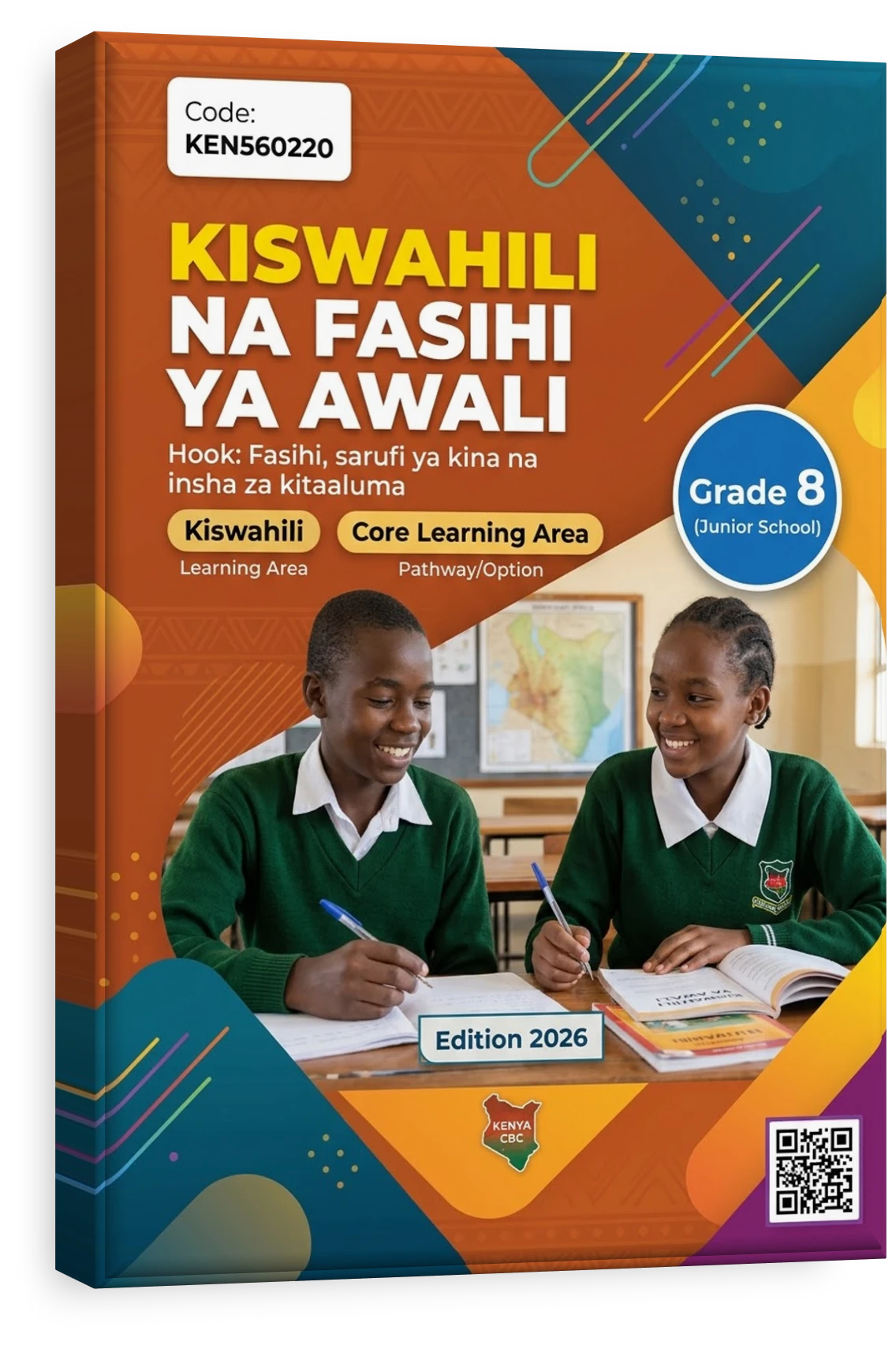
Kiswahili na Fasihi ya Awali
Level: Grade 8 (Junior School) — Core Learning Area
Official Curriculum – Competency-Based Curriculum (CBC) – Kenya Institute of Curriculum Development (KICD).
PRELIMINARIES
1. Kiswahili ni Mwenyewe: Lugha Inayotuunganisha
A market vendor in Eastleigh bargains in Kiswahili with a customer from Garissa who speaks no Kikuyu and no Luo. Neither needed English. Kenya’s national language carries news bulletins, church sermons, political rallies and family quarrels alike, stitching dozens of communities into one conversation. For a Grade 8 learner, mastering Kiswahili sarufi and fasihi is not a school requirement to survive; it is the key that opens radio, parliament, poetry and the KCSE paper still three years away. This book treats that key seriously, chapter by chapter.
2. Jinsi Kitabu Hiki Kinavyofanya Kazi
Every chapter in this book follows the same four-beat rhythm, like a matatu route with fixed stops. First comes a real situation from Kenyan life that raises a language question. Then the grammar or literary notion is explained plainly, with examples a learner already recognises. Third, an exercise or short investigation puts the idea to work on paper. Fourth, the chapter closes on the skill now owned, applied immediately to a letter, a story or a conversation the learner might actually have at home.
3. Kwa Walimu na Wazazi: Darasa Kubwa, Vifaa Vichache
Forty, fifty, sometimes sixty learners share one Kiswahili lesson and a single chalkboard; this book assumes exactly that. Pair work replaces expensive materials: two learners correcting each other’s ngeli errors cost nothing but five minutes. At home, a parent who speaks Kiswahili fluently but never studied its grammar can still help enormously, by listening to a child read a paragraph aloud and asking what happened next. Reading a newspaper together turns an ordinary evening into daily revision no textbook can replace.
Chapter I. Ngeli: Kuzijua Familia za Nomino
I.1 Kwa Nini « Mtoto Wale » Hazieleweki
A learner in Nakuru writes « mtoto wale wamefika » instead of « watoto wale wamefika » and the teacher’s red pen circles the sentence twice. Why does Kiswahili insist a noun and its modifiers agree so strictly, when English barely bothers? Every Kiswahili noun belongs to a class, a ngeli, and that class commands the verb, the adjective and the demonstrative that follow it. Getting the class wrong does not just sound odd; it can change who did what to whom. This chapter starts there, with the sentence that confused half the class.
I.2 Ngeli Nane Muhimu na Alama Zake
Kiswahili groups nouns into families recognised by their plural markers: M-WA for people (mtoto, watoto), M-MI for trees and body parts (mti, miti), KI-VI for tools and language names (kitabu, vitabu), N-N for many borrowed and animal nouns, U-U mostly abstract, PA-KU-MU for place and manner, and YA-ZA for size classes. Each family forces matching agreement across the whole sentence: watoto wale wazuri wamefika, never a mismatched chain of singular and plural. Learning eight families by their shape, not by memorising lists, makes the whole language click into place.
I.3 Zoezi: Kupanga Nomino za Nyumbani Kwenye Ngeli Zake
Working in pairs, learners list twenty nouns from home and the school compound, sort each into its ngeli family, then build one full sentence per family with correct agreement across noun, adjective and verb. A learner who sorts « ndizi » wrongly discovers the mismatch instantly once the sentence refuses to agree. Checking a partner’s sentence for a hidden ngeli error becomes a small detective exercise, repeated until the eight patterns stop needing the chart pinned to the wall and start arriving by instinct instead.
I.4 Ngeli Zinapotumika Barabarani na Gazetini
A road sign reading « Magari Yaendayo Mbio Hupata Ajali » only makes sense once « magari » is recognised as a YA-class noun, forcing « yaendayo » and not « zinazoenda ». The same instinct now lets a learner read a newspaper headline, a shop signboard in Kericho or a county notice without stumbling over agreement. What began as a confusing exercise becomes a tool for reading the real Kiswahili printed everywhere outside the classroom, from matatu stickers to the minutes of a church harambee meeting.
Chapter II. Vitenzi na Nyakati: Wakati Ndio Hadithi
II.1 Mama Alipika Ugali: Lini Hasa?
Grandmother in Kitale tells a story and shifts between « nilikuwa nikila », « nilikula » and « nimekula » within three sentences, each one marking a slightly different moment of eating. A learner retelling the tale flattens everything into « nilikula » and the timeline collapses into confusion: did she eat before arriving, while arriving, or just now? Kiswahili tenses are not decoration; they are the engine that keeps a narrative in order, and losing one tense marker can quietly erase an entire sequence of events.
II.2 Alama za Wakati: LI, NA, TA, ME, NGE
Kiswahili marks tense with a single letter or two slipped between the subject prefix and the verb root: LI for the simple past, NA for the present continuous, TA for the future, ME for a completed action still felt now, and NGE for a condition that has not happened. « Alipika » and « amepika » both describe cooking in the past, yet only one implies the ugali is still warm on the table. Noticing that tiny marker becomes the habit this section builds, one verb at a time.
II.3 Zoezi: Simulizi ya Siku Moja Shuleni
Each learner writes six sentences describing one ordinary school day, deliberately using a different tense marker in each: what usually happens, what is happening now, what will happen tomorrow, what has already happened, and what would happen if the bell rang early. Swapping papers with a neighbour, learners hunt for a tense used wrongly, the way a mechanic in Kisumu hunts for a loose wire. A single misplaced NA where TA belongs turns a plan into something that is already underway.
II.4 Barua ya Kweli Yenye Nyakati Sahihi
Armed with five tense markers instead of one, a learner can now write a letter to an aunt in Homa Bay describing last term’s exams, this term’s timetable and next year’s hopes for the next exam series, each in its correct tense without guessing. The skill that started as a confusing chart of letters has become the difference between a letter that reads like a timeline and one that reads like noise, understood easily by anyone who opens the envelope.
Chapter III. Insha: Kutoka Wazo Hadi Ukurasa
III.1 Insha Isiyo na Mwanzo Wala Mwisho
Handed a title like « Safari Yangu », many Grade 8 learners write one long paragraph with no clear beginning, middle or end, and the marker struggles to find where the story even starts. What separates a composition that earns full marks from one that loses them is rarely vocabulary; it is structure. A reader in Nyahururu, or an examiner far away, needs a clear opening hook, a developed middle and a closing line, every single time, whatever topic is given on the day.
III.2 Mfumo wa Insha: Utangulizi, Kiini, Hitimisho
A well-built composition opens with a single gripping sentence, not « Siku moja… », develops three or four paragraphs each carrying one idea forward, and closes by returning to the opening image with something new added. Paragraphing matters as much as grammar: one idea, one paragraph, one clear link to the next. Kiswahili rewards connectors like « hata hivyo », « kwa hiyo » and « aidha » that stitch paragraphs together, turning a pile of sentences into a composition a reader can actually follow.
III.3 Zoezi: Insha ya « Jioni Moja Nyumbani Kwetu »
Learners draft a four-paragraph composition titled « Jioni Moja Nyumbani Kwetu », first sketching the hook, the three middle beats and the closing line on a small plan before writing a single sentence of the final draft. Swapping plans with a desk-mate before drafting catches a weak opening early, when it costs five minutes to fix rather than a rewritten page. Only after the plan survives review does the actual insha get written, sentence by sentence, following its own skeleton.
III.4 Insha Inayofaa Kutumwa kwa Gazeti
The same four-part skeleton now supports an insha ready to be read aloud in class or even submitted to a school magazine in Nanyuki, because a composition built on a plan survives being read by a stranger, not just marked by a teacher who already knows the writer. What began as a shapeless paragraph has become a reusable structure a learner can apply to any insha title given in an exam, a competition or even a letter home.
Chapter IV. Methali na Nahau: Hekima Iliyofichwa
IV.1 « Haraka Haraka Haina Baraka »: Methali Gani Hii?
A boda boda rider in Eldoret ignores a flat tyre warning and crashes before reaching Iten; his neighbours simply say « haraka haraka haina baraka » and everyone nods, no further explanation needed. How does one short sentence carry an entire moral lesson that a paragraph would struggle to state so sharply? Methali compress generations of observation into a fixed phrase, and a Grade 8 learner who cannot decode them misses half of what elders, radio hosts and even politicians actually mean.
IV.2 Methali, Nahau na Misemo: Tofauti Zake
A methali stands alone as complete wisdom (« mstahimilivu hula mbivu »); a nahau is a fixed expression whose words, read literally, make no sense at all (« kupiga danadana » has nothing to do with striking anything); a msemo is a looser popular saying without the methali’s formal weight. Recognising which category a phrase belongs to changes how a learner should translate or explain it: word for word for none of them, but meaning for meaning for all three, patiently matched to context.
IV.3 Zoezi: Kukusanya Methali kutoka Nyumbani
Learners interview a grandparent, a neighbour or a shopkeeper in Taita Hills, Vihiga or wherever home happens to be, collecting five methali or nahau never seen in the textbook, writing down the literal words, the real meaning and the situation where each one was used. Comparing lists in class reveals the same wisdom dressed in different regional phrasing, proof that methali travel with communities rather than staying fixed to any single chart or county.
IV.4 Kutumia Methali Kuboresha Insha na Mazungumzo
A composition that closes with a well-chosen methali, placed exactly where it fits rather than forced in for decoration, reads like it was written by someone who actually speaks the language rather than someone translating from English in their head. The same instinct now lets a learner follow a church sermon, a baraza at the chief’s camp or a radio debate without missing the proverb everyone else already understood, because the wisdom behind it finally has a name.
Chapter V. Hadithi Fupi: Wahusika Wanaoishi Kwenye Kurasa
V.1 Kwa Nini Sungura Hushinda Fisi Kila Wakati?
In story after story told around a fire in Kakamega or printed in a Grade 8 reader, Sungura the small hare outsmarts Fisi the powerful hyena, never through strength but through a trick planned three steps ahead. Why does Kiswahili fasihi keep returning to a weak character who wins by cunning rather than force? Reading a hadithi fupi closely enough to ask that question is the first step toward literary analysis, long before the word « theme » ever appears on an exam paper.
V.2 Wahusika, Mandhari na Dhamira
Every hadithi fupi rests on three elements worth naming precisely: wahusika, the characters and how they change or stay fixed; mandhari, the setting that shapes what is possible in the story; and dhamira, the message the writer wants to leave behind once the last page is turned. A story set during a drought in Kajiado carries a different dhamira than the same plot set beside a lake, because mandhari is never just background, it pushes the characters toward their choices.
V.3 Zoezi: Kuchambua Hadithi Fupi Darasani
Given a short printed hadithi, learners work in groups to identify the mhusika mkuu, describe one choice that character makes and explain in their own words what the story seems to be teaching, without simply retelling the plot from start to finish. Groups then defend their reading of the dhamira to the rest of the class, discovering that two groups can support different interpretations from the very same paragraph, provided each one points to real evidence from the text.
V.4 Kuandika Hadithi Fupi Yako Mwenyewe
Having taken stories apart, learners now build one: a hadithi fupi of their own, set somewhere real to them, perhaps a cooperative dairy queue in Nyandarua or a posho mill on a Saturday morning, with one mhusika who makes a clear choice and one dhamira the writer can state in a single sentence once finished. The skill that started as reading comprehension has become authorship, and a learner who can build dhamira on purpose recognises it faster in anyone else’s writing too.
Chapter VI. Ushairi: Sauti na Hesabu ya Silabi
VI.1 Shairi Linalofuata Kanuni Ngumu
A shairi performed at a wedding in Lamu follows rules a free-verse poem never bothers with: a fixed number of mizani per mstari, a matching vina at the end of each line, and a set number of mishororo per ubeti. A learner who writes a heartfelt poem but ignores every rule may still move an audience, yet fail an assessment built around traditional ushairi. The question this chapter opens with is simple: what exactly are mizani and vina, and why do they matter so much?
VI.2 Mizani, Vina na Ubeti: Vipimo vya Shairi
Mizani are syllable counts within a line, often fixed at eight per mstari depending on the form; vina are the matching sounds at the end of lines, usually the final two letters, that bind a ubeti together the way rhyme binds an English poem. A classic tarbia stanza carries four mishororo of eight mizani each, vina arranged in a set pattern. Counting syllables on fingers, the way a learner once counted sums, turns an abstract rule into something countable and checkable line by line.
VI.3 Zoezi: Kuhesabu Mizani na Kutunga Ubeti
Working from a printed shairi, learners count the mizani in each mstari aloud, clapping once per syllable the way a choir counts beats, then try composing a single ubeti of their own about rain reaching Marsabit after months of drought, checking that every mstari lands on the same syllable count and that the vina actually rhyme. A ubeti that scans perfectly but says nothing fails as surely as one bursting with feeling but broken in its mizani; both halves must hold together.
VI.4 Ushairi Kama Sauti ya Jamii
Finished poems are read aloud in class the way a shairi would be performed at a real gathering, because ushairi was composed to be heard, not only marked silently with a red pen. A learner who has counted mizani by hand now listens differently to Kiswahili news jingles on the radio or praise poems sung at a harambee in Kabarnet, catching the structure beneath performances that once sounded like pure, unexplainable music.
Chapter VII. Tamthilia na Hoja: Kuongea kwa Hadhira Mbili
VII.1 Mgogoro Jukwaani: Kwa Nini Watazamaji Wanashikilia Pumzi?
A school tamthilia performed in a hall in Machakos holds two hundred restless learners silent for ten minutes, not through loud voices but through mgogoro, a conflict between two characters who both believe they are right. What makes drama different from the hadithi fupi studied earlier, when both carry wahusika and dhamira? Tamthilia removes the narrator entirely; everything must be shown through maongezi and matendo on stage, and that single difference changes how the whole text must be read.
VII.2 Vipengele vya Tamthilia: Maongezi, Maelekezo, Maonyesho
A play script separates maongezi, the lines characters actually speak, from maelekezo ya jukwaani, the stage directions no audience hears but every actor must obey, down to where a character stands when the lights change. Maonyesho, the staging itself, turns flat text into a living scene. A learner reading tamthilia silently must mentally perform all three at once, imagining voice, movement and set simultaneously, a harder skill than it first appears on a printed page.
VII.3 Zoezi: Hoja Mbili Zinazopingana
Pairing the chapter’s drama with argumentative writing, learners draft an insha ya hoja defending one side of a real local debate, perhaps whether a Kajiado secondary school should allow phones at all, stating one hoja per paragraph and countering the strongest objection before the conclusion rather than ignoring it. A hoja without a counter-argument convinces nobody who already disagrees; naming the opposing view and then answering it is exactly what separates persuasion from simple complaint repeated three times.
VII.4 Insha ya Hoja Iliyokamilika: Kutetea kwa Ushahidi
By the chapter’s close, a learner can produce a four-paragraph insha ya hoja that states a position, defends it with two concrete reasons, answers the strongest objection and closes with a call to action a reader in Bomet or Busia could actually follow. The habit built across seven chapters, from ngeli agreement to an argued conclusion, now supports any writing task Grade 8 Kiswahili can set, because structure, once truly learned, transfers to every page after it.
ANNEXES
A. Kamusi Fupi: Maneno ya Sarufi na Fasihi kwa Kiingereza
This glossary lists every technical term used across the seven chapters side by side with its English equivalent: ngeli (noun class), kiambishi (affix), mzizi (root), wakati (tense), mhusika (character), mandhari (setting), dhamira (theme), mizani (syllable count), vina (rhyme), mgogoro (conflict), hoja (argument). A learner or parent unsure of a word mid-chapter turns here first, rather than guessing from context, and a teacher preparing a quick revision quiz can pull ten terms straight off this single page.
B. Karatasi ya Kazi Nyumbani na Kipimo cha Tathmini
A one-page home activity sheet sends learners to find one methali and one tense-marked sentence from a real conversation overheard at home or at a market, writing both down with their meaning. Alongside it sits a simple assessment rubric scoring any insha out of twenty: five for structure, five for grammar and ngeli agreement, five for vocabulary including at least one methali or nahau where fitting, and five for an ending that actually closes the piece properly.
C. Kumbukumbu ya Miradi na Rasimu za Insha
A running project log gives each learner one page per chapter to record the title of every insha, hadithi or ubeti drafted, the date it was written, the main correction received and one thing to fix next time before the following composition. Kept from Chapter I to Chapter VII, this log turns scattered exercise-book pages into a single portfolio a teacher in a large county class can review in minutes at the end of term, tracking real progress instead of guessing at it.
Discussion (0)
Aucune intervention pour le moment. Soyez le premier à contribuer.
Votre intervention Annuler la réponse