
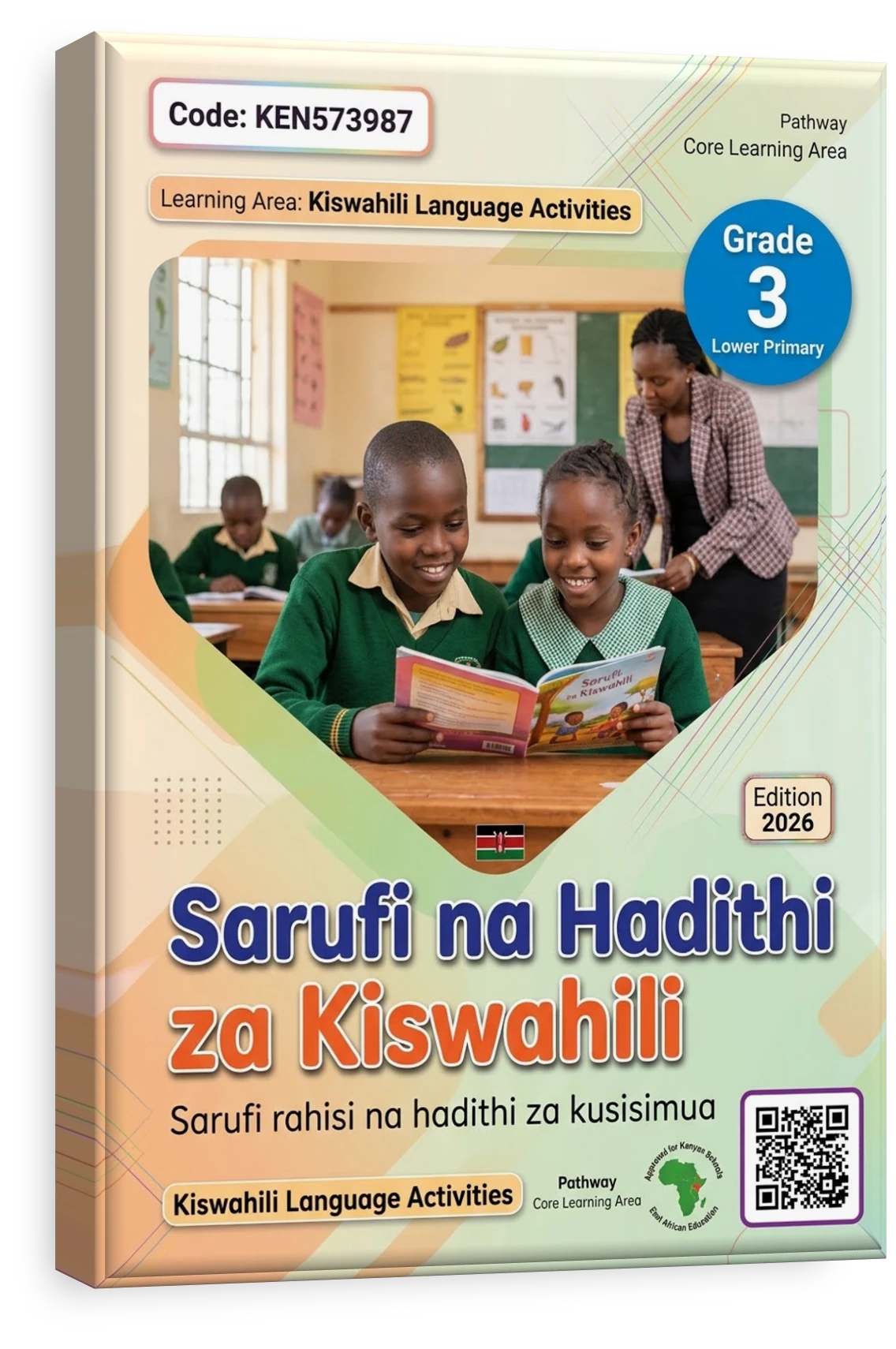
Sarufi na Hadithi za Kiswahili
Level: Grade 3 (Lower Primary) — Core Learning Area
Official Curriculum – Competency-Based Curriculum (CBC) – Kenya Institute of Curriculum Development (KICD).
PRELIMINARIES
1. Welcome to Sarufi na Hadithi
Kiswahili grammar, sarufi, and stories, hadithi, grow together in this Grade 3 book, each lesson rooted in scenes a learner already knows: a grandmother telling tales beside Lake Victoria, a father naming vegetables at a sukuma wiki stall, children waiting safely at a matatu stop. Knowledge builds gradually from naming familiar things to forming whole sentences describing daily village and home life. Lesson objective: introduce learners to the purpose of this book, connecting grammar rules to real Kiswahili heard every day at home and school. Operational benefit: learners approach sarufi confidently, recognising it as a tool for telling their own stories clearly.
2. Why Grammar and Stories Belong Together
Grammar alone can feel dry, yet paired with hadithi, Kiswahili stories, it becomes a living tool for expressing ideas about family gatherings, Rift Valley hillsides, or a busy market morning near home. Sarufi rules taught in isolation rarely stick, but a rule practised while retelling a favourite tale about a clever hare or a wise elder sinks deeper into memory. Lesson objective: show learners that correct nouns, verbs and sentence order make their own stories easier for classmates to understand and enjoy. Operational benefit: learners write and speak more clearly, since grammar practice and storytelling reinforce each other throughout every lesson in this book.
3. A Guide for Parents and Teachers
Parents and teachers share the task of nurturing strong Kiswahili skills, whether beside a classroom chalkboard or at home after fetching water or helping prepare ugali for supper. Every chapter offers simple activities using materials already present in most Kenyan households: old newspapers, exercise books, or stories remembered from grandparents near Lake Victoria or the Rift Valley escarpment. Lesson objective: equip every caregiver, however busy, with clear guidance for supporting a Grade 3 learner’s grammar and storytelling practice. Operational benefit: learners practise Kiswahili continuously across settings, strengthening sarufi and hadithi skills both inside and beyond the classroom walls.
Chapter I. Naming Our World
I.1 Naming People and Animals at Home
Every Kiswahili sentence begins with naming what we see, so this lesson starts with majina, nouns, for people and animals found around a typical Kenyan home: mama, baba, kaka, dada, mbwa, mbuzi and ng’ombe grazing near the compound fence. Knowledge taught guides learners to say and write each noun correctly, listening carefully to pronunciation before copying words into exercise books. Lesson objective: build a strong vocabulary of family and animal nouns used daily within home and village life. Operational benefit: learners recognise and use common nouns confidently, forming a foundation for every sentence built in later chapters.
I.2 Naming Places We Know
Beyond the home, learners name places shaping daily Kenyan life: shule, soko, kanisa au msikiti, and wider landmarks like Ziwa Victoria, Lake Victoria, or the sweeping Bonde la Ufa, Rift Valley, studied on a classroom map. Knowledge presented links each Kiswahili place-name to a real location learners may have visited or heard described by elders during storytelling evenings. Lesson objective: expand noun vocabulary beyond the household into school, market and landscape terms describing wider community geography. Operational benefit: learners describe their surroundings accurately in Kiswahili, preparing for richer descriptive sentences introduced throughout later chapters of this book.
I.3 Singular and Plural Forms
Kiswahili nouns change shape between umoja, singular, and wingi, plural, so mtoto becomes watoto while kitabu becomes vitabu, a pattern learners practise using real classroom objects and market goods like matunda, fruits, sold near a village stall. Knowledge taught highlights common prefix changes, especially the shift from mu- or m- to wa- for people, encouraging learners to listen for the sound difference. Lesson objective: help learners recognise and produce correct singular and plural noun forms through guided repetition and object sorting games. Operational benefit: accurate plural use prevents confusion when learners describe groups of people, animals or goods bought at market.
I.4 The M-WA Noun Class
Nouns describing people and some animals belong to the M-WA ngeli, noun class, where mtu becomes watu and mwalimu becomes walimu, a pattern learners discover by sorting word cards during a guided classroom activity near Lake Victoria fishing villages or inland farming homes. Knowledge delivered introduces the matching verb prefix a- for one person and wa- for many, so mtoto anacheza becomes watoto wanacheza. Lesson objective: introduce the M-WA class gently through pattern recognition rather than abstract rule memorisation. Operational benefit: learners build subject-verb agreement awareness early, supporting correct sentence construction throughout every remaining chapter.
Chapter II. Building Simple Sentences
II.1 Subject and Verb Together
A complete Kiswahili sentence needs kiima, the subject, joined with kiarifu, the verb, so mtoto anasoma, the child is reading, or baba anapika ugali, father is cooking ugali, both show this essential pairing learners practise daily. Knowledge taught guides learners to identify who or what performs an action before naming the action itself, using simple pictures showing village and home scenes for support. Lesson objective: help learners build grammatically complete sentences by correctly joining a subject noun with its matching verb form. Operational benefit: learners communicate clear, complete ideas rather than scattered words when speaking or writing about daily activities.
II.2 Using Personal Pronouns
Instead of repeating a name, Kiswahili speakers often use viwakilishi, pronouns, such as mimi, wewe, yeye, sisi, nyinyi and wao, practised through short dialogues imagining learners waiting together safely at a matatu stop before school. Knowledge presented shows how pronouns replace nouns already mentioned, keeping conversation natural rather than repetitive, while matching verb prefixes still agree correctly with each pronoun chosen. Lesson objective: strengthen fluent, natural-sounding sentences through guided pronoun substitution exercises based on everyday classroom and travel situations. Operational benefit: learners speak more smoothly, avoiding awkward repetition common among beginners still learning sentence structure.
II.3 Describing Words
Vivumishi, descriptive words, add colour to plain nouns, turning mti into mti mkubwa, a big tree, or embe into embe tamu, a sweet mango, items learners might find growing near a rural homestead or sold fresh at a bustling local market. Knowledge taught encourages learners to notice how certain describing words change slightly depending on the noun class they modify, building early grammatical sensitivity. Lesson objective: expand descriptive vocabulary while practising correct agreement between nouns and their describing words through guided market-themed exercises. Operational benefit: learners produce richer, more vivid sentences when describing objects, people and places within their community.
II.4 Asking Good Questions
Curiosity grows through questions, so learners practise nani, who; nini, what; wapi, where; and lini, when, forming simple questions about family members, lost items, or safe routes home past a busy matatu stage near the village centre. Knowledge delivered models correct question word order, placing the question word appropriately within a Kiswahili sentence before practising spoken question-and-answer pairs with a partner. Lesson objective: build confident questioning skills supporting both classroom discussion and safe, informed conversation within the wider community. Operational benefit: learners gather information clearly and politely, a skill useful well beyond the Kiswahili lesson itself.
Chapter III. Verbs Across Time
III.1 Speaking About Now
The marker -na- shows an action happening now, so ninasoma means I am reading while mama anapika sukuma wiki means mother is cooking sukuma wiki for supper this very evening. Knowledge taught walks learners through forming present tense verbs by inserting -na- between the subject prefix and verb root, practising aloud using actions happening right inside the classroom. Lesson objective: build accurate present tense verb formation through guided oral practice describing ongoing classroom and home activities. Operational benefit: learners narrate current events confidently, a skill supporting classroom discussion, storytelling and simple daily conversation at home.
III.2 Speaking About Yesterday
Past actions use the marker -li-, so nilisoma means I read while watoto walicheza karibu na ziwa means children played near the lake during yesterday’s school outing or weekend visit. Knowledge presented contrasts -na- and -li- side by side, helping learners hear and feel the sound difference between present and completed action within short practice sentences. Lesson objective: introduce past tense formation clearly, distinguishing it confidently from present tense through paired oral and written exercises. Operational benefit: learners recount recent events accurately, supporting classroom storytelling sessions and simple spoken accounts shared with family at home.
III.3 Speaking About Tomorrow
Future plans use the marker -ta-, so nitasoma kesho means I will read tomorrow while tutatembelea soko wikendi means we will visit the market over the weekend to buy fresh vegetables. Knowledge taught practises forming future tense verbs through guided sentences about upcoming school events, family visits, or planned trips near the Rift Valley or a familiar local market. Lesson objective: build confident future tense formation through structured practice describing plans and intentions relevant to learners’ own lives. Operational benefit: learners express plans and promises clearly, supporting cooperative classroom planning and respectful communication at home.
III.4 Saying What Did Not Happen
Negative sentences change the verb pattern, so sisomi means I do not read while hatukwenda sokoni means we did not go to the market because of heavy rain near the homestead that morning. Knowledge delivered introduces the negative prefix si- alongside slightly altered endings, practised through simple true-or-false style sentences about daily routines, chores and hygiene habits like washing hands before meals. Lesson objective: help learners form clear negative statements correctly across present and past situations through guided repetition. Operational benefit: learners express disagreement or absence of action politely and accurately during classroom and home conversations.
Chapter IV. Listening to and Retelling Stories
IV.1 Who and Where in a Story
Every hadithi needs wahusika, characters, and mahali, a setting, so learners first identify who appears in a story and where events unfold, perhaps a fishing village along Lake Victoria or a quiet homestead near the Rift Valley slopes. Knowledge taught trains learners to listen attentively for character names and location clues before any other story detail, using short tales read aloud by the teacher. Lesson objective: build listening comprehension skills by identifying characters and setting as the first steps of understanding any hadithi. Operational benefit: learners follow stories more confidently, preparing a strong foundation for later retelling and discussion activities.
IV.2 What Happens First, Next and Last
Stories unfold through mwanzo, mwisho and matukio ya kati, beginning, middle and end, a structure learners practise by arranging picture cards showing a simple tale about a boy helping carry maize to a local market stall. Knowledge presented strengthens sequencing skills, asking learners to say what happened first, what followed, and how the story concluded using clear time-order words. Lesson objective: develop narrative sequencing skills through guided retelling exercises using familiar, locally relevant story scenarios. Operational benefit: learners organise their own spoken and written accounts logically, a skill valuable across every subject area.
IV.3 Finding the Lesson in a Story
Many Kiswahili hadithi carry fundisho, a lesson, often teaching honesty, kindness or caution, such as a tale warning children to stay alert and hold an adult’s hand near a busy matatu stage. Knowledge taught guides learners through gentle discussion questions asking what a character learned and why their choice mattered, connecting story events to real safety and behaviour lessons at home. Lesson objective: strengthen comprehension by identifying the moral message embedded within a traditional or modern Kiswahili story. Operational benefit: learners connect storytelling to real-life decision-making, remembering lessons about safety, honesty and respect more deeply.
IV.4 Telling a Story in My Own Words
Retelling a familiar hadithi using one’s own words, rather than memorised exact phrases, proves a learner truly understood characters, setting and sequence of events shared during an earlier classroom reading session. Knowledge delivered encourages learners to stand confidently before classmates, describing a tale about village life, animals, or a family trip to buy sukuma wiki and ugali flour at the market. Lesson objective: build spoken retelling confidence and vocabulary flexibility through supportive peer and teacher feedback after each attempt. Operational benefit: learners gain public speaking confidence alongside deeper comprehension, strengthening both Kiswahili fluency and classroom participation.
Chapter V. Writing and Reciting
V.1 Writing About My Day
Writing short sentences describing a typical day, from waking at home to walking carefully past a matatu stop on the way to school, helps learners connect spoken Kiswahili to confident written expression. Knowledge taught guides learners through simple sentence starters, encouraging correct noun, verb and tense choices practised earlier while describing washing hands, eating breakfast, and arriving safely at the classroom gate. Lesson objective: build writing fluency by composing short, personally meaningful sentences about daily routine and safety habits. Operational benefit: learners transfer spoken grammar skills into written form, strengthening overall Kiswahili literacy steadily across the term.
V.2 Writing About My Family and Home
A short paragraph describing family members, home chores, or a shared meal of ugali and sukuma wiki gives learners a meaningful writing task connecting grammar lessons to genuine personal experience near Lake Victoria or inland farming communities. Knowledge presented reviews correct noun and verb agreement while encouraging learners to add describing words making their writing more vivid and personal. Lesson objective: strengthen paragraph writing skills by combining several learnt grammar points within one coherent, personally relevant piece of writing. Operational benefit: learners produce confident short compositions, demonstrating accumulated grammar knowledge gathered across earlier chapters of this book.
V.3 Reciting Short Rhymes and Poems
Mashairi mafupi, short poems and rhymes, often passed down through generations near Lake Victoria or across Rift Valley communities, help learners practise rhythm, pronunciation and memory while enjoying shared classroom performance. Knowledge taught introduces simple poems about nature, family or daily chores, encouraging learners to recite confidently before classmates during short weekly performance sessions. Lesson objective: build pronunciation confidence and appreciation for Kiswahili oral literature through guided memorisation and group recitation practice. Operational benefit: learners develop stronger spoken fluency and cultural appreciation, supporting both language skill and classroom community spirit.
V.4 Using Proverbs Wisely
Methali, proverbs, such as haraka haraka haina baraka, carry wisdom useful during everyday decisions, including reminders to walk carefully rather than rush dangerously near a busy matatu stage after school. Knowledge delivered introduces several age-appropriate proverbs, discussing their meaning through simple classroom examples connected to hygiene, patience, honesty and safety relevant to a Grade 3 learner’s daily life. Lesson objective: build cultural and linguistic appreciation by understanding and applying traditional Kiswahili proverbs correctly in context. Operational benefit: learners gain wise, memorable language tools supporting both classroom behaviour and respectful family conversation at home.
ANNEXES
A. A Home Practice Guide for Sarufi
Home practice strengthens classroom sarufi lessons without requiring special materials, since parents and older siblings can review nouns, verbs and tenses together while preparing ugali, walking to a nearby market, or resting after chores near the homestead. Knowledge offered suggests short nightly routines: naming five household nouns, practising one verb across present, past and future tense, or correcting a simple sentence together. Lesson objective: provide caregivers with practical, low-cost grammar practice routines extending every chapter’s classroom learning into daily home life. Operational benefit: consistent home repetition reinforces classroom grammar steadily, helping learners retain sarufi concepts across school terms confidently.
B. A Storytelling Checklist for Families
A simple storytelling checklist helps families continue hadithi practice at home, encouraging an evening tale shared beside the cooking fire or during a quiet moment after walking safely home past the matatu stop. Knowledge organised into this checklist reminds families to ask who, what, where and what lesson a story taught, mirroring classroom comprehension questions used throughout Chapter Four. Lesson objective: extend storytelling comprehension practice beyond school hours through accessible, structured family conversation routines. Operational benefit: regular home storytelling deepens listening, sequencing and moral reasoning skills, complementing classroom hadithi lessons meaningfully.
C. Preparing for Kiswahili Classroom Assessments
Regular classroom assessments check growing sarufi and hadithi skills through short spoken and written tasks rather than lengthy formal examinations unsuitable for Grade 3 learners still building foundational confidence. Knowledge presented advises teachers to assess noun naming, simple sentence construction, tense accuracy and story retelling gradually across the term, noting progress informally within a continuous assessment record. Lesson objective: support fair, developmentally appropriate assessment practices reflecting genuine Kiswahili grammar and storytelling growth achieved throughout this book. Operational benefit: teachers and parents gain clear, honest insight into a learner’s real progress, guiding further support where truly needed.
Discussion (0)
Aucune intervention pour le moment. Soyez le premier à contribuer.
Votre intervention Annuler la réponse