
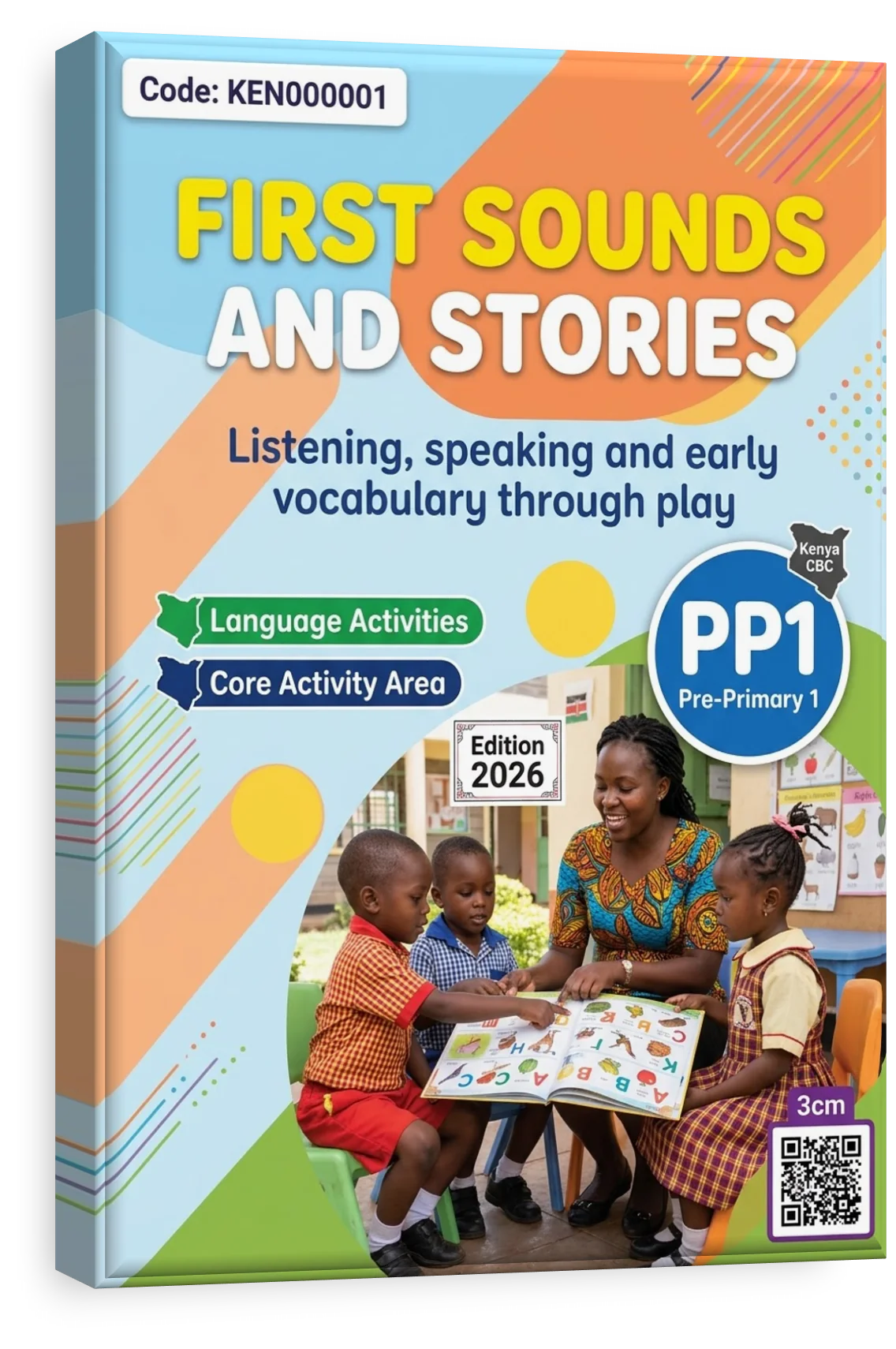
First Sounds and Stories
Level: Pre-Primary 1 (PP1) — Core Activity Area
Official Curriculum – Competency-Based Curriculum (CBC) – Kenya Institute of Curriculum Development (KICD).
PRELIMINARIES
1. Why Listening Comes First
Young learners at Pre-Primary 1 build every later skill upon careful listening, so our first lesson objective trains ears before mouths speak. Kenyan classrooms overflow with sounds worth noticing: a rooster calling near Kiambu, a matatu horn in town, a mother pounding maize at home. Teachers gather children in a circle, ring a small bell, and ask who heard it first. Operational benefit for a four-year-old: sharper attention, calmer behaviour, and readiness to follow spoken instructions safely at school, at the market, and along the road home each day.
2. Talking Is a Skill We Grow
Speaking grows slowly, like a seedling watered daily on the shamba, and our lesson objective names that growth so parents and teachers nurture it patiently. Every child arrives at PP1 already babbling household words, naming siblings, animals, and favourite foods eaten at home. Guided play turns those first words into fuller sentences through gentle modelling, repetition, and praise. Operational benefit: a learner gains confidence to greet neighbours, request help politely, and describe daily happenings clearly, building social courage valuable for every later subject.
3. Play Is the Classroom
Competency-Based Curriculum treats play as serious learning, not as a break from it, and our lesson objective asks teachers to design games that quietly teach listening and speaking. Hopping between chalk circles while naming shamba animals, passing a ball while singing greeting songs, or sorting market fruits by colour all count as structured language practice. Operational benefit for every pre-primary learner: knowledge sticks longer when hands move, voices sing, and laughter fills the room, giving children natural, joyful repetition that builds vocabulary without fear of mistakes or correction.
Chapter I. Sounds Around Us
I.1 Morning Greetings and Classroom Sounds
Every school day in Kenya opens with greeting rituals, and our lesson objective teaches learners to recognise and respond to common classroom sounds and phrases such as « Habari asubuhi » or « Good morning, teacher. » Children practise listening for the register bell, the clapping signal for silence, and the teacher’s calling of names. Repeating greetings with correct tone builds listening memory and social confidence. Operational benefit: a four-year-old settles quickly into classroom routine, responds respectfully to adults, and feels secure knowing exactly what each familiar morning sound means for the day ahead.
I.2 Animal and Nature Sounds on the Shamba
Shamba life surrounds most Kenyan pre-primary learners with cockerels crowing, goats bleating, and rain drumming on iron roofs, so our lesson objective trains children to identify these sounds and name the animal or event producing them. Teachers imitate a cow mooing or wind rustling maize leaves, inviting learners to guess and respond aloud. Matching sound to source sharpens discrimination skills essential for later reading. Operational benefit: learners describe home experiences confidently, connect classroom learning to familiar farm life, and grow vocabulary rooted firmly in their own lived environment.
I.3 Following Simple Instructions
Safety and cooperation depend on listening to instructions correctly, so our lesson objective builds this skill through short, clear commands practised daily such as « stand up, » « sit down, » « touch your nose, » or « fetch the cup. » Teachers use call-and-response games, gradually lengthening instructions once children master shorter ones confidently. Correct response without repeated reminders signals genuine listening comprehension rather than mere guessing. Operational benefit: a young learner follows household chores at home, obeys road-safety guidance near the market, and cooperates smoothly within classroom group activities throughout the school term.
I.4 Listening Games with Rhythm and Clapping
Rhythm sharpens auditory memory, so our lesson objective uses clapping games, drumbeats, and simple percussion made from tins or sticks to train children in counting sounds and copying patterns accurately. Teachers clap a short pattern; learners repeat it exactly before patterns grow longer and trickier. Singing counting rhymes alongside clapping links numbers naturally with sound sequencing. Operational benefit: four and five-year-olds develop concentration spans needed for longer lessons later, strengthen fine motor coordination through clapping, and experience joyful mastery that keeps them eager to keep listening and learning more.
Chapter II. Finding Our Voices
II.1 Naming Family and Home Objects
Vocabulary begins at home, so our lesson objective asks learners to name family members, household items, and daily routines using complete, simple sentences rather than single words alone. Picture cards showing a jiko, a water jerrican, or a sleeping mat prompt children to say « this is our jiko » confidently. Teachers correct gently, modelling fuller phrases without discouraging attempts. Operational benefit: a pre-primary learner communicates needs clearly to caregivers, describes home chores proudly during circle time, and builds a speaking foundation that transfers smoothly into classroom conversation and storytelling later.
II.2 Describing People Who Help Us
Community helpers shape every Kenyan neighbourhood, so our lesson objective guides learners to name and describe the chief, the health worker, the shopkeeper, and the boda boda rider using descriptive words about their work and tools. Role-play corners let children dress as a nurse or a farmer while speaking about daily duties aloud. Describing helpers builds empathy alongside vocabulary growth naturally. Operational benefit: learners recognise trusted adults confidently, speak respectfully when seeking help in public, and appreciate how different jobs support their family and wider community life.
II.3 Asking and Answering Simple Questions
Curiosity deserves language tools, so our lesson objective teaches learners to form simple questions beginning with « what, » « where, » and « who, » then answer classmates’ questions using short, clear replies during paired activities. Teachers model question-answer pairs about market items, such as « Where is the sukuma wiki? » paired with « It is near the tomatoes. » Practising both roles, asking and answering, strengthens conversational turn-taking. Operational benefit: a young learner seeks information confidently from parents or teachers, participates actively in group discussion, and develops comfortable two-way communication skills needed throughout schooling.
II.4 Taking Turns to Speak in Circle Time
Circle time structures daily speaking practice, so our lesson objective establishes fair turn-taking through a shared object, perhaps a smooth stone or decorated gourd, passed hand to hand as each child speaks briefly about their day. Waiting patiently while holding silence teaches self-control alongside listening respect for classmates’ voices. Teachers praise both speakers and patient listeners equally during feedback moments. Operational benefit: learners gain confidence speaking before groups, practise patience valued within Kenyan community gatherings, and build listening courtesy that supports harmonious classroom relationships throughout the entire school year.
Chapter III. Words We Collect
III.1 Market Day Words
Market visits offer rich vocabulary harvests, so our lesson objective introduces words for common goods such as mangoes, maize flour, beans, and fish, alongside polite trading phrases like « how much » and « thank you. » Role-play markets built from empty baskets and paper shillings let children practise naming items and prices using Kenyan Shilling amounts. Repetition during pretend buying and selling cements new words quickly. Operational benefit: learners accompany caregivers to real markets with growing confidence, recognise familiar foods by name, and practise polite exchange language used daily.
III.2 Counting Words with Shamba Objects
Numbers gain meaning through touch, so our lesson objective pairs counting words one to ten with real shamba objects such as maize cobs, beans, or stones gathered during outdoor play sessions. Children count aloud while placing each object into a row, saying the number word clearly before moving to the next item. Counting familiar harvest objects roots abstract numbers in concrete, trusted experience. Operational benefit: four-year-olds build early numeracy vocabulary alongside speaking practice, strengthen one-to-one correspondence understanding, and prepare confidently for formal mathematics activities introduced later in primary school.
III.3 Colours and Shapes Around Us
Describing the visible world needs precise words, so our lesson objective teaches colour and shape vocabulary using items already present in classroom and compound: a red hibiscus flower, a round chapati, a square mat, green banana leaves. Sorting games ask learners to group objects by colour first, then by shape, naming each category aloud repeatedly. Matching language to visible attributes strengthens descriptive speaking skills steadily. Operational benefit: learners describe clothing, food, and surroundings accurately, follow simple sorting instructions at home, and develop observation habits valuable across every future learning area.
III.4 Days, Weather and Seasons Vocabulary
Time and weather shape Kenyan daily routines, so our lesson objective introduces words for days of the week alongside weather terms such as sunny, rainy, cloudy, and cold, connected to real morning observation outside the window. Children chart each day’s weather using drawn symbols while saying the matching word aloud. Linking vocabulary to lived daily experience makes abstract time concepts tangible. Operational benefit: learners discuss planting seasons relevant to shamba life, dress appropriately after hearing weather forecasts, and build calendar awareness supporting routine at home.
Chapter IV. Stories That Teach
IV.1 Listening to a Story from Grandmother
Oral storytelling carries Kenyan heritage, so our lesson objective exposes learners to short traditional tales, perhaps about a clever hare or a wise tortoise, told slowly with expressive voice and pause for questions. Children listen for sequence: what happened first, next, and last within the familiar narrative structure. Grandmother or elder visitors strengthen authenticity and community connection during storytelling sessions held outdoors. Operational benefit: learners build listening stamina for longer narratives, absorb cultural values embedded within tales, and strengthen memory skills needed for later reading comprehension across every subject studied.
IV.2 Retelling a Story in Our Own Words
Comprehension shows itself through retelling, so our lesson objective asks learners to recount a heard story using their own simple words, supported by picture sequence cards showing beginning, middle, and end clearly. Teachers prompt gently with « what happened next » when children pause uncertainly during practice. Retelling strengthens sequencing memory and builds speaking fluency simultaneously through meaningful, enjoyable repetition. Operational benefit: a pre-primary learner reports classroom events accurately to parents at home, organises thoughts logically before speaking, and gains storytelling confidence that supports future written composition skills in later grades.
IV.3 Story Characters and Feelings
Stories teach emotional vocabulary powerfully, so our lesson objective asks learners to name how a character feels, happy, scared, proud, or sad, and explain briefly why using simple cause phrases like « because the tortoise won. » Puppet characters made from socks or paper bags help children voice feelings safely during guided role-play. Naming emotions within fiction builds bridges toward naming real feelings confidently. Operational benefit: learners develop empathy toward classmates experiencing similar emotions, express their own feelings using appropriate words, and strengthen social-emotional competency valued strongly within Competency-Based Curriculum goals.
IV.4 Making Up Our Own Short Story
Creativity deserves early encouragement, so our lesson objective invites learners to invent a brief original story using three familiar picture prompts, perhaps a goat, a river, and a basket, arranged however imagination chooses. Teachers scribe spoken ideas onto paper while children watch their words become print, linking speech to text. Sharing invented stories before classmates builds authorship pride and public speaking courage. Operational benefit: learners practise organising ideas into sequence, gain confidence that their spoken words matter and deserve an audience, and plant seeds for storytelling enjoyment.
Chapter V. Sounds Into Letters
V.1 First Sounds of Our Names
Every child’s own name becomes the first reading lesson, so our lesson objective teaches learners to isolate the beginning sound of their name, such as « mmm » for Mary or « ttt » for Tatu, before matching that sound elsewhere. Name cards displayed around the classroom invite daily recognition. Starting phonic awareness with personal vocabulary increases motivation naturally. Operational benefit: learners build the earliest bridge between spoken sound and printed symbol, recognise their own name confidently on belongings, and prepare steadily for formal letter-sound lessons in Grade One.
V.2 Rhyming Words and Songs
Rhyme trains the ear for sound patterns, so our lesson objective teaches learners to notice matching end-sounds within familiar Kenyan songs and simple rhymes about rain, animals, or counting fingers. Children clap when they hear two rhyming words within a sung verse, such as « cat » and « mat, » building active listening engagement. Singing together daily cements rhythm, memory, and pronunciation simultaneously through joyful repetition. Operational benefit: learners develop phonological awareness proven essential for later reading success, enjoy shared musical culture with classmates, and practise clear pronunciation through confident, repeated group singing.
V.3 Picture and Word Matching
Bridging pictures to printed words prepares learners for literacy, so our lesson objective pairs familiar images, a cow, a hut, a mango, with their written labels displayed on classroom charts and flashcards. Children point to the correct picture when the teacher says a word aloud, then point to matching print beside it. Repeated matching builds early sight-word recognition gently without pressure. Operational benefit: learners gain visual familiarity with print before formal reading instruction begins, strengthen vocabulary retention, and develop quiet confidence approaching books and printed materials.
V.4 Celebrating What We Can Say
Confidence deserves celebration, so our lesson objective gathers every skill learned across the term into a joyful class concert where children greet visitors, recite a rhyme, retell a favourite story, and name shamba objects proudly before an audience of parents. Preparing performance pieces consolidates listening, speaking, and vocabulary gains naturally through purposeful rehearsal. Parents witness tangible progress, strengthening home-school partnership meaningfully. Operational benefit: learners experience pride in spoken achievement, build lasting public-speaking courage, and complete Pre-Primary 1 ready for richer language demands awaiting them in Pre-Primary 2.
ANNEXES
A. Home-School Talking Chart
Parents extend classroom learning naturally when given simple tools, so this resource offers a weekly chart listing five talking tasks, such as naming three shamba animals or describing yesterday’s weather, for families to practise together each evening. Caregivers tick a box after each shared conversation, showing consistent practice clearly. Teachers review charts weekly, praising effort during morning circle time. Operational benefit: learners receive extra listening and speaking practice beyond school hours, families strengthen bonds through conversation, and teachers gain valuable insight into home language environments supporting each child.
B. Simple Songs and Rhymes for Everyday Routines
Daily transitions become learning moments when paired with song, so this resource collects short Kiswahili and English rhymes for handwashing, lining up, tidying toys, and saying goodbye, each lasting under one minute. Melodies borrow familiar local tunes already known to most Kenyan children, easing memorisation. Teachers introduce one new song weekly while reinforcing favourites during transition moments each day. Operational benefit: routines run smoothly without shouting or delay, learners absorb vocabulary painlessly through repeated melody, and classroom atmosphere stays calm, musical, and genuinely joyful.
C. Teacher’s Quick Assessment Checklist for Listening and Speaking
Tracking progress need not burden busy teachers, so this resource provides a one-page checklist covering five observable behaviours: responds to name, follows two-step instructions, names five familiar objects, asks a simple question, and retells a short story sequence correctly. Teachers mark each child quarterly using simple ticks gathered during natural play rather than formal testing sessions that might frighten young learners. Operational benefit: teachers identify learners needing extra support early, celebrate steady growth with confidence, and report meaningful, evidence-based progress to parents during each term’s open day meeting.
Discussion (0)
Aucune intervention pour le moment. Soyez le premier à contribuer.
Votre intervention Annuler la réponse