
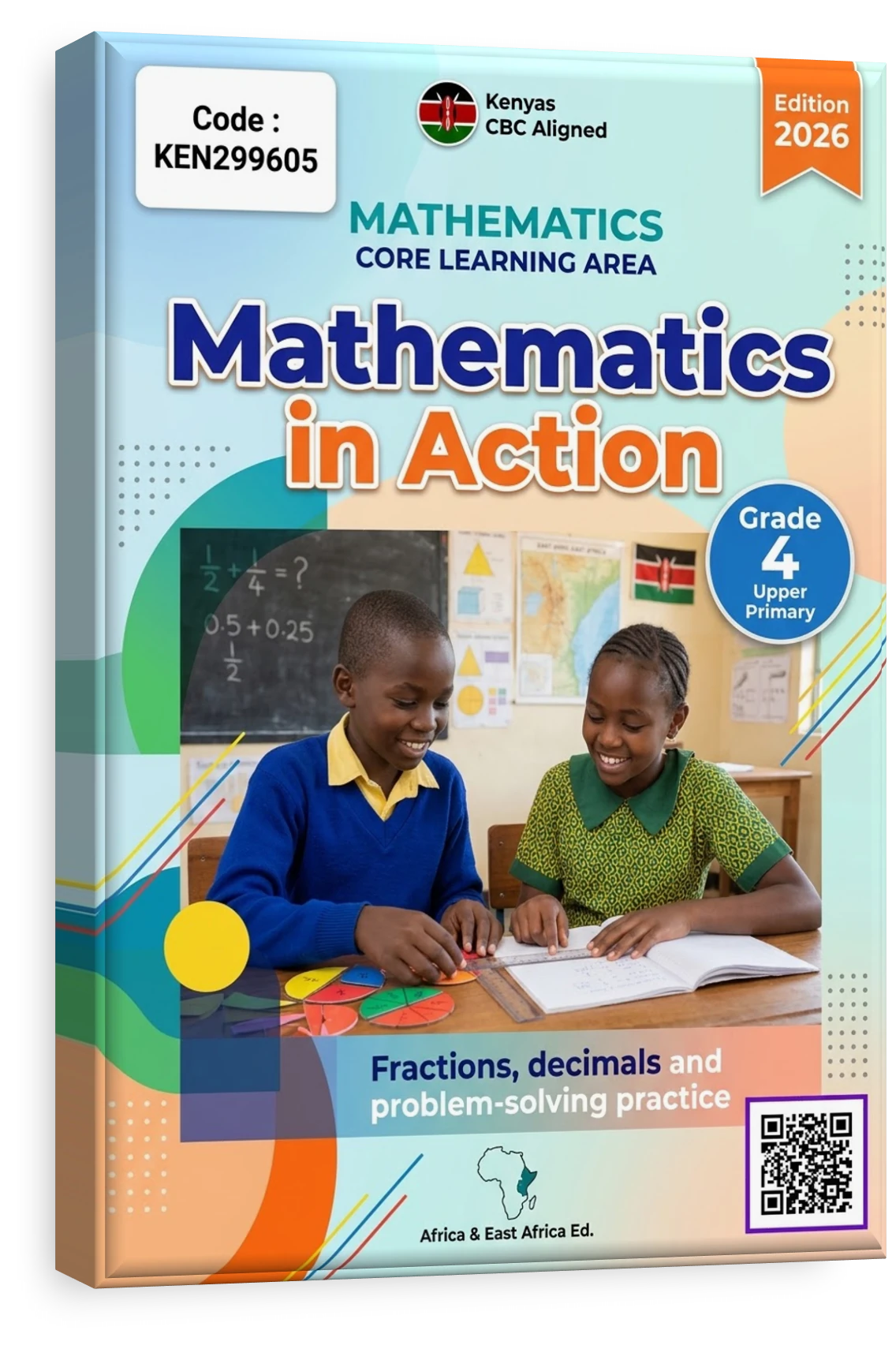
Mathematics in Action
Level: Grade 4 (Upper Primary) — Core Learning Area
Official Curriculum – Competency-Based Curriculum (CBC) – Kenya Institute of Curriculum Development (KICD).
PRELIMINARIES
1. Counting the Shillings Everyone Brings
A harambee at a Kakamega church once collected coins and notes from forty families, and somebody had to count it correctly before the chairman announced the total. Grade 4 mathematics is that same counting, grouping and checking, scaled up to the thousands. Splitting a matatu fare three ways, working out how many desks a classroom needs, or sharing a harvest fairly become number problems worth solving. By December, sums that once needed a borrowed calculator get solved with pencil alone.
2. Four Steps, Every Chapter, No Surprises
Open any chapter here and the same pattern repeats, so nobody gets lost halfway through a topic. First comes a real Kenyan situation that raises a genuine question, perhaps a tea basket on a scale or a fisherman dividing a catch. Next the mathematics behind it is explained plainly, with worked examples. Then comes an exercise or small investigation using things already lying around a classroom. Finally the new skill gets applied somewhere ordinary, so it stays.
3. Forty Pupils, One Blackboard, Still Possible
Large classes and thin budgets are the normal condition of Kenyan primary schools, not an excuse to skip hands-on mathematics. Bottle tops, maize grains and torn paper replace counters and fraction strips at no cost, and pairing a confident pupil with a struggling one covers more ground than one teacher alone could. At home, a parent weighing maize at the market, counting change at a kiosk, or splitting chapatis among children is already teaching mathematics this book simply names.
Chapter I. The Numbers Kenya Counts By
I.1 A Budget Nobody Could Read Aloud
At a county baraza in Kitui, an officer announced a road budget of four million, two hundred thousand shillings, and half the crowd lost track after the word « million ». Such numbers appear constantly in Kenya, from county budgets to census figures, yet few people read or compare them with confidence. A six-digit number stops frightening anyone once its digits sit in clear places: ones, tens, hundreds, thousands, ten-thousands, hundred-thousands. Grade 4 begins by making such figures ordinary.
I.2 Where Every Digit Lives
Place value gives each digit in a number its own job depending on where it sits. In 4,205,730, the 4 stands for four million, the 2 for two hundred thousand, and the final 0 for nothing in the ones column, yet its place still matters. Writing the number in expanded form, 4,000,000 + 200,000 + 5,000 + 700 + 30, shows what each digit contributes. Rounding a figure to the nearest ten thousand depends on reading that chart correctly.
I.3 Building Millions Out of Bottle Caps
Five groups thread bottle caps onto skewers planted in a soil tray, one skewer for ones, one for tens, one for hundreds, up to hundred-thousands. Calling out a county population figure sets off a race to thread the correct number of caps onto each skewer, then check a neighbour’s tray. Swapping ten caps on one skewer for a single cap on the next teaches regrouping by hand, and mistakes show up instantly, before any marked book would reveal them.
I.4 Reading Nairobi’s Numbers With Confidence
A headline reporting that Nairobi County collected two billion shillings in a month, or that a survey counted fifteen thousand traders, no longer intimidates a learner who has built such numbers from bottle caps. The same confidence carries into comparing two phone credit balances, checking a school fees receipt for the right amount, or reading a population sign on a county office door. Six-digit numbers have stopped being a wall of digits; they have become information worth questioning.
Chapter II. Tallying Harambee Day
II.1 The Ledger That Did Not Balance
A harambee committee in Kisii recorded contributions from sixty families in a notebook, column after column of shillings, and at the end the written total did not match the cash counted twice. Somewhere a figure had been added wrongly, or a borrowed ten forgotten. This happens wherever Kenyans pool money, from church collections to savings groups, and is precisely the gap careful addition and subtraction with regrouping closes. Grade 4 learners meet that broken ledger as their starting puzzle.
II.2 Carrying, Borrowing, and Getting It Right
Adding 48,650 and 27,890 means lining up columns from the ones upward, carrying a ten into the next column whenever a sum reaches ten or more, as the harambee clerk should have done. Subtracting 48,650 from 76,340 works the opposite way, borrowing a ten whenever the top digit is smaller than below it. Checking a subtraction by adding the answer back to the smaller number catches mistakes before they reach a notebook.
II.3 Rebuilding the Broken Ledger
Working in pairs, a photocopied page of the Kisii committee’s messy notebook gets re-added column by column, hunting for exactly where the error crept in. A class trip fund then becomes the live version: weekly contributions of KES 50 from forty pupils get entered, totalled, and checked against money counted in a tin. Finding one shilling missing, and tracing which addition went wrong, teaches more about carrying and borrowing than ten pages of isolated sums ever could.
II.4 A Dukawalla Who Never Shortchanges
A shopkeeper in a small Nakuru duka serves customer after customer, adding sugar, soap and cooking oil, then subtracting the total from whatever note is handed over to work out change. Getting that subtraction wrong, even by ten shillings, either loses money all day or quietly cheats a customer. The same regrouping now checks a shopping receipt at home, splits a bill fairly among friends, or confirms that change from a hundred-shilling note is right.
Chapter III. Sharing the Catch Fairly
III.1 Four Men, One Boat, One Problem
A fishing crew on Lake Victoria hauls in ninety-six Nile perch after a long night, and the four crew members must split fish and money from selling them exactly evenly, nothing left over to argue about. Dividing ninety-six by four is simple once numbers cooperate, but what happens when the catch is ninety-seven, with one fish stubbornly left over? That leftover fish is the whole reason division has remainders, and this chapter takes that beach argument seriously.
III.2 Tables, Long Division, and the Remainder
Multiplication tables up to twelve let a learner find six times eight or nine times eleven instantly, speeding up the division that follows. Long division breaks a bigger number down step by step: how many times four goes into ninety-seven, what remains, and whether that remainder carries forward or gets recorded separately. Ninety-seven divided by four gives twenty-four, remainder one: three crew members get twenty-four fish each, the fourth gets twenty-three, or the extra is sold and shared as cash.
III.3 Fair Shares With Real Objects
Twenty-three exercise books are shared among five groups at the front of the class, and every group must explain, out loud, what to do with the three books that will not divide evenly. Some choose to sell the extras for shared sweets, others let one group keep an extra book this week and another gets it next. Repeating the sharing with seventeen mangoes, then forty-one pencils, lets remainders stop feeling like mistakes and start feeling normal.
III.4 Buying in Bulk at Gikomba
A trader at Gikomba market sells exercise books at six for KES 150, and a parent buying for three children must work out whether eighteen books at once saves money over six at a time. Multiplying and dividing confidently turns that choice into a quick calculation rather than a guess trusted to the trader’s word. The same skill prices a dozen mandazi, counts seats filled on a matatu charging per head, or checks a flour sack split among neighbours fairly.
Chapter IV. Splitting the Ugali Plate
IV.1 Three Children, One Plate of Ugali
Supper is one large plate of ugali for three hungry children, and cutting it into three identical pieces matters more to them than almost anything else that evening. Each piece is one third of the plate, written as 1/3, and every child understands that cutting it into four pieces instead would make each share smaller, not larger. That kitchen argument, repeated in homes across Kenya daily, is the real starting point for fractions, before numerator and denominator become needed words.
IV.2 Naming the Parts Without Fear
A fraction has two numbers stacked together: the denominator below, showing how many equal pieces the whole was cut into, and the numerator above, showing how many pieces are being counted. Two thirds, written 2/3, means the ugali plate was cut into three equal pieces and two are being eaten. Fractions with the same denominator compare easily: 2/5 is smaller than 3/5 because fewer fifths are counted. Equivalent fractions like 2/4 and 1/2 describe the same amount with different-sized pieces.
IV.3 A Chapati Becomes a Fraction Wall
Paper circles the size of a chapati get folded in half, then into quarters, then eighths, each crease labelled before a single cut is made. Laying the folded, unfolded and re-folded circles side by side builds a fraction wall showing that two quarters and one half cover exactly the same space. Banana-leaf strips, cut into equal lengths and compared against each other, repeat the lesson outdoors, sorted by eye into equivalent fractions before a ruler settles any argument.
IV.4 Dividing a Harvest Without a Single Fight
A family shamba yields a sack of beans split among a grandmother, two parents and three children in shares agreed beforehand: one half for the parents together, one third for the children together, the rest for the grandmother. Working out how many kilograms that means, once the sack is weighed, uses fractions the chapati and the fraction wall already practised. A recipe calling for three-quarters of a cup of flour now reads as an ordinary instruction, not a puzzle.
Chapter V. Weighing Tea to the Last Decimal
V.1 A Basket That Reads 23.6
At a tea-buying centre near Kericho, a picker’s basket is tipped onto a scale that flashes 23.6 kilograms, and payment depends on reading that number correctly past the whole kilograms. Rounding it to 24, or worse to 20, either overpays or underpays a picker who worked all morning under the sun. That small dot between the 3 and the 6 is not decoration; it carries real shillings, exactly where fractions grow awkward to write.
V.2 Tenths, Hundredths, and the Dot Between
A decimal point separates whole numbers from the parts smaller than one, the first position after it showing tenths and the second showing hundredths. The number 23.6 means twenty-three whole kilograms plus six tenths of another, the same amount as the fraction 6/10. Lining decimal points up directly underneath each other before adding or subtracting prevents the common error of mixing tenths with hundredths. Comparing 23.6 and 23.58 means checking the tenths digit first, since six tenths beats five.
V.3 Measuring Milk to the Nearest Tenth
A graduated jug, borrowed from the school kitchen, gets filled with water poured from a cup until the surface sits exactly between two marked lines, forcing a decimal reading rather than a whole number guess. Recording litre readings for ten different containers, from a soda bottle to a cooking pot, builds a table of decimal measurements collected by hand, not copied. Weighing classroom objects on a kitchen scale and recording mass to one decimal place repeats the habit with grams.
V.4 Shopping Where Every Shilling Has a Decimal
Fuel at a Kericho petrol station is priced at KES 182.50 per litre, and working out the cost of filling a twenty-litre jerry can for a motorbike means multiplying a decimal by a whole number without losing the point. Milk sold at KES 65.50 per litre poses the same challenge for a family buying three and a half litres. The careful reading that saved a tea picker’s fair pay now checks a fuel bill or a dairy payment slip.
Chapter VI. Counting Elephants, Reading Graphs
VI.1 Too Many Elephants to Remember
Rangers conducting an elephant census in Amboseli count herds crossing open plains for four separate days, and by evening nobody can recall whether Monday’s count of thirty-one was higher than Thursday’s forty-two without writing numbers down somewhere clear. Scattered figures scribbled on different pages are nearly useless for deciding where conservation resources should go next season. The real problem is not counting elephants; it is making four days of counts readable at a single glance, which organised data provides.
VI.2 Tally Marks Into Bars
A tally mark for every elephant seen, grouped in fives for quick counting, turns a day’s sightings into a single number ready for a frequency table. Plotting daily totals as a bar graph, each bar’s height standing for a day’s count on a chosen scale such as ten elephants per square, lets four days compare instantly without reading a written number. Too large a scale flattens every bar into near-nothing, while too small a scale sends bars off the page.
VI.3 A Week of Counting at the School Gate
For five mornings, a rotating duo tallies every matatu, boda boda and bicycle passing the school gate between seven and eight o’clock, recording totals in a notebook kept by the classroom door. Those five numbers become the class’s own bar graph, drawn on manila paper with a ruler and a chosen scale, displayed where every visiting parent can read it. Walking the compound’s boundary with a tape measure and adding the four side lengths rounds off the week.
VI.4 Reading the County’s Story in a Graph
A newspaper graph comparing rainfall across counties, or a report comparing wildlife counts between Maasai Mara and other reserves, now reads as a story, not a wall of numbers, because a learner knows how bars, scales and totals were built. The same eye checks whether a county health chart on malaria cases is rising or falling, or whether a shamba’s harvest graph, kept over seasons, shows real improvement. Mathematics has become a way of asking sharper questions about Kenya itself.
ANNEXES
A. Shillings and Sehemu: A Working Glossary
This glossary gathers every key word used across the six chapters, paired with its Kiswahili equivalent so a bilingual classroom never loses meaning: fraction (sehemu), decimal (desimali), remainder (mabaki), perimeter (mzingo), place value (thamani ya nafasi), and data (takwimu). Each entry gives a one-line definition and the chapter where the idea first appeared, so a learner revising at home can look a term up without hunting through every page. Parents unsure of English mathematics vocabulary use it as a bridge.
B. A Home Activity Sheet Needing No Textbook
Six short activities, one matched to each chapter, use only objects found at home: counting coins into place-value columns, totalling a week’s small purchases, sharing fruit to practise fractions, weighing cooking ingredients to one decimal place, and tallying visitors seen in a day. A simple rubric lets a parent mark each activity « done alone », « done with help », or « needs another try », no mathematics background required. A space for the parent’s initials turns the sheet into proof of practice.
C. The Formula and Project Log
One side of this sheet lists every method used: the place-value chart, the steps of long division, the rule for adding fractions with equal denominators, the decimal alignment rule, and the four-side addition for perimeter, each with a worked example for quick revision. The other side is a blank log, dated row by row, where a learner records every investigation done across the term, from bottle-cap millions to the school-gate traffic count, a personal record of real mathematics.
Discussion (0)
Aucune intervention pour le moment. Soyez le premier à contribuer.
Votre intervention Annuler la réponse