
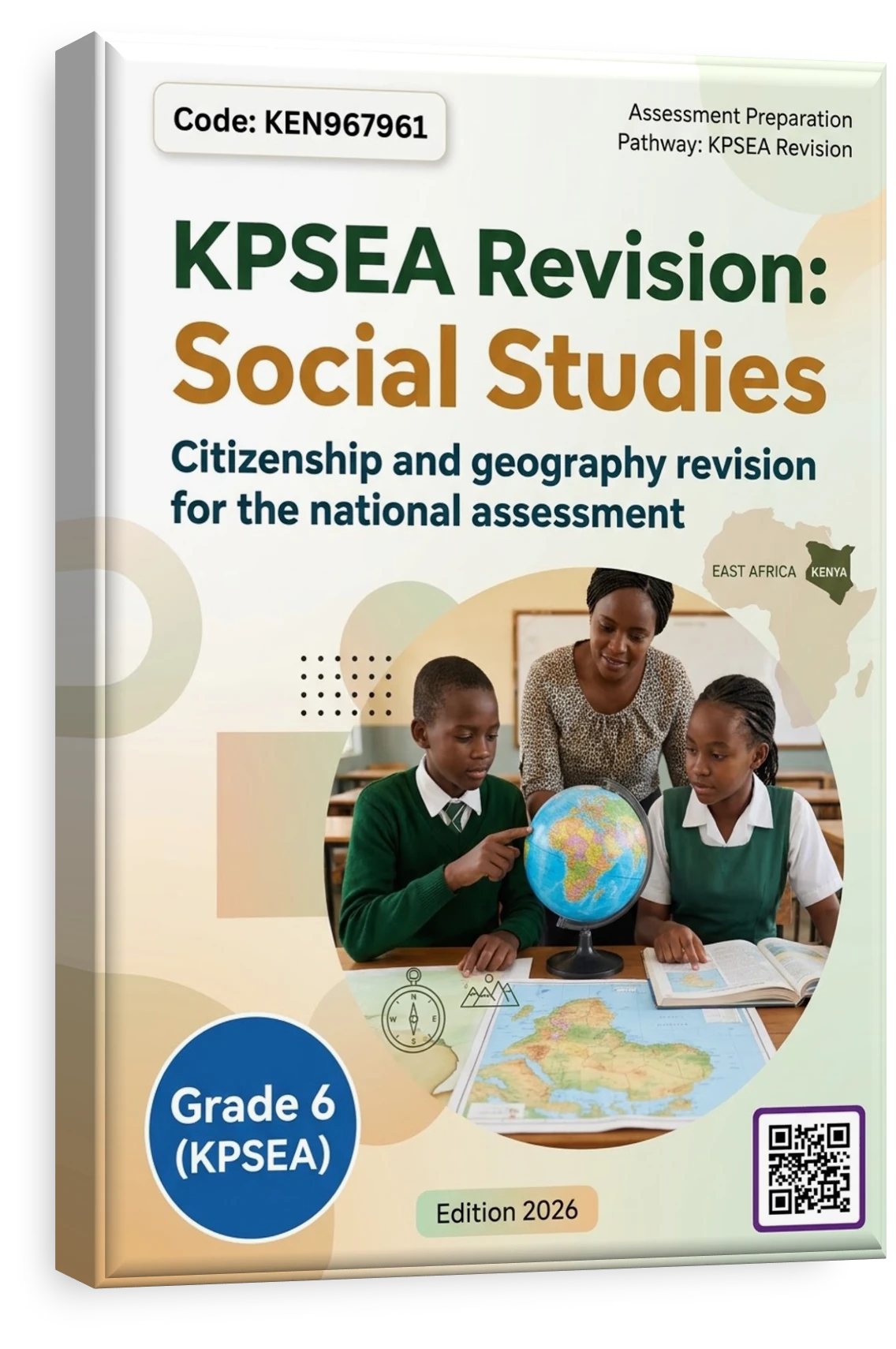
KPSEA Revision: Social Studies
Level: Grade 6 (KPSEA) — KPSEA Revision
Official Curriculum – Competency-Based Curriculum (CBC) – Kenya Institute of Curriculum Development (KICD).
PRELIMINARIES
1. A County You Can Name Without Hesitating
Ask a ten-year-old near Nyahururu which county lies next to hers and many freeze, yet by December she must place all forty-seven correctly on a national paper. Social studies turns that gap into a real question: why does Laikipia share a wheat belt with one neighbour and a dry border with Isiolo? Every page here answers something a learner will actually meet inside the KPSEA hall, from county boundaries to a governor’s duties, so the actual prize is a defensible answer, not a recited list.
2. Four Steps, Every Chapter, No Exceptions
Every chapter here follows the same rhythm, so a learner revising alone in Kapenguria or Mumias always knows what comes next. First, a real situation raises a question worth answering. Second, the idea behind it is explained in plain, exact language. Third, a short activity, a chart, an interview, a sketch map, turns the idea into something done with the hands. Fourth comes the payoff: the skill now owned, applied outside the exam room. Four steps, repeated six times, build one steady habit of thinking like a citizen.
3. Forty Learners, One Chalkboard, Still Enough
Most Kenyan classrooms preparing for KPSEA have forty or more learners and a single chalkboard, not an atlas each. Every activity here was chosen for that reality: a sketch map drawn from memory, a rainfall diary on a torn exercise-book page, a role-play needing only five volunteers. At home, a parent in Bungoma or Narok can help just as well, asking a child to name their county’s neighbours on any wall calendar, or to recall what the chief’s office actually requires for a document.
Chapter I. Finding Kenya on Every Map You Meet
I.1 Lost Between Mandera and Lamu
On a mock KPSEA paper, a learner in Eldoret placed Mandera, far in Kenya’s north-east, somewhere along the coast near Lamu’s dhow harbours, two counties sharing almost nothing except a border with another nation. The mistake is common, two marks lost on a single map question. Kenya’s forty-seven counties cluster around clear physical regions, and once a learner sees the pattern, such confusion disappears. Why does one county trade by camel and another by boat, within the same republic? Answering that is where this chapter truly begins.
I.2 Highlands, Rift, Coast and the Dry North
Kenya’s surface falls into regions a learner can picture rather than memorise: the cool central highlands around Mount Kenya, the Great Rift Valley splitting the country north to south, the Indian Ocean coast from Malindi to Diani, the Lake Victoria basin in the west, and the vast arid lands stretching from Turkana to Garissa. Each of the forty-seven counties sits mainly within one of these, which explains its rainfall, its crops and even its building materials. Knowing the region first makes every county fact easier to recall.
I.3 Building a County Map from Memory Alone
With no atlas to share, forty learners can still build an accurate map together. Working in pairs, they trace Kenya’s outline onto scrap paper, mark the Equator and the coastline first, then add counties one region at a time, checking each placement against a classmate from a different part of the country. A learner from Kisii confirms the west, one from Moyale the far north, one from Mombasa the coast. By the final round, the map holds together purely from shared memory, corrected argument by argument until everyone agrees.
I.4 Answering a Map Question Without Flinching
A learner who has built that map once rarely panics when the KPSEA paper asks where River Tana begins or which county borders Tanzania at Namanga. The skill is not memorising forty-seven names in order; it is reading a described location, picturing the region it sits in, and placing it with reasonable confidence. The same habit helps outside the exam hall too: planning a family’s road journey home for the holidays, or simply understanding why a cousin’s letter from Marsabit describes a landscape nothing like home.
Chapter II. Rain, Rivers and the Resources They Carry
II.1 Why Kitui Thirsts While Nyeri Floods
In the same month, families in Kitui sometimes wait anxiously for rain while rivers near Nyeri rise fast enough to worry farmers downstream. A learner asked to explain the difference on a past KPSEA paper wrote simply that one place is unlucky, which earned no marks. Kenya’s climate is not random; it follows altitude, distance from the ocean and wind patterns that a learner can actually describe. Before reaching for an answer, this chapter asks a harder question first: what exactly decides how much rain a place receives, and when?
II.2 Long Rains, Short Rains and the Map of Water
Most of Kenya depends on two rainy seasons, the long rains around March to May and the short rains around October to December, though the far north sees far less of either. Rivers such as the Tana and the Athi carry highland rain toward the ocean, while Lake Victoria feeds the humid west. Where rain is scarce, people rely instead on boreholes, dams and stored energy, including geothermal steam at Olkaria and wind turbines above Turkana’s plains. Resources follow climate, almost without exception.
II.3 Keeping a Two-Week Weather Diary
For two weeks, the morning sky gets a one-word verdict in a shared diary, clear, cloudy, light shower or downpour, since few schools own a rain gauge. Exchanging those diaries with a pen-friend class in a different region, perhaps one near Lake Baringo and another near Wajir, shows real contrast instead of a textbook claim. Some weeks match almost exactly; others could not be more different. Comparing the two records honestly teaches more about climate zones than any single paragraph ever could.
II.4 Choosing Where Water and Power Should Go
Once a learner can read a simple climate pattern, planning questions start making sense: why dig a borehole in a dry sub-county rather than build a dam where floods already happen, or why a windmill project suits an exposed plain better than a sheltered valley. This is the same reasoning county planners use before approving a project, only in miniature. On the KPSEA paper, that reasoning turns a guess into a justified answer, the kind examiners reward because it shows understanding, not memorised luck.
Chapter III. Two Governments, One Country
III.1 A Pothole Nobody Will Own
A stretch of road near Chuka floods every rainy season, yet neither the chief nor the area MCA seems to be fixing it, and a frustrated parent complains that the government is doing nothing. The complaint is only half fair: Kenya actually has two governments, national and county, each responsible for different things. A learner who cannot say which one builds that particular road will struggle with an entire section of the KPSEA paper. Untangling who answers to whom is the real task of this chapter.
III.2 Forty-Seven Counties, One National Government
Since 2013, Kenya has run two levels of government side by side. The national government, led from Nairobi, handles defence, foreign affairs, currency and overall education policy. Each county elects its own governor and county assembly, whose members, called MCAs, pass local laws and oversee county roads, health centres, markets and agricultural extension. A county cannot declare war or print money; a national ministry cannot ordinarily resurface a village market road. The split, once learned, answers most questions about who is responsible outright.
III.3 A County Assembly Meets in Class
Six learners take on the roles of governor, speaker, two MCAs, a clerk and a market trader, debating a real problem: should the county budget repair a flooded road or extend a dispensary? Each role argues its own interest, the trader for the road, a health-minded MCA for the dispensary, while the speaker keeps order and the clerk records the vote. Acting out the debate, rather than reading about it, shows how an assembly turns a complaint into a funded decision, or a stalemate.
III.4 Knowing Which Office to Visit First
After this chapter, a learner facing a real problem, a blocked drain, an unregistered birth, a boundary dispute between two shambas, can usually name the correct office before an adult does: the ward office, the sub-county, the county assembly or a national ministry. That single skill answers several KPSEA questions reliably and, more importantly, saves a family hours of being sent from one office to another. Knowing the system is not a classroom exercise; it is the difference between a solved problem and an afternoon wasted in a queue.
Chapter IV. Papers, Rights and the Citizen You Are Becoming
IV.1 The Boy Who Could Not Sit His Exam
A bright learner in Homa Bay was nearly barred from sitting a national exam because his birth was never officially registered, and without that first document, no later one could be issued either. His family had simply never visited the chief’s office after he was born. The story is common enough that KPSEA sets questions on it directly. Why does one small paper, filled in within weeks of birth, decide so much about a Kenyan’s later life? This chapter follows that paper from the moment it is written.
IV.2 From Birth Certificate to Voter’s Card
Kenya’s Constitution grants every child rights to a name, a nationality and education, but exercising them in practice depends on paperwork issued in careful order. A birth certificate, first registered at the chief’s office or a Huduma Centre, opens the door to school registration and later a national identity card at eighteen, which in turn opens a bank account, formal employment and the ballot box. Each document depends on the one before it. Skipping a step early, as happened in Homa Bay, can quietly close doors many years later.
IV.3 Tracing One Paper’s Whole Journey
A short interview at home, asking a parent exactly how their own birth was registered, which office came first, how long the certificate took, gives each learner one real case rather than a textbook description. Comparing accounts across the class usually reveals the same route everywhere: the chief’s office or a hospital record first, then a Huduma Centre for the certificate itself. Sketching that route as a simple arrow diagram turns an abstract civic process into a traced, personal fact.
IV.4 Helping a Family Start the Right Form
A learner who has traced that journey once can genuinely help at home: reminding a parent with a new baby sibling which office to visit first, or explaining to a worried neighbour why a birth certificate, not a church baptism card, is the document schools and hospitals actually require. That is citizenship practised rather than recited. On the KPSEA paper, the same understanding turns a question about rights and responsibilities into one a learner can answer from lived family experience, not a memorised definition.
Chapter V. Markets, Money and Working Together
V.1 One Trader, No Bargaining Power
A single tomato seller at a small market near Kerugoya cannot negotiate fuel or fertiliser prices with anyone; suppliers simply quote a price and she pays it or walks away empty-handed. Yet a nearby dairy cooperative, pooling the milk of two hundred farmers, negotiates processing fees few individual farmers ever could alone. The difference is not luck but organisation. Why do some Kenyan traders and farmers manage to shape the prices around them while others simply accept whatever is offered? That question drives this whole chapter forward.
V.2 Cooperatives, Saccos and the Power of Many
Kenya’s economy runs on farming, fishing, trade, small manufacturing and services, but much of its real strength comes from people combining resources. Dairy and coffee cooperatives collect produce from many smallholders and sell it together at a fairer price. Savings and credit cooperatives, known as saccos, let members save small amounts monthly and borrow larger sums later for school fees or a business. Informal chama groups do something similar on a smaller scale, often using mobile money transfers to collect contributions reliably, even across different towns.
V.3 Working Out a Chama’s Six-Month Savings
Imagine eight parents agreeing to contribute five hundred shillings each, every month, into one shared account, the full pooled amount going to a different member each round. Working through the sums round by round shows exactly how much each person has paid in after six months, and how much the member receiving that round collects in total. The arithmetic is simple, multiplication and a running total, but the lesson underneath is not: pooling small, regular amounts can raise a sum no single member could save alone that quickly.
V.4 Explaining Why Saving Together Works
Having worked through the chama arithmetic, a learner can explain, convincingly and in their own words, why a cooperative or sacco often achieves what an individual trader cannot: shared risk, bargaining power and a disciplined savings habit. That explanation answers one of the sturdier KPSEA economics questions, the kind asking a learner to justify an opinion rather than recall a fact. At home, the same understanding is worth repeating aloud, since a family weighing whether to join a local sacco is making a decision this chapter has already rehearsed.
Chapter VI. Kenya’s Place Among Its Neighbours
VI.1 Elephants Do Not Read County Boundaries
Elephants moving between the Maasai Mara and conservation areas across the Tanzanian border sometimes trample crops on farms sitting along their old migration path, leaving angry farmers and a genuine policy problem. Wildlife, rivers and weather systems rarely respect lines drawn on a political map. Trade is similar: goods crossing daily at the Busia border with Uganda depend on agreements between two separate countries working smoothly together. Why would Kenya need to cooperate formally with its neighbours rather than manage everything alone?
VI.2 Parks, Partners and a Wider Region
Kenya protects wildlife through national parks and conservancies, often working with neighbouring countries on shared ecosystems and anti-poaching patrols, since animals migrate regardless of any border post. Regionally, Kenya belongs to the East African Community alongside Uganda, Tanzania, Rwanda, Burundi, South Sudan, the Democratic Republic of Congo and Somalia, cooperating on trade, infrastructure and free movement of people. More broadly, membership in the African Union links Kenya to cooperation across the whole continent. Cooperation, not isolation, increasingly decides how well a country like Kenya actually functions.
VI.3 A Two-Country Role-Play, One Shared Problem
Half the class represents Kenya, half represents a neighbouring country, and together they must negotiate a short agreement solving one shared problem: migrating wildlife damaging border-area crops, or a river whose water both sides need for irrigation. Each side lists its concerns first, then both groups draft three simple rules they can genuinely accept. The exercise rarely produces a tidy solution on the first attempt, which is exactly the point: real cooperation between countries takes patient, repeated negotiation, not a single lucky agreement signed in an afternoon.
VI.4 Why Kenya Needs Good Neighbours
After negotiating even a pretend agreement, a learner understands something textbooks rarely convey clearly: cooperation protects Kenya’s own interests as much as anyone else’s. Protected wildlife draws tourists whose spending supports conservancies and nearby communities; smooth cross-border trade keeps goods affordable; shared water agreements prevent conflict upstream and downstream alike. On the KPSEA paper, a question about regional cooperation stops being an abstract list of organisation names and becomes a reasoned answer about why Kenya chooses partnership deliberately, again and again, rather than going it alone.
ANNEXES
A. Words Worth Knowing, in English and Kiswahili
This glossary gathers the chapter’s key terms with their everyday Kiswahili equivalents, since a learner often knows the idea in one language before the other: devolution as ugatuzi, county as kaunti, cooperative as chama cha ushirika, constitution as katiba, citizen as raia, boundary as mpaka. Each entry gives a one-line Kenyan example rather than a dictionary definition, so revision stays concrete. A learner stuck on an English exam term can check it here and answer with real confidence instead of a guess.
B. A Home Revision Sheet and a Timed Mock Round
This sheet gives a parent, however busy, five quick questions per chapter to ask aloud at home, no marking required, just a chance to talk through an answer out loud before the real assessment. It ends with one full timed round of ten KPSEA-style social studies questions, covering maps, government levels, documents, cooperatives and regional cooperation, to be attempted under genuine exam time limits. Reviewing wrong answers together afterward, slowly and without blame, usually fixes a misunderstanding faster than any amount of silent re-reading ever could.
C. The Project Log Every Chapter Points Back To
Every hands-on activity in this book, the memory map, the weather diary, the county-assembly role-play, the chama arithmetic, the cross-border negotiation, is logged here in one place: date attempted, what was done, what surprised the learner, and a rough self-mark out of ten against a simple rubric covering accuracy, effort and clear explanation. By the final chapter, the log itself becomes a genuine revision tool, showing at a glance which skills are already solid and which ones still deserve one more careful look before the exam.

Discussion (0)
Aucune intervention pour le moment. Soyez le premier à contribuer.
Votre intervention Annuler la réponse