
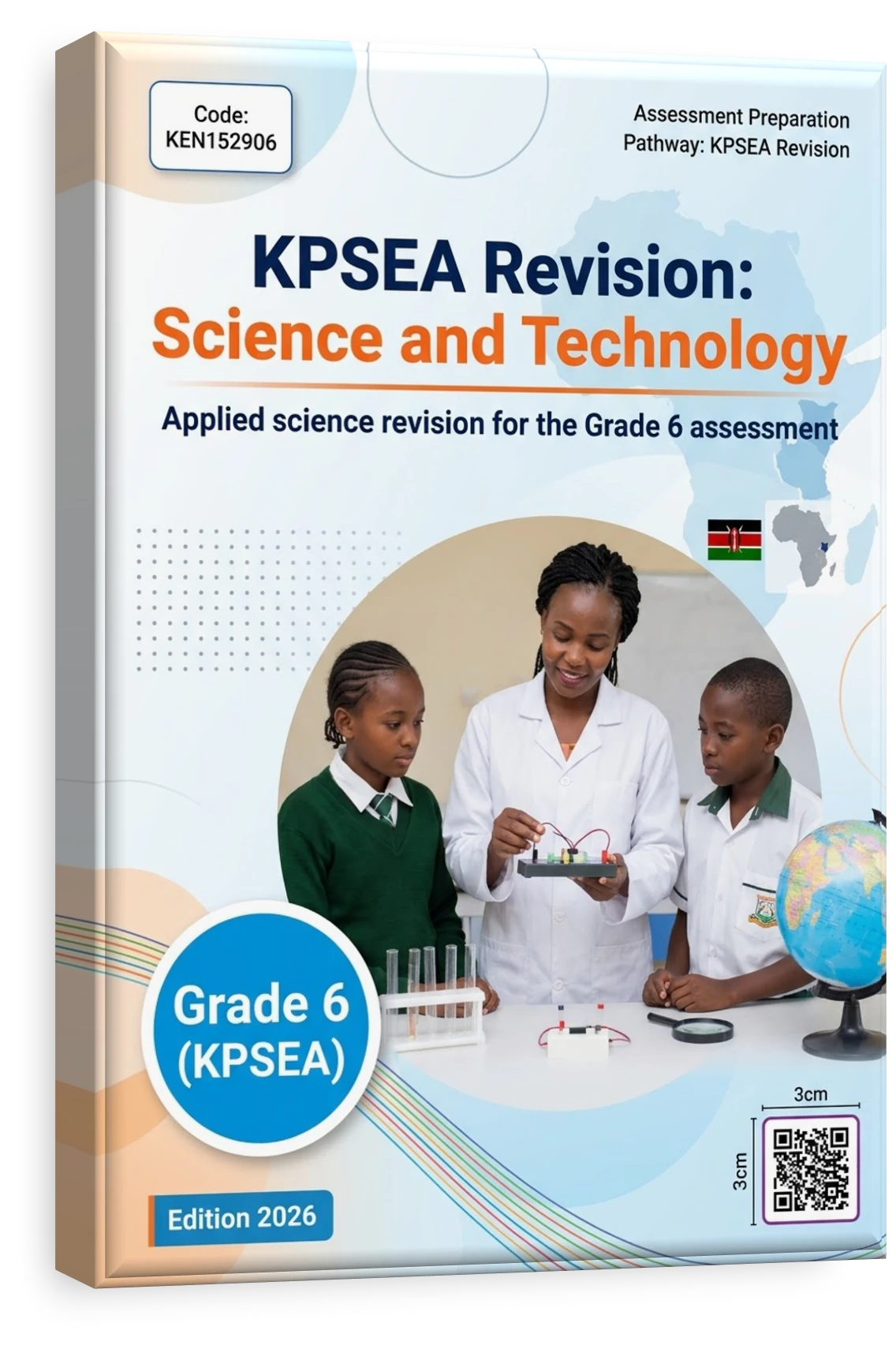
KPSEA Revision: Science and Technology
Level: Grade 6 (KPSEA) — KPSEA Revision
Official Curriculum – Competency-Based Curriculum (CBC) – Kenya Institute of Curriculum Development (KICD).
PRELIMINARIES
1. Why a Grade Six Scientist Already Lives in Your Home
A flower-farm worker in Naivasha tests the water’s pH every morning before a single stem is cut; get it wrong, and a whole greenhouse of roses wilts by evening. That same instinct, observe first, explain second, sits behind every chapter in this book. Grade 6 science is not a subject to survive before high school; it is the reasoning the KPSEA will test directly: notice a problem, name the idea behind it, then act. Each page answers a question a Kenyan household actually asks.
2. The Four-Step Rhythm Behind Every Chapter
Each chapter follows the same path, and once a learner knows it, revision gets faster. First comes a real situation: a tap that stays dry, a bulb that will not light. Then the idea itself, explained in plain words with a diagram or example. Third is a hands-on task: counting, measuring, building, sorting. Last comes the payoff: the skill used on an actual problem at home, at school, or in the community. KPSEA questions follow this same order, from situation to understanding to action.
3. Teaching Science With Forty Learners and One Beaker
Forty children and a single measuring jug is the normal science lesson in many Kenyan primary schools, and it still works. Group observation, one set of materials passed round while others record on slate boards or scrap paper, turns scarcity into teamwork. At home, a parent can repeat almost every investigation here with a basin, a candle stub or kitchen scraps, no laboratory required. What matters for KPSEA is not equipment but a learner who can explain why something happened, out loud, in their own words.
Chapter I. What Lives, Breathes and Branches Around Us
I.1 The Bat Cave Puzzle of Mount Elgon
Deep inside the Kitum Cave on Mount Elgon, bats hang upside down by the thousand, and elephants visit at night to lick salt from the walls. Are bats birds because they fly, or something else entirely? A learner who has only ever sorted animals into « wild » and « tame » meets a real puzzle here. Answering it properly needs a clear set of rules, not a guess, and that is exactly the gap the next idea closes.
I.2 Backbones, Breathing and Branches: Sorting Living Things
Living things sort neatly once the right questions are asked: does it have a backbone, does it breathe through lungs, gills or skin, does it make its own food like a plant or hunt for it like an animal? Vertebrates split into fish, amphibians, reptiles, birds and mammals; invertebrates include insects, spiders and worms, and plants divide by whether they flower or not. These groups are not labels to memorise; they predict how a creature lives, eats and survives.
I.3 A Flamingo Count at Lake Bogoria
Lake Bogoria turns pink some mornings when a million flamingos crowd its hot, alkaline shore to feed on algae. Counting them properly means picking a stretch of shoreline, marking it with stones, and tallying birds in that strip before multiplying for the whole lake. The same method, sample a small area carefully, then scale up, works for counting insects in a school garden or trees along a road. Numbers collected this way become evidence, not a guess pulled from the air.
I.4 Reading a Food Web at Nairobi National Park
Lions, zebras and the grass they depend on sit minutes from Nairobi’s skyscrapers inside Nairobi National Park, a food web in miniature. Remove the grass through drought and zebra numbers fall; fewer zebras then means hungrier lions. Drawing arrows from sun to grass to zebra to lion turns an abstract word, ecosystem, into a diagram anyone can follow. A learner who can trace that chain both ways has mastered this chapter’s real goal: seeing nature as connected, not as separate animals.
Chapter II. Inside the Human Body
II.1 Why Does My Stomach Hurt After Ugali and Sodas?
A child at a county hospital in Machakos complains of stomach pain after a large lunch of ugali, beans and a fizzy soda. The nurse asks what and how much was eaten before examining anything else. That question points straight at digestion: food has to be broken down, and too much too fast overloads the system. Understanding what happens between the first bite and the last stage of digestion turns a common complaint into a lesson about the body’s own machinery.
II.2 From Mouth to Small Intestine: Tracing What Happens to a Meal
Digestion starts in the mouth, where teeth and saliva begin breaking food apart before it is even swallowed. The stomach churns it with acid, the small intestine absorbs nutrients into the blood, and the large intestine removes what is left as waste. Each organ has one clear job, and missing a meal, chewing too fast or drinking too little water changes how well the whole chain works. Knowing the order of these organs is exactly the kind of fact a KPSEA paper rewards.
II.3 Counting Breaths in an Isiolo Classroom
In an Isiolo classroom, pairs of learners time each other’s breathing for one minute while resting, then again straight after running around the compound. The count nearly doubles, and a simple balloon stretched over a bottle, pushed and pulled by a straw, shows why: lungs expand to pull air in and relax to push it out. Recording both numbers on a chart turns a playground game into real data about how the respiratory system responds to effort.
II.4 Pacing a Run Near Iten
Runners training on the dirt roads above Iten check their pulse at the wrist, not because they are tired but because the number tells them how hard the heart is working. A resting pulse near seventy beats a minute can double during a hill climb, pushing blood faster to muscles that need oxygen. Feeling for that beat and counting it for fifteen seconds, then multiplying by four, turns the circulatory system from a diagram into something a learner can measure on themselves.
Chapter III. Matter That Changes Without Disappearing
III.1 What Happens to Maize Flour at the Kitale Posho Mill
Whole maize grains go into the hopper at a Kitale posho mill hard, dry and yellow; flour comes out soft, pale and fine enough to float in the air. Nothing has been added and nothing has vanished, yet the material looks completely different. That contradiction, same matter, new form, is the question this chapter answers properly. A learner who can explain where the « missing » grain actually went has grasped something far bigger than milling.
III.2 Solid, Liquid, Gas: Matter Changes Without Disappearing
Matter exists as solid, liquid or gas, and heat or cold can move it between the three without losing a single gram. Ice becomes water, water becomes steam, and steam condenses back into water on a cold lid. Milling, melting and dissolving all rearrange particles rather than destroying them, which is why weighing maize before and after grinding gives nearly the same total. This single idea explains cooking, weather and dozens of KPSEA questions that look, at first, unrelated.
III.3 Separating Milk and Water at an Eldoret Dairy
A cooperative dairy near Eldoret tests delivered milk by checking whether water has been added to stretch the volume for a better price. Filtration through fine cloth catches solid impurities, but water mixed into milk needs a different trick entirely, since the two liquids blend completely. Comparing density with a simple hydrometer reveals the fraud in seconds. The lesson travels beyond milk: sieving, filtering, evaporating and decanting each separates a different kind of mixture, and choosing the right one matters.
III.4 Clearing Muddy Water in Lodwar
After heavy rain near Lodwar, water collected from a seasonal river runs the colour of tea, thick with suspended soil. Passing it through layers of coarse sand, fine sand and charcoal in a cut plastic bottle clears it visibly within minutes, though boiling is still needed before anyone drinks it. Building that filter from material found around any compound turns a chapter on separating mixtures into a skill that protects a family during the driest, dustiest months of the year.
Chapter IV. Energy, Forces and Simple Machines
IV.1 The KPLC Token That Finished Too Soon
A family in Nanyuki buys a KPLC token on Monday and finds the lights cutting out by Thursday, far sooner than expected. Checking which appliance was left running longest, an iron box or a bulb, starts to explain why. Electrical energy is bought in units, and every device converts it into heat, light or motion at a different rate. That household budgeting problem is the doorway into a chapter about where energy comes from and how fast it gets used up.
IV.2 Sun, Wind and Water: Where Kenya’s Power Comes From
Turbines on the ridges above Lake Turkana spin day and night, turning wind into electricity for the national grid, while dams on the Tana River use falling water instead. Both are renewable sources, unlike the diesel generators that still power some remote schools. Solar panels capture a third kind of energy directly from sunlight without burning anything at all. Naming each source correctly, and knowing which ones Kenya depends on most, is a fact worth more than most learners realise.
IV.3 Building a Seesaw Crane in a Kariakor Workshop
A jua kali welder near Kariakor lifts a heavy engine block using nothing more than a long metal bar resting on a block, a lever doing in seconds what no one could manage by hand. Building a miniature version from a ruler and a pencil, then testing where the load sits compared with the push, shows the same principle at work. Pulleys, wheels and ramps all trade distance for force in their own way, and testing each one makes the trade visible.
IV.4 Lighting a Bulb With a Dry Cell
Steam rising from the wells at Olkaria drives turbines that supply a large share of Kenya’s electricity, proof that heat deep underground can end up lighting a bulb far away in a classroom. Building that same outcome on a smaller scale, a dry cell, two wires and a torch bulb connected in a loop, shows what a complete circuit actually needs. Breaking the loop at any point, even with a single loose wire, and the light disappears; that fault-finding skill is the chapter’s real prize.
Chapter V. Water, Weather and a Changing Environment
V.1 When the Borehole in Wajir Runs Dry
Herders near Wajir sometimes walk their livestock for hours when a borehole runs dry during a poor rainy season, a hardship that repeats across much of northern Kenya. Asking where that water should have come from, and where it goes when it disappears, opens a bigger question about the whole water cycle. A region can receive rain and still face shortage, depending on how fast water evaporates, drains away or is used, and that distinction matters more than rainfall totals alone.
V.2 Clouds, Rain and the Journey Back to the Ground
Water evaporates from oceans, lakes and even leaves, rises as invisible vapour, cools into clouds, and eventually falls again as rain, hail or dew before the whole cycle restarts. Kenya’s long rains and short rains follow this pattern at different times across the country rather than together. Drawing the cycle as a loop rather than a straight line fixes a common mistake, since water is never created or destroyed, only moved between the sky, the ground and every living thing.
V.3 Measuring Rainfall on the Kabarnet Highlands
A homemade rain gauge, a straight-sided jar marked in centimetres and left open on a pole near Kabarnet, collects a clear record of how much fell overnight. Comparing readings across a month against the same site the previous year shows whether a season is running wetter or drier than usual. That habit, reading and recording a measurement at the same time each day, is precisely the scientific discipline a KPSEA practical question is built to test.
V.4 A Chama Builds a Water Tank in Makueni
Women in a savings chama in Makueni pooled small weekly contributions until there was enough to roof a water tank that now carries a family through the driest months without a long walk to a river. Harambee spirit, many small amounts becoming one large result, works for conservation exactly as it works for a wedding or a school fee. Catching rainwater off a roof instead of letting it run into the soil is the chapter’s conservation idea turned into something a family can actually build.
Chapter VI. Health, Technology and Getting Ready
VI.1 Cholera Reaches a Homa Bay Fishing Village
A fishing village on Lake Victoria near Homa Bay reports several cases of severe diarrhoea within the same week, and health workers trace it back to water drawn from the lake without boiling. Cholera spreads through contaminated water and food with alarming speed in a crowded community. The outbreak raises an urgent question this chapter has to answer plainly: what exactly makes water unsafe, and which simple habits stop a single sick household from becoming an entire village’s crisis.
VI.2 Three Plates a Day: Balancing a Mwea Family’s Diet
Rice farmers around Mwea eat what they grow in abundance, yet a diet built almost entirely on rice can still leave a child undernourished without the right balance alongside it. A proper plate needs energy foods like rice or ugali, body-building foods like beans, fish or milk, and protective foods like vegetables and fruit, in roughly equal measure. Spotting which group is missing from a typical family meal is a far more useful skill than simply naming the three groups.
VI.3 Designing a Phone Charger for a Voi Kiosk
A kiosk owner outside Voi without a grid connection still needs to charge customers’ phones every day, and a small solar panel wired to a battery and a USB socket solves the problem cheaply. Sketching that simple circuit, panel, battery, switch and socket, before building a working version with classroom materials, turns scattered facts about electricity into one practical device. Technology like this, built from a clear understanding of energy and circuits, is already changing how rural Kenya gets power.
VI.4 Ready for the KPSEA Paper
Every system studied this year, digestion, circulation, energy, matter, water and health, reappears in KPSEA questions dressed as a short scenario rather than a direct definition. A learner who has practised naming the idea behind a situation, not just memorising a list, answers faster and more accurately under timed conditions. Revisiting the four-step rhythm from the start of the book, question, idea, investigation, application, one final time turns six chapters of content into confidence walking into the exam room.
ANNEXES
A. Science Words in English and Kiswahili, and a Safety Checklist
This annex lists forty key terms from the book, digestion, circuit, vertebrate and more, each with its Kiswahili equivalent such as kiungo cha chakula for digestive organ, so meaning is never lost between languages at home. A short safety checklist follows: no tasting unknown substances, no bare flames without supervision, hands washed after handling soil or water samples. A teacher can read both sections aloud before any practical lesson, and a parent can use the glossary to discuss homework in whichever language the family speaks best.
B. A Kitchen Investigation for Home, and How KPSEA Marks It
One home activity sheet guides a family through growing mould on bread under different conditions, light against dark, dry against damp, using only what the kitchen already has. An assessment rubric alongside it shows exactly how a teacher scores observation, recording and explanation separately, so a learner knows which skill needs more practice. A bank of twenty practice questions, written in the short-scenario style KPSEA actually uses, closes the annex with answers a learner can check without help.
C. The Formula and Diagram Sheet Every Reviser Needs
This final annex gathers every diagram from the book onto a few pages: the digestive and circulatory systems labelled clearly, the water cycle drawn as a loop, a complete circuit with its symbols, and the three states of matter with arrows showing how heat moves between them. A blank project log at the end lets a learner record their own investigations, date by date, in the same format used throughout the chapters, ready to revise from in the final week before the KPSEA.
Discussion (0)
Aucune intervention pour le moment. Soyez le premier à contribuer.
Votre intervention Annuler la réponse