
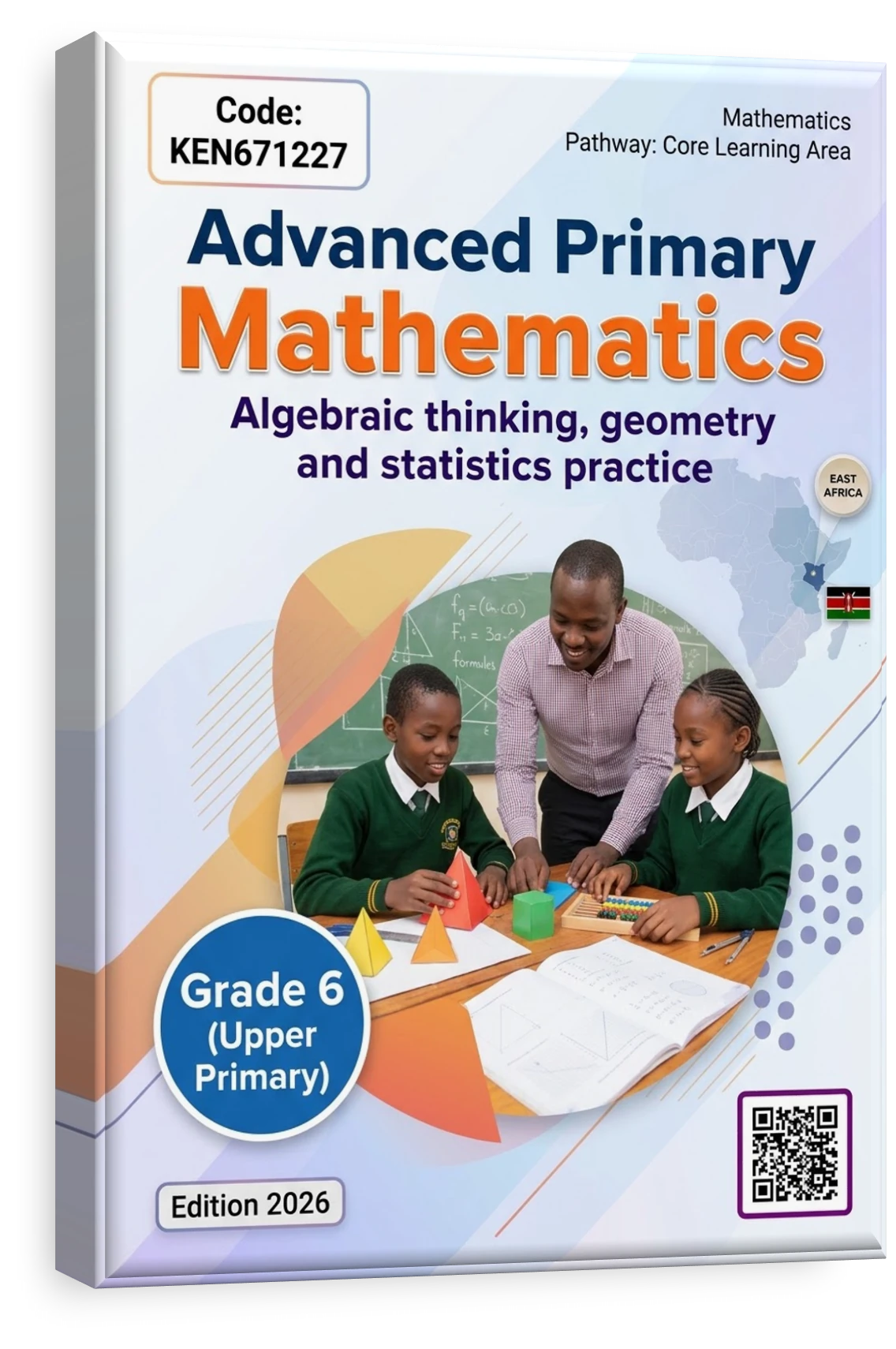
Advanced Primary Mathematics
Level: Grade 6 (Upper Primary) — Core Learning Area
Official Curriculum – Competency-Based Curriculum (CBC) – Kenya Institute of Curriculum Development (KICD).
PRELIMINARIES
1. Why a Sacco Loan Cannot Be Repaid by Guesswork
In Nyeri, a sacco member borrows KES 20,000 to buy a water pump for the family shamba, repayable with interest over ten months. Guess the monthly instalment wrong and either the pump sits unpaid for years or the family quietly overpays without ever noticing the mistake. Grade six mathematics hands a ten or eleven year old that exact power: numbers that settle arguments, plans that work, loans that close on time. This book turns algebra, geometry and statistics into tools a learner already needs at home.
2. How This Book Moves: Problem, Idea, Practice, Payoff
Each chapter keeps the same four-beat rhythm. First a real puzzle, perhaps counting sacks of maize at a Nakuru posho mill, opens the question and makes it matter. Then the mathematical idea behind it is explained plainly, with worked examples a learner can copy. Third comes a hands-on task: measuring, sorting, drawing or calculating with real objects and real shillings. Finally the new skill answers the original puzzle completely, so nothing learned stays trapped inside an exercise book.
3. Forty Learners, One Chalkboard: Making Mathematics Work at Home
Kenyan classrooms are often large, with one teacher, one board and few textbooks to share between rows. Pair learners so every problem is talked through aloud before it is written down; a borrowed exercise book or a cleared patch of dust can replace a missing ruler. At home, a parent can turn a chama’s weekly contributions, a shopping list or a KPLC token reading into genuine practice. Confidence in mathematics grows fastest where numbers are handled daily, not saved for exam day alone.
Chapter I. Counting a Nation: Place Value and the Four Operations
I.1 What Seven Zeroes Mean on a County Budget
Posted outside the Machakos county offices, a budget notice reads KES 9,240,000 for new boreholes. Many learners can read the shillings sign but stumble the moment the zeroes start multiplying. Which digit controls the millions, and which only the hundreds? A number that size is not just long, it carries different weight in every position, and misreading one place can turn a borehole budget into something worth only a classroom’s chalk supply. The question is simple: what does each digit actually stand for?
I.2 Place Value Up to Millions, Digit by Digit
Every digit in a number has a value fixed by where it sits: ones, tens, hundreds, thousands, ten thousands, hundred thousands, then millions. KES 9,240,000 breaks into nine millions, two hundred thousands, four ten thousands and no units left over. Reading it aloud group by group prevents the common mistake of adding an extra zero or dropping one by accident. The same place-value chart that reads a budget also reads a phone number, a population count or a weighbridge ticket.
I.3 Building a Place Value Chart from Bean Seeds and Bottle Tops
Working in pairs, learners sort dried beans into piles of ten, then bundle ten piles into a hundred using bottle tops as containers, physically rebuilding the place value chart with their own hands. Given a real figure, perhaps a Narok weighbridge slip showing 48,750 kilograms of wheat, they write the number, circle each digit’s place and explain its value to a partner. Swapping roles afterwards catches careless mistakes faster than any worksheet marked alone at a desk.
I.4 Settling a Harambee Account to the Last Shilling
A church harambee in Kiambu raised KES 1,386,450 towards a new borehole, spent on pipes, labour and a pump across three instalments. Using addition and subtraction on the recorded amounts, learners check whether the committee’s final balance matches what was actually collected, catching one entry copied with a misplaced digit. The skill travels straight home afterwards: checking change at a shop, a school fee receipt or a sacco statement with the very same confidence and care.
Chapter II. Sharing Fairly: Fractions and Decimals
II.1 Dividing One Cow’s Milk Among Three Households
A Nandi homestead keeps one cow whose morning milk, four litres, must be shared fairly among three households that jointly fed it through the dry season. Splitting four by three refuses to give a whole number, yet nobody at the gate wants an argument over cups. Somewhere between whole litres and empty containers lies an answer that is exact, even if it is not a tidy one. That gap, between what divides evenly and what does not, is exactly where fractions start to matter.
II.2 What a Fraction Actually Counts
A fraction names parts of a whole: the bottom number shows how many equal parts something is cut into, the top number shows how many of those parts are taken. Four litres shared by three households becomes four thirds, better written as one whole litre plus one third more for everyone. Equivalent fractions, like two quarters and one half, describe the same amount in different words, and ordering fractions means comparing how much of the whole each one truly holds.
II.3 Handing Out Chapati Dough to Prove Fractions Are Real
Handed a ball of dough, or a folded paper circle standing in for chapati, learners cut it into halves, then quarters, then eighths, labelling every cut before comparing sizes by eye and then by measurement. A simple table records which combinations of pieces rebuild a whole, revealing that three eighths plus five eighths always makes one, however the dough happens to be shaped. Converting a few of these fractions to decimals on paper closes the gap between cutting dough and calculating on it.
II.4 Pricing a Bag of Maize Sold in Thirds
A trader in Eldoret sells a ninety-kilogram bag of maize to three customers who want it split unevenly: a half, a third and a sixth. Checking that the three fractions add exactly to one confirms nobody was shortchanged, before decimal prices per kilogram are worked out to the nearest fifty cents. What began as a dough-cutting game now settles a real transaction, and the learner leaves able to judge whether any shared purchase was divided honestly.
Chapter III. Letters That Hold Numbers: Algebraic Thinking
III.1 The Mystery Number in a Matatu Fare
A matatu fare from town to a village rises by an unknown amount every rainy season, and a regular passenger wants to predict next month’s cost without waiting to be told at the stage. Calling the unknown rise ‘n’ turns a guessing game into a question that can actually be answered with working. Why write a letter where a number should be? Because some numbers are not yet known, and algebra exists precisely to reason about them before they are revealed.
III.2 Expressions, Variables and What the Equals Sign Really Means
A variable is a letter standing in for a number not yet fixed; an expression such as ‘n + 50’ combines variables and numbers using an operation. The equals sign is not a label meaning ‘the answer follows’, it is a balance: whatever is true on one side must stay true on the other side too. Solving ‘n + 50 = 120’ means finding the one value of n that keeps both sides equal, here seventy, found by undoing the addition carefully.
III.3 Balancing a Seesaw of Stones to Find the Hidden Weight
A ruler balanced on a pencil becomes a simple seesaw: learners place known weights, bottle tops of equal mass, on one side and a mystery parcel on the other, adding or removing stones until balance is reached. Recording each trial as an equation, then solving it on paper, shows physically why adding or removing the same amount from both sides keeps a balance true throughout. The seesaw becomes a working model nobody in the group forgets quickly.
III.4 Writing a Rule for a Water Vendor’s Daily Earnings
A water vendor in Isiolo pushes a handcart of jerricans to homes with no piped supply, charging a fixed KES 30 call-out fee plus KES 10 per twenty-litre jerrican delivered. Predicting a day’s earnings without recalculating every stop needs a rule, not guesswork trip by trip. Writing it as an expression, 30 plus 10 times the number of jerricans, lets the vendor plug in any count instantly and check a customer’s bill. Learners test the rule against three real deliveries before trusting it fully.
Chapter IV. Shapes That Hold Up Roofs: Geometry
IV.1 Why a Tin Roof’s Corner Keeps Leaking
A newly built house in Kisii has a tin roof whose corner keeps letting rain through, and the fundi blames an angle that was never checked properly during construction. Was the corner meant to be a perfect right angle, and was it actually cut that way on site? Angles that look close enough to the eye can be several degrees off, and on a roof, every stolen degree becomes a gap. Measuring, not guessing, is the only way to find the real fault.
IV.2 Naming and Measuring Angles with a Protractor
An angle is the amount of turn between two lines meeting at a point, measured in degrees: acute angles are smaller than ninety, right angles are exactly ninety, obtuse angles sit between ninety and one hundred eighty, and straight angles complete a full one hundred eighty degrees. A protractor placed with its centre on the vertex and its base line on one arm reads the angle directly off the scale. The same tool checks a roof corner or a classroom door frame just as easily.
IV.3 Checking Every Corner of the School Compound
Working outdoors in small groups, learners use a home-made protractor, a circle of card marked in degrees, to measure corners of the classroom block, a gate and a desk, recording which are true right angles and which fall short. A string and three pegs test the three-four-five rule, an old builder’s trick for marking a right angle without any instrument at all. Comparing results across groups shows how even small construction errors add up over the length of a wall.
IV.4 Calculating How Much Iron Sheet a Repaired Roof Needs
Back to the leaking Kisii roof: once its corner is corrected to a true right angle, the rectangular section needing new iron sheets can be measured accurately, length by width, to find its area. Multiplying the two gives the exact surface to cover, letting the family buy only what is needed instead of guessing and wasting money at the hardware shop. Geometry, started as a leak nobody could explain, ends as a roof nobody has to fix twice in one season.
Chapter V. Measuring a Working Day: Length, Mass, Capacity, Time and Money
V.1 Did the Milk Tanker Deliver What It Promised?
A cooperative in Nyandarua receives a tanker said to hold two thousand litres of milk, but the collection clerk suspects it arrives short most mornings before the queue even starts. Without a reliable way to measure and convert between litres and the smaller containers used on site, nobody can prove or disprove the suspicion, and farmers keep losing money quietly every week. Getting measurement right here is not an abstract skill; it decides whether people are paid what they are actually owed.
V.2 Converting Between Units Without Losing a Digit
Length, mass, capacity and time each have units that scale by powers of ten or by fixed conversions: a thousand grams make a kilogram, a thousand millilitres make a litre, sixty minutes make an hour exactly. Moving between units means multiplying or dividing by that conversion factor, never guessing at the answer. Money works the same way in Kenya, with one hundred cents making a shilling, and a clear method for converting prevents the small, repeated errors that quietly drain a family budget.
V.3 Timing and Measuring a Real Delivery Route
Using a stopwatch, a tape measure and containers of known volume, learners simulate the milk delivery by timing how long it takes to fill drums with water and converting the totals between litres and millilitres carefully. A table records the tanker’s claimed volume against the measured one, repeated three times for fairness and accuracy. The exercise also tracks how long the whole simulated route takes, converting minutes into hours and back, exactly as a real delivery schedule would require of any driver.
V.4 Proving a Shortfall and Writing the Receipt That Fixes It
Combining the measured volumes with careful unit conversion, learners calculate the tanker’s actual shortfall against its claimed two thousand litres and convert the missing litres into the shillings the cooperative was underpaid that week. Writing this as a simple receipt, with units labelled clearly throughout, is the same skill a shopkeeper, a fuel seller or a parent checking a gas cylinder needs every single day. Measurement stops being a classroom topic and becomes a quiet form of honesty.
Chapter VI. Reading a Crowd: Statistics and Probability
VI.1 Which Market Day Really Sells the Most Tomatoes?
A trader in Kitale’s market insists Saturdays are her best day, but her cousin running a stall in Busia claims Wednesdays beat every other day there instead. Neither has ever written the numbers down; both are arguing from memory and pride rather than proof. Settling the question needs more than an opinion, it needs data collected honestly over several weeks and a fair way to compare results. Statistics exists for exactly this kind of argument, turned into something provable.
VI.2 Collecting Data, Drawing It, and Finding the Mean
Data becomes useful once it is organised: a tally sheet counts occurrences, a frequency table groups them, and a bar graph or pictograph makes the pattern visible at a glance. The mean, found by adding all the values and dividing by how many there are, gives one number that represents a whole set fairly, while the mode shows the most common value and the range shows the spread between highest and lowest figure. Each tool answers a slightly different question about the same set.
VI.3 A Week of Real Sales Turned into a Class Graph
Given seven days of invented but realistic tomato sales figures for Kitale and Busia, learners build frequency tables, draw bar graphs to scale on graph paper, and calculate the mean and range for each market carefully. Working in groups, they must defend which single number best answers the original argument, mean, mode or highest single day, and justify the choice aloud in their own words rather than simply naming a formula from the board.
VI.4 Declaring a Winner and Explaining Why, With Numbers
Comparing the two means settles the cousins’ argument fairly: whichever market’s average truly outperforms the other wins, provided the range shows the result was not just one lucky day pulling the figures up. Learners write a short verdict citing the mean, the mode and the spread together, the same reasoning a county agricultural officer would use before advising farmers where to sell. Probability closes the chapter: estimating, from the data, how likely next Saturday is to repeat the pattern.
ANNEXES
A. A Bilingual Glossary: English and Kiswahili Mathematics Words
This annex lists every key term from the book, place value, fraction, variable, angle, mean, in English beside its Kiswahili equivalent: nambari kamili, sehemu, kigezo, pembe, wastani. A learner more comfortable in either language can follow a lesson without losing the mathematics underneath the words. Each entry carries a one-line definition and a page reference back to where the idea first appears, making the glossary a quick revision tool before any test or KPSEA practice session.
B. Practice Questions in the Style of the KPSEA
Thirty questions mirror the format, timing and command words used in the Kenya Primary School Education Assessment, covering every chapter in proportion to its weight in the syllabus: numbers, fractions, algebra, geometry, measurement and statistics. Each question carries a worked solution and a short note on the common mistake it is designed to catch, such as misreading a unit or forgetting to simplify a fraction fully. A suggested timing guide helps learners practise working calmly under real exam pressure.
C. A Home Project Log for Numbers Found Around the Compound
This log gives families a simple weekly sheet for turning daily life into mathematics practice: recording a shopping list’s total, a water drum’s capacity, a chama contribution table or a plot’s measured area, one entry at a time. Each page asks for the real figures found, the calculation carried out, and a one-line check of whether the answer makes sense. Returned to class each term, the log becomes evidence of mathematics genuinely lived outside the exercise book.



Discussion (0)
Aucune intervention pour le moment. Soyez le premier à contribuer.
Votre intervention Annuler la réponse