
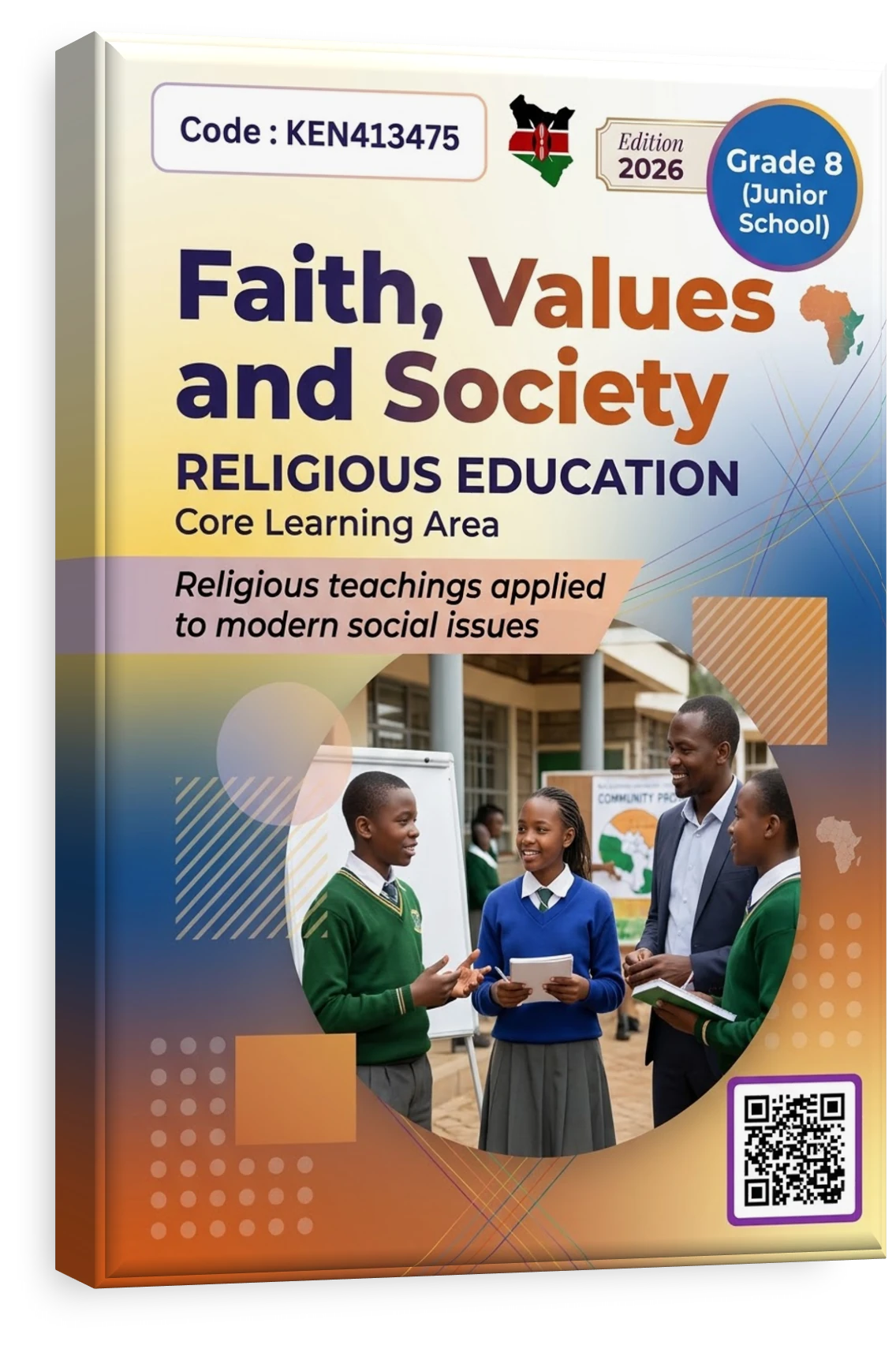
Faith, Values and Society
Level: Grade 8 (Junior School) — Core Learning Area
Official Curriculum – Competency-Based Curriculum (CBC) – Kenya Institute of Curriculum Development (KICD).
PRELIMINARIES
1. Why Faith and Values Still Decide the School Day
A Grade 8 learner in Kitale is handed a leaked assessment paper the night before a test. Taking it feels safe; refusing feels lonely. That single decision pulls on everything this course studies — conscience, scripture, culture and law each offering an answer to the same question. Faith and values are not Sunday or Friday topics alone; they decide what happens with a leaked paper, a found wallet, or a friend under pressure, which is why this book treats such moments as the real lesson.
2. Four Steps, Every Chapter, No Exceptions
Every chapter in this book follows the same rhythm. First, a real Kenyan situation raises a question nobody can dodge. Second, the idea behind it is explained plainly, with its proper name and its source — scripture, the Constitution, or community custom. Third, an exercise, survey or short project tests the idea against daily life. Fourth, the chapter names the skill now owned and shows exactly where it is used outside class — at home, at church, mosque, temple or the market.
3. A Note for Teachers and Parents in Crowded Classrooms
Religious education in a class of seventy is rarely a lecture about one faith; it is a careful conversation across several. Keep sacred texts and county customs on the table together, invite a parent or elder to speak when one is willing, and let silence stand in for respect when a topic is sensitive at home. No laboratory or textbook stack is required — a notebook, a Bible, Qur’an or Bhagavad Gita at home, and one honest family conversation a week carry most of the work this book sets.
Chapter I. Faith, Values and Everyday Choices
I.1 The Exam Paper Nobody Was Supposed to See
During a mock KCSE-style test in Kericho, a Grade 8 class discovers that the answer key has been photocopied and is circulating under desks. Some learners grab it; others hesitate, unsure whether loyalty to friends outweighs loyalty to the truth. The class teacher says nothing yet, waiting to see what values surface on their own. That silence is the real lesson of the day, and it is the question this chapter opens with: where do the rules a learner actually follows come from?
I.2 Conscience, Scripture, Custom and Law: Four Sources, One Compass
Every learner carries four sources of guidance, often without naming them. Conscience is the quiet voice that reacts before reasoning starts. Scripture — the Bible, the Qur’an, the Bhagavad Gita or the oral teachings of a community — offers settled answers tested over centuries. Custom passes down through grandparents and clan elders long before any classroom. Kenya’s Constitution, in Article 10, adds national values such as integrity and patriotism that bind everyone regardless of faith. Naming the source behind a choice is this subject’s first real skill.
I.3 A Week-Long Values Journal
For seven days, each learner keeps a short journal: one choice made, one line on what guided it — fear, fairness, a Bible verse, a hadith, a grandmother’s saying, or simply not wanting to get caught. No entry is wrong; the point is noticing patterns. By Friday, small groups compare journals without naming names, sorting entries under the four sources from the previous section. Patterns usually surprise the group: fear and fairness, it turns out, do most of the daily work that scripture and custom only occasionally interrupt.
I.4 Naming the Value, Owning the Choice
By the end of the week, most learners can do something new: catch themselves mid-decision and name the value doing the deciding. That habit travels straight out of the exercise book. A learner who can say “this is fairness talking, not fear” is better placed to resist a leaked exam paper, a bullying dare, or pressure to lie for a friend — the exact situation this chapter opened with, now met with language instead of panic.
Chapter II. Honesty in the Marketplace
II.1 The Scale That Weighed Short in Eldoret
A trader in Eldoret’s open-air market sells maize flour by the kilogram, except his scale is quietly fixed to read heavier than it should. A regular customer, suspicious after her flour runs out faster than expected, buys from three different stalls and compares the weights at home on a borrowed kitchen scale. The gap is small per bag but adds up across a whole market day. Her discovery raises the question every tradition answers in its own words: what does it mean to deal honestly with another person’s money?
II.2 What the Qur’an, the Torah and Satya Agree On
Honesty in trade is one of the rare points where Kenya’s faith traditions speak almost in unison. The Qur’an condemns those who give short measure, naming it among the gravest offences in Surah Al-Mutaffifin. The Ten Commandments forbid false witness and theft. Hindu ethics centres on Satya, truthfulness, as a duty owed to every transaction. African customary law treated a cheating trader as a threat to the clan’s reputation. Four different vocabularies, one shared rule: a scale, a receipt and a price tag must tell the truth.
II.3 Role-Playing the Rigged Scale
Two desks become a mock market stall: a kilogram of dried beans, one real scale and one quietly tampered, hidden under the table. A seller and a buyer act out the sale, then the buyer must spot the trick using only a receipt and simple arithmetic — weight claimed minus weight delivered, multiplied by the price per kilogram. Totalling the trick across a month of small purchases turns an abstract warning into a household budget problem, usually worth several hundred shillings quietly lost to a rigged scale.
II.4 Checking Change Before Leaving the Counter
What stays after the role-play is a habit, not a grudge against traders: reading a scale and a receipt before trusting either. A shopper who can check weight against price, out loud if needed, is harder to shortchange at any stall in the country. The same honesty the chapter opened with now runs the other way too — the same learner who once wondered about dishonest trading is now the one other households ask to double-check a receipt before paying.
Chapter III. Many Faiths, One Neighbourhood
III.1 Call to Prayer and Church Bells on the Same Street
In Eastleigh, a loudspeaker calls the faithful to midday prayer at the same hour a nearby church choir begins practice for Sunday. A new learner who has just moved from a rural county finds the mix confusing at first — which greeting, which silence, which day off belongs to whom? Walking two streets with an older neighbour clears up more than any lecture could: a mosque, a church and a Hindu temple share the same block, and each has survived there for decades by minding its neighbours.
III.2 Article 32 and the Many Names for Respect
Kenya’s Constitution settles the legal side of the question: Article 32 guarantees freedom of conscience, religion, belief and opinion to everyone, with no faith placed above another. Each tradition then adds its own language for the same respect — the Christian idea of loving one’s neighbour, the Islamic principle that there is no compulsion in religion, the Hindu welcome of many paths to one truth, and the African value of utu, treating a stranger as a person first. Knowing the shared destination behind different words prevents most neighbourhood friction.
III.3 Mapping the Block’s Places of Worship
A hand-drawn map of the home neighbourhood — not Eastleigh this time, but wherever each family actually lives — marks every mosque, church, temple or shrine within walking distance, however small. A short interview with one worshipper from a different tradition follows, built around a single question: what value matters most here on an ordinary Friday, Saturday or Sunday? Pinned up side by side, the maps turn an abstract constitutional right into a visible, countable fact of the local street.
III.4 Greeting a Neighbour in Their Own Tradition
What survives the mapping exercise is a set of small, usable habits: knowing that Friday afternoon is prayer time for a Muslim neighbour, that a Hindu household may be fasting before a festival, that a Sunday morning greeting differs from a weekday one. None of this requires sharing a belief, only noticing a rhythm. A learner who can time a visit, a phone call or a loud radio around a neighbour’s prayer hour has turned Article 32 from a legal clause into an everyday courtesy.
Chapter IV. Family Ties and Shared Responsibility
IV.1 A Wedding With Two Ceremonies in Kajiado
A Kajiado wedding this year runs in two parts: a Maasai ceremony at dawn with beadwork, blessings and a shared meal of meat and milk, followed by a church service at midday with hymns and vows. The bride’s younger cousin, watching both, wonders which one actually makes the marriage real — the custom her grandmother insists on, or the certificate the church will issue. The honest answer this chapter works toward is that most Kenyan families run on both at once, and a wise household knows how to honour each.
IV.2 Roles, Duties and the Fifth Commandment
Every tradition represented in Kenya assigns duties inside a family, though the words differ. The Fifth Commandment commands honouring father and mother; the Qur’an pairs devotion to God directly with kindness to parents; Hindu dharma names distinct duties for each stage and role within a household; Gikuyu, Luo, Kalenjin and other customary systems assign specific tasks to firstborns, co-wives or age-sets. None of these are optional extras — they are the working rules that keep a homestead functioning when money, land or a death must be shared out fairly.
IV.3 Drawing the Family Tree of Responsibilities
A three-generation family tree goes up on paper: grandparents, parents, the learner and any siblings. Next to each name goes one duty actually carried out — school fees, cooking, herding, fetching water, a sacco contribution, a prayer led at dawn. Comparing trees in small groups shows the same pattern repeating across different faiths and counties: responsibility rarely falls evenly, and the youngest often carries more than they are credited for. Counting entries, rather than guessing, turns a vague sense of fairness into a number the whole family can discuss.
IV.4 A Chores Rota That Actually Holds
Out of the counting comes a tool most households can use the same week: a chores rota that assigns tasks by capacity, not by age or gender alone, and reviews itself every month as children grow. A learner who has built one family tree already knows how to read another, which becomes useful later when a dowry negotiation, a will or a co-wife’s share has to be understood rather than simply accepted. Fairness, this chapter’s real subject, turns out to be something a household can design on purpose.
Chapter V. Fair Wages, Fair Shares
V.1 Paid Late on a Naivasha Flower Farm
A flower-farm worker in Naivasha packs roses for export all month, then finds her wages three days late with no explanation and no slip. She needs the money for rent and a younger brother’s school fees, and she is not sure whether raising it with the supervisor risks her job. Her dilemma sits exactly where faith and law meet: what does fairness demand from an employer, and what can a worker who feels cheated actually do about it without losing everything?
V.2 Zakat, Tithe, Seva and the Employment Act
Social justice is not a modern invention grafted onto old religions; each tradition already carries it. Zakat obliges Muslims who can afford it to give a fixed share of wealth to those with less. Tithing asks the same of Christians, often ten percent of income, returned to community and worship. Hindu seva treats selfless service, including fair treatment of workers, as spiritual practice, not charity. Kenya’s Employment Act backs every one of these teachings with an enforceable minimum wage and a legal right to a payslip on time.
V.3 Budgeting a Month’s Wage, Then Giving a Share
Working from a realistic monthly wage in Kenyan shillings, each small group drafts a budget: rent, food, transport, school fees, savings. Only then does the group calculate what zakat, a tithe or a seva contribution would actually cost in shillings at the rates named in the previous section, and decide where that money would come from without breaking the budget. The arithmetic is simple; the discussion it starts, about what a household can honestly afford to give, usually is not.
V.4 Knowing Where to Report an Unfair Wage
The budgeting exercise leaves behind a concrete, transferable skill: reading a payslip, checking it against the minimum wage for the sector, and knowing that Kenya’s labour office, not silence, is the correct next step when something does not add up. The Naivasha worker from the opening situation now has a path — a conversation backed by numbers, a written record of late payments, and, if needed, a formal complaint. Faith supplies the conviction that unfair treatment matters; the law supplies the exact door to walk through.
Chapter VI. Guardians of the Land and Water
VI.1 When the Mau Forest Shrinks, Rivers Downstream Run Dry
Logging and settlement have shrunk the Mau Forest complex over the past two decades, and the effect travels far beyond its edge: rivers that feed Lake Nakuru and Lake Victoria’s basin run lower, and farmers in Narok and Nakuru counties report shorter, less reliable rains. A learner whose family keeps cattle downstream has watched a once-permanent stream turn seasonal within a single lifetime. The question the chapter now asks is old and urgent at once: who is responsible for land nobody seems to own outright?
VI.2 Dominion, Khalifa and the Sacred Grove
Every tradition in this book answers the ownership question with a version of stewardship rather than control. Genesis gives humanity dominion over creation, but early rabbinic and Christian commentary reads that as responsibility, not licence to exhaust it. The Qur’an names humans khalifa, trustees placed on earth to care for what was never theirs alone. Hindu teaching treats rivers, mountains and certain trees as sacred, owed reverence rather than use. Many Kenyan communities kept groves or hilltops off-limits to the axe for the same reason, before the word environment existed.
VI.3 Planting and Measuring a Tree Nursery
Behind the classroom, each small group starts a tree nursery with three or four indigenous species suited to the local county — cedar or bamboo for highland areas, acacia or baobab for drier ones. A simple log records planting date, height every two weeks and any losses, turning patience into data. By the time the seedlings are ready to move to the school compound or a family shamba, the log has already taught what no single lecture could: how slowly land recovers, and how much faster it can be lost.
VI.4 A Stewardship Habit That Starts at the Gate
What the nursery leaves behind is not green fingers alone but a working definition of stewardship: use what the land offers, replace what is taken, and protect what nobody planted but everybody depends on. A learner who has measured a seedling’s slow growth is less likely to see a standing tree as free timber. Starting a small compost heap or a kitchen-garden bed at home extends the lesson from the Mau Forest’s distant crisis to a gate the whole family walks through every day.
Chapter VII. Truth and Trust in the Digital Wallet
VII.1 The Text Message That Looked Like M-Pesa
A shopkeeper in Thika receives a text that looks exactly like an M-Pesa confirmation: a customer claims to have sent KES 3,000 by mistake and asks for an urgent reversal to a different number. The message format is convincing, the tone is polite, and the pressure is immediate — act now or lose the chance to help a stranger. Checking the actual M-Pesa menu instead of the text message reveals no such payment ever arrived. The scam only works on whoever trusts the message faster than they check the facts.
VII.2 Deception Is Old; the Screen Is New
Phones are new, but the lie behind this scam is ancient, and every tradition in this book named it long ago. The Ninth Commandment forbids bearing false witness; the Qur’an condemns those who consume others’ wealth by falsehood; Hindu ethics treats deceit as a violation of Satya; African proverbs warn that a smooth tongue often hides an empty hand. A scam message is an old lie wearing a new, fast-moving costume — digital citizenship, respecting data and property that is not yours, is this chapter’s update to an old commandment.
VII.3 Spotting the Red Flags in a Scam Message
A set of real-style scam messages, phone numbers removed, gets passed round in small groups for close reading. Each group marks the red flags: urgency, a request to act outside the official app, a reward for helping a stranger, spelling that almost but not quite matches the real service. From the flags, each group writes a short response guide ending on one habit that defeats most of them: always check the menu, never the message.
VII.4 Verifying Before Acting, at Home and in the Shop
The habit that survives beyond this lesson is simple and transferable: verify through the official channel before reacting to any message, call or claim that creates urgency. The Thika shopkeeper from the opening situation now has a rule the whole family can use — on M-Pesa, on a church harambee appeal, on a job offer that asks for a fee upfront. Faith and values, which opened this book with a leaked exam paper, close it the same way: naming the value at stake turns panic into one calm, checkable question.
ANNEXES
A. Glossary: Faith and Values Words, in English and Kiswahili
Imani (faith), maadili (values/ethics), dhamiri (conscience), haki (justice/rights), heshima (respect), ukweli (truth), wajibu (duty/responsibility), zaka (zakat, obligatory giving), sadaka (voluntary charity), utu (humanity, personhood) — ten words worth knowing by heart, because a classroom discussion in English often switches to Kiswahili the moment it gets personal. Next to each word sits one ground rule for respectful dialogue: no tradition is mocked, no learner is forced to share private belief, and disagreement stays about ideas, never about the person holding them.
B. Home Activity Sheet and a Simple Journal Rubric
A single sheet sent home asks one family member to answer, out loud, the same question the learner is studying that week — about honesty, fairness, prayer, or sharing — and asks the learner to write down the answer in their own words. A short rubric then scores each week’s journal entry on three things only: a real situation described (not invented), a value correctly named, and one honest sentence about what was hard to decide. No entry is marked wrong for the choice made, only for vagueness.
C. The Chapter Project Log
One running log carries three projects through the book: the family-tree chart from Chapter IV, the tree nursery from Chapter VI, and the scam-message response guide from Chapter VII. Each entry records the date, what was done, one number worth remembering — a height in centimetres, an amount in shillings, a count of red flags — and one sentence on what the project changed in how the family behaves. By the final page, the log is proof that faith and values, tracked honestly, add up to more than good intentions.



Discussion (0)
Aucune intervention pour le moment. Soyez le premier à contribuer.
Votre intervention Annuler la réponse